Clear Sky Science · en
Revisiting dimensionality in measurement of sense of coherence among rural healthcare workers using network analysis
Why this matters for everyday health workers
The COVID-19 pandemic placed huge psychological pressure on doctors, nurses, and support staff, especially in regional and rural areas where services are already stretched. This study asks a deceptively simple question: how do we best measure a health worker’s inner capacity to make sense of chaos, stay hopeful, and keep going? By sharpening that measurement tool, the researchers aim to give health services a more reliable way to spot who is coping well, who is struggling, and which support programs actually work.
An inner compass for handling stress
The research focuses on “sense of coherence,” a way of describing how strongly people feel that life is understandable, manageable, and worth the effort. A strong sense of coherence has been linked in many studies to better mental health and quality of life, including among hospital staff and first responders. Yet there has been long-standing argument about whether this inner compass is one single thing or a bundle of several parts, and whether the standard 13‑question survey used worldwide truly captures it. These debates are not just academic: if the scale is poorly understood or scored, health services may misread staff wellbeing and design less effective resilience programs.
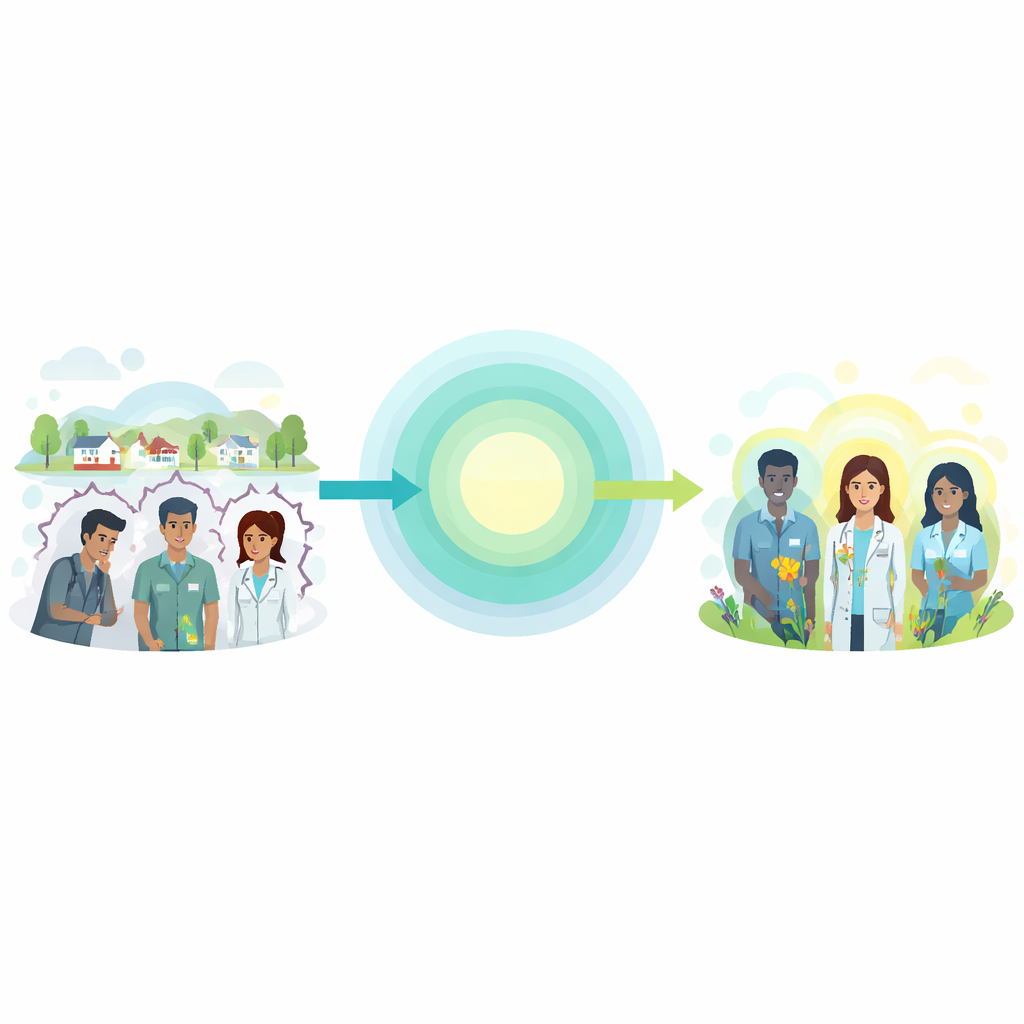
A closer look at rural healthcare workers
The team drew on a large ongoing project tracking the health of healthcare workers in the Loddon Mallee region of rural Victoria, Australia, during the pandemic. At the 12‑month follow‑up, 649 staff in both clinical and non‑clinical roles completed an online survey, and 597 answered every question on the sense‑of‑coherence scale. Most were women over 40, many working in nursing roles and holding university-level qualifications—broadly mirroring the local rural workforce. Alongside the sense‑of‑coherence questions, participants also completed brief standard checklists for depression, anxiety, and resilience, allowing the researchers to see how scores on the inner-compass scale matched real signs of strain or strength.
Pulling patterns from a web of answers
Instead of relying on traditional statistics that group questions into factors, the authors used a newer method borrowed from network science. In this approach, each survey question is treated as a point in a web, and the links between points show how strongly answers tend to move together. The method, called Exploratory Graph Analysis, can reveal hidden clusters of questions, flag items that are almost duplicates, and test how stable the pattern is across many simulated samples. The team first checked that response options were actually used in practice, then trimmed rarely chosen categories to avoid distortions. They next scanned the network for pairs of questions that were so tightly linked they were probably asking almost the same thing.
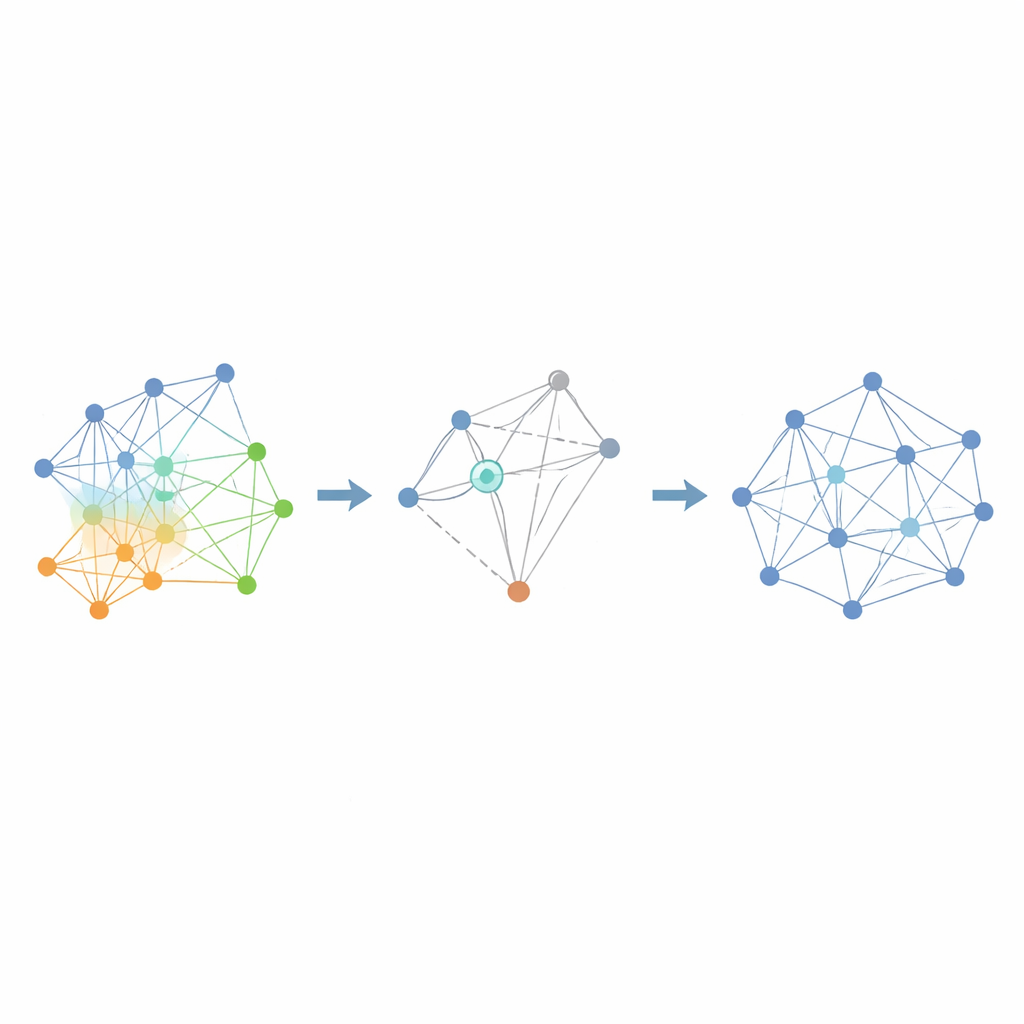
From thirteen questions down to a stronger twelve
The initial network suggested three clusters among the 13 questions, but it also exposed a problem: two items that both asked about being let down or surprised by people you relied on were nearly indistinguishable, effectively forming a mini-cluster of their own. On closer reading, one of these was narrower and more subjective, so the researchers removed it. When they rebuilt the network using the remaining 12 questions, a very different picture emerged—a single, highly stable cluster. All items now hung together as one clear dimension, and the overall score showed high internal consistency. As expected, higher scores on this refined 12‑item scale were strongly linked with fewer depressive and anxiety symptoms and with greater resilience, supporting its usefulness as a practical measure.
What this means for protecting frontline staff
For a lay reader, the main takeaway is that the authors have fine‑tuned a common mental health tool so it works more cleanly and reliably for rural healthcare workers. By dropping one redundant question and confirming that the remaining items act together as a single, strong measure, they offer a shorter, clearer scale that closely tracks both distress and bounce‑back ability. This improved 12‑item questionnaire could help hospitals and health services better monitor staff wellbeing, target support to those most at risk, and design programs that genuinely strengthen workers’ inner resources before the next crisis hits—though the authors stress that more work is needed to test the tool in other regions, cultures, and over time.
Citation: Cordon, E.L., McEvoy, M., Skinner, T. et al. Revisiting dimensionality in measurement of sense of coherence among rural healthcare workers using network analysis. Sci Rep 16, 11309 (2026). https://doi.org/10.1038/s41598-026-40880-1
Keywords: sense of coherence, healthcare worker wellbeing, rural health, psychological resilience, network psychometrics