Clear Sky Science · en
Substrate heterogeneity outweighs colour in shaping thermal environment and intertidal barnacle recruitment on artificial surfaces
Why tiny seashore crannies matter
Walk along a rocky shore at low tide and you’ll see barnacles crusting the rocks like living armor. But as we build more seawalls, piers, and other hard structures along coasts, these creatures must colonize surfaces that don’t look or feel like natural rock. This study asks a deceptively simple question with big implications for coastal design: when it comes to helping barnacles settle and survive on man‑made structures, what matters more—the color of the surface, or the presence of small cracks and grooves?
Testing barnacles on custom-made tiles
To tease apart these effects, the researchers used 3D printers to create standardized plastic tiles that mimic parts of a seawall. Some tiles were completely flat, while others had a corrugated face with ridges and crevices, adding tiny hideouts only a few millimeters across. Each design came in two colors: black and white. Because the underlying material was the same in all tiles, any differences in temperature or barnacle colonization could be traced to surface structure and color alone. The team bolted 32 of these tiles to a dark natural rock platform in northern Chile, in the wave‑swept zone where the sea regularly rises and falls.
How the tiles heat up in the sun
During low tides, when tiles are exposed to air and sun, the researchers used infrared cameras to measure how hot each surface became. As expected, black tiles absorbed far more sunlight than white ones, warming by about 6–12 °C over a couple of hours, compared with only 1–4 °C for white tiles. But the story changed when surface shape came into play. On the ridged, heterogeneous tiles, crevices were consistently cooler than nearby ridges, especially on black tiles: shady pockets stayed 2–6 °C cooler than the sun‑exposed peaks. In effect, the same dark material created a patchwork of micro‑climates—tiny hot and cool spots only centimeters apart—simply because of its three‑dimensional texture. 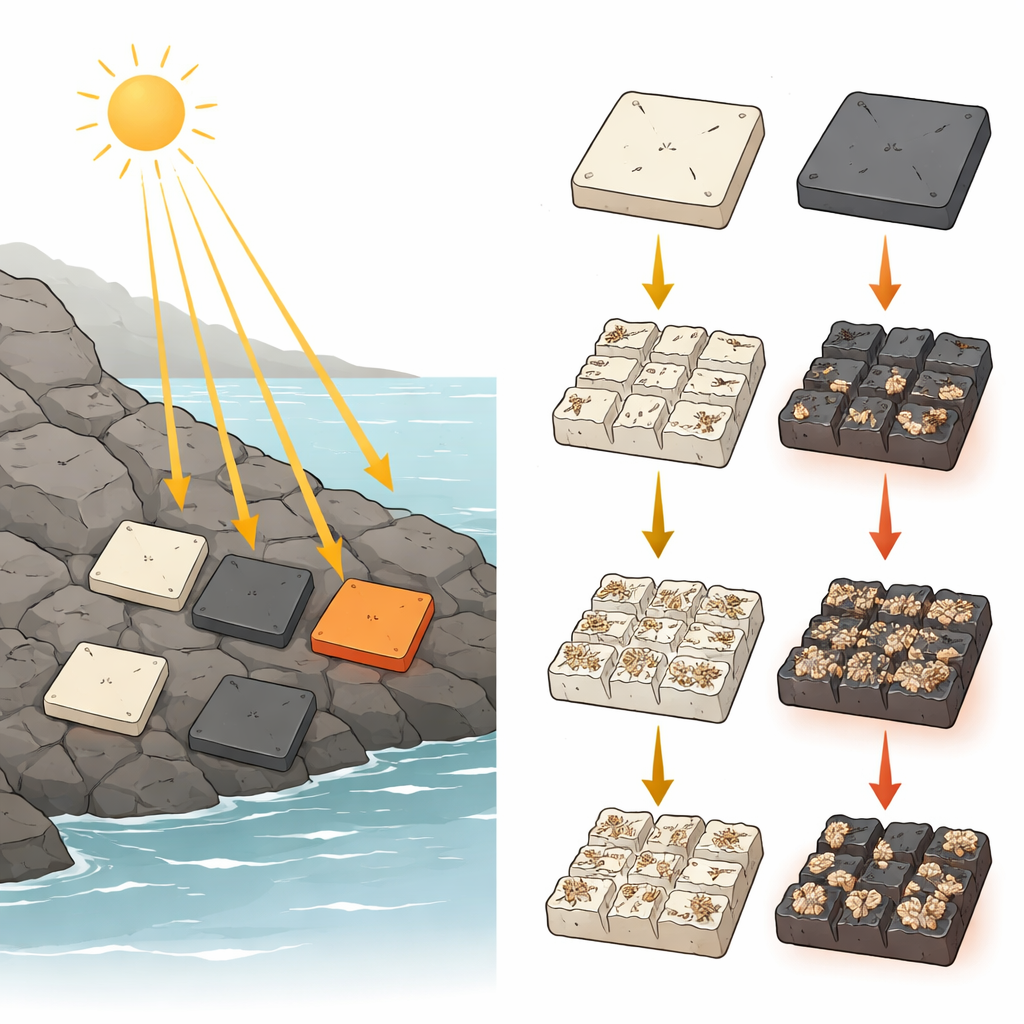
Who settles where on these mini landscapes
After about a month in the sea, the tiles were collected and inspected under a microscope to count new recruits of two common barnacle species, Jehlius cirratus and Notochthamalus scabrosus. Across the board, tiles with ridges and crevices attracted many more young barnacles than flat tiles. The fine‑scale picture was even more striking: within structured tiles, both species overwhelmingly chose crevices over ridges. These shaded hollows hosted roughly 20 times more recruits than the exposed peaks, regardless of whether the tile was black or white. In contrast, overall surface color had a modest or even negligible effect on recruitment, and the combination of color and structure did not produce any hidden “synergy” beyond their separate influences.
Different species, different sensitivities
Although both barnacle species favored crevices, they did not respond identically to color. Jehlius cirratus recruitment was driven almost entirely by microhabitat identity: it simply preferred crevices and seemed relatively indifferent to whether they were on black or white tiles. Notochthamalus scabrosus, in contrast, showed higher recruitment on black tiles when comparing flat and structured surfaces, hinting that this species may be more sensitive to the warmer or darker conditions associated with dark backgrounds. Yet even for this more color‑responsive species, the presence of cool, shaded crevices remained the dominant factor shaping where juveniles ended up.
Design lessons for coastal structures
The findings carry practical lessons for how we build along the sea. As coastal cities expand, engineers are increasingly asked to create “eco‑friendly” sea defenses that support marine life rather than simply repel waves. This study shows that sculpting small‑scale texture—ridges, pits, and crevices—can create thermal refuges that dramatically boost the successful settlement of intertidal animals, even on otherwise hot, dark artificial surfaces. While choosing lighter surface colors can help limit overall heating, it is the microscopic topography that ultimately decides whether barnacle larvae find safe footholds to grow into adults. In other words, for life on harsh sun‑baked shores, the tiny nooks and crannies of a surface matter more than its shade. 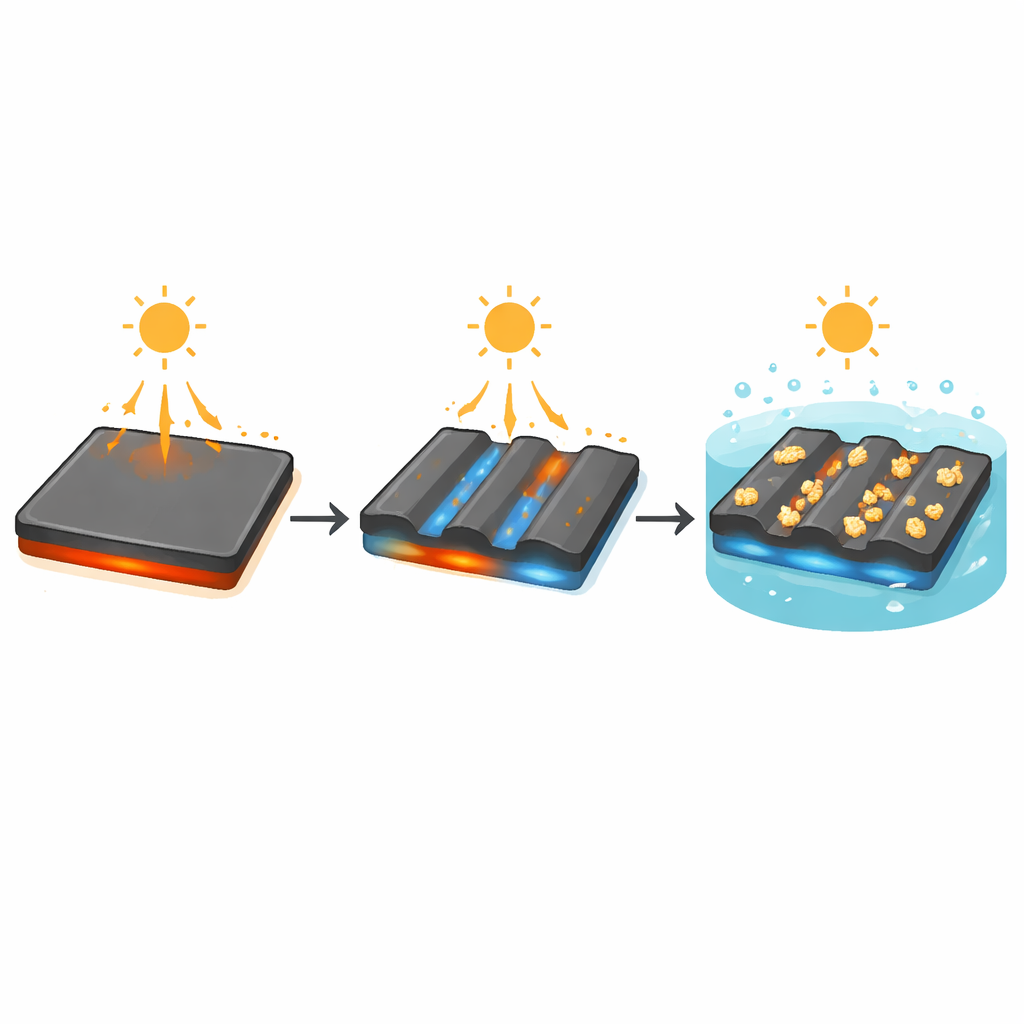
Citation: Lagos, N.A., Lardies, M.A., García-Herrera, C. et al. Substrate heterogeneity outweighs colour in shaping thermal environment and intertidal barnacle recruitment on artificial surfaces. Sci Rep 16, 11163 (2026). https://doi.org/10.1038/s41598-026-40877-w
Keywords: barnacle recruitment, intertidal ecology, thermal microhabitats, eco-engineering, coastal infrastructure
See more on the researcher's website: https://www.instagram.com/shell_nbs/