Clear Sky Science · en
Spatially resolved isotopic analysis of a uranium-bearing particle from inside the Fukushima Daiichi unit 2 reactor using high-resolution SIMS
Why a tiny grain from Fukushima matters
Inside the damaged reactors at Fukushima Daiichi, much of the nuclear fuel melted, mixed with steel and other structures, and then hardened into complex “fuel debris.” Safely removing this material is one of the biggest hurdles to finishing the cleanup. This study focuses on a single microscopic particle of that debris and shows how a powerful imaging technique can reveal, in remarkable detail, what it is made of and how it formed—information that ultimately helps make future work around the reactors safer and more predictable.
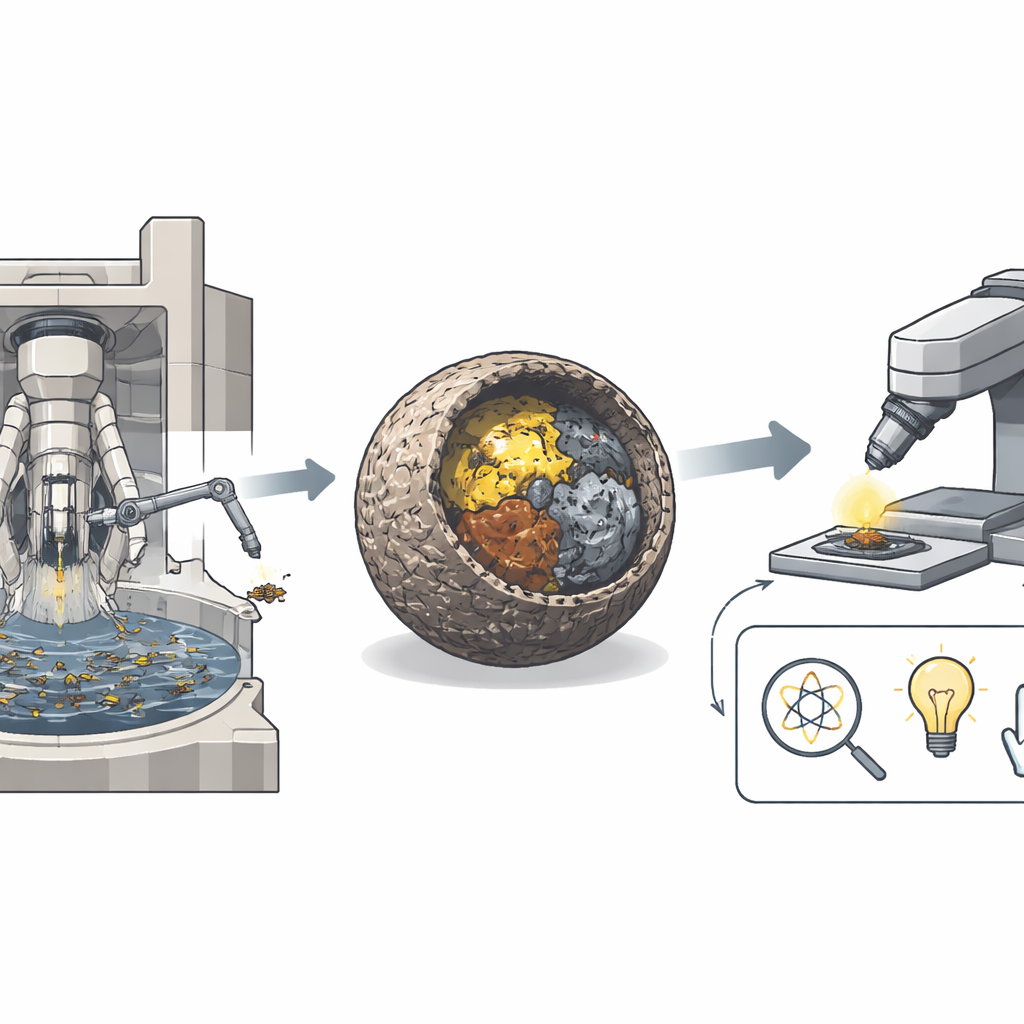
Looking closely at a speck of debris
The researchers examined a roughly 50-micrometer-wide particle—about the width of a fine human hair—collected from inside the Unit 2 reactor building. This tiny grain is thought to be part of the solidified mixture of melted fuel and reactor hardware created during the 2011 accident. Until now, most studies of such material have dissolved samples and measured only average compositions, losing any fine-scale structure. Here, the team wanted to see how different elements, especially uranium from the fuel and boron from the control rods, were arranged inside the particle, and how their atomic “flavors,” or isotopes, varied from place to place.
Cutting and mapping the particle in three dimensions
To do this, they used a custom instrument that combines a focused ion beam—essentially a nanoscale carving tool—with a high-resolution mass spectrometer. The beam first sliced away thin layers of the particle, letting the scientists view smooth cross-sections with electron imaging. These images showed a compact, bubble-free interior, suggesting that gases escaped or were absent when the droplet of molten material cooled and solidified. Crucially, the same instrument then scanned each fresh surface to make compositional maps, revealing where key elements such as uranium, zirconium, iron, chromium, boron, and lithium were concentrated within the grain.
Untangling the mixture of fuel, steel, and control rods
The chemical maps showed that the particle is not uniform but divided into micrometer-sized regions with distinct mixtures. One zone contains both uranium and zirconium, consistent with melted fuel pellets and their cladding solidifying together. Another region is rich in iron, boron, and lithium, pointing to input from steel structures and boron carbide control rods. A third region is dominated by chromium, likely reflecting different high-temperature reactions and separation as the melt cooled. Uranium is spread throughout much of the interior, while boron is more concentrated near the outer parts, hinting that uranium-rich melt solidified earlier and boron-bearing material migrated outward before freezing. Together, these patterns record a stepwise melt-and-cool history of fuel and surrounding hardware.
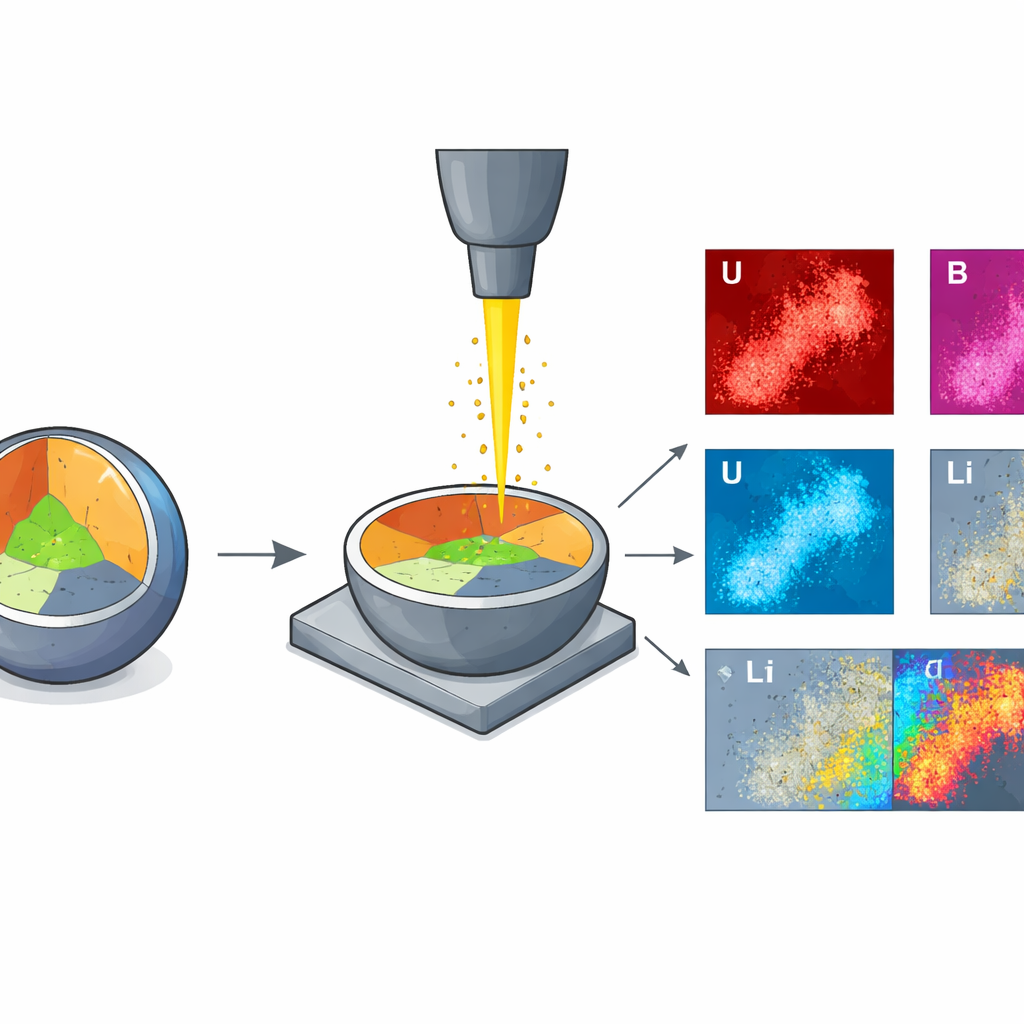
Reading the particle’s atomic memory
Beyond mapping elements, the team measured isotopes—variants of the same element with different masses—within the particle. The uranium showed an enrichment level between natural uranium and the fresh fuel originally loaded into Unit 2, meaning it came from fuel that had been used in the reactor but not completely “burned.” Even more revealing were the boron and lithium isotopes. Boron-10 in control rods can capture neutrons and transform into lithium-7. In the particle, boron had a slightly reduced share of boron-10 compared with nature, while lithium-7 was greatly increased. This distinctive pairing is a fingerprint of that neutron-capture reaction, proving that the control-rod material embedded in the particle had once actively absorbed neutrons during normal power operation.
What this means for cleanup and safety
By decoding the structure and isotopic makeup of a single microscopic grain, the study offers a new window into what happened inside the Fukushima reactor core as it overheated, melted, and then cooled. The work delivers the first direct evidence that fuel, structural steel, and control rods ended up fused together in individual debris particles, and that the history of neutron absorption is still written in their isotopes. The high-resolution imaging approach demonstrated here can be applied to many more samples, helping engineers better gauge how fuel is distributed, how mixed it is with neutron-absorbing materials like boron, and how it formed. That knowledge supports more reliable assessments of criticality risk and informs strategies for safely cutting, retrieving, and storing the remaining fuel debris.
Citation: Yoshida, T., Maeda, K., Sekio, Y. et al. Spatially resolved isotopic analysis of a uranium-bearing particle from inside the Fukushima Daiichi unit 2 reactor using high-resolution SIMS. Sci Rep 16, 9865 (2026). https://doi.org/10.1038/s41598-026-40875-y
Keywords: Fukushima fuel debris, SIMS imaging, uranium isotopes, boron control rods, nuclear decommissioning