Clear Sky Science · en
Mechanical and durability assessment of marble dust–fiber concrete supported by ML prediction
Turning Building Waste into a Useful Resource
Concrete is the backbone of modern cities, but making its key ingredient, cement, releases large amounts of carbon dioxide. At the same time, industries generate vast piles of marble dust and plastic waste that are difficult to dispose of safely. This study explores whether those two problems can help solve each other: can waste marble dust and recycled plastic fibers be blended into concrete to make it not only greener, but also stronger and longer‑lasting, with help from modern machine‑learning tools?
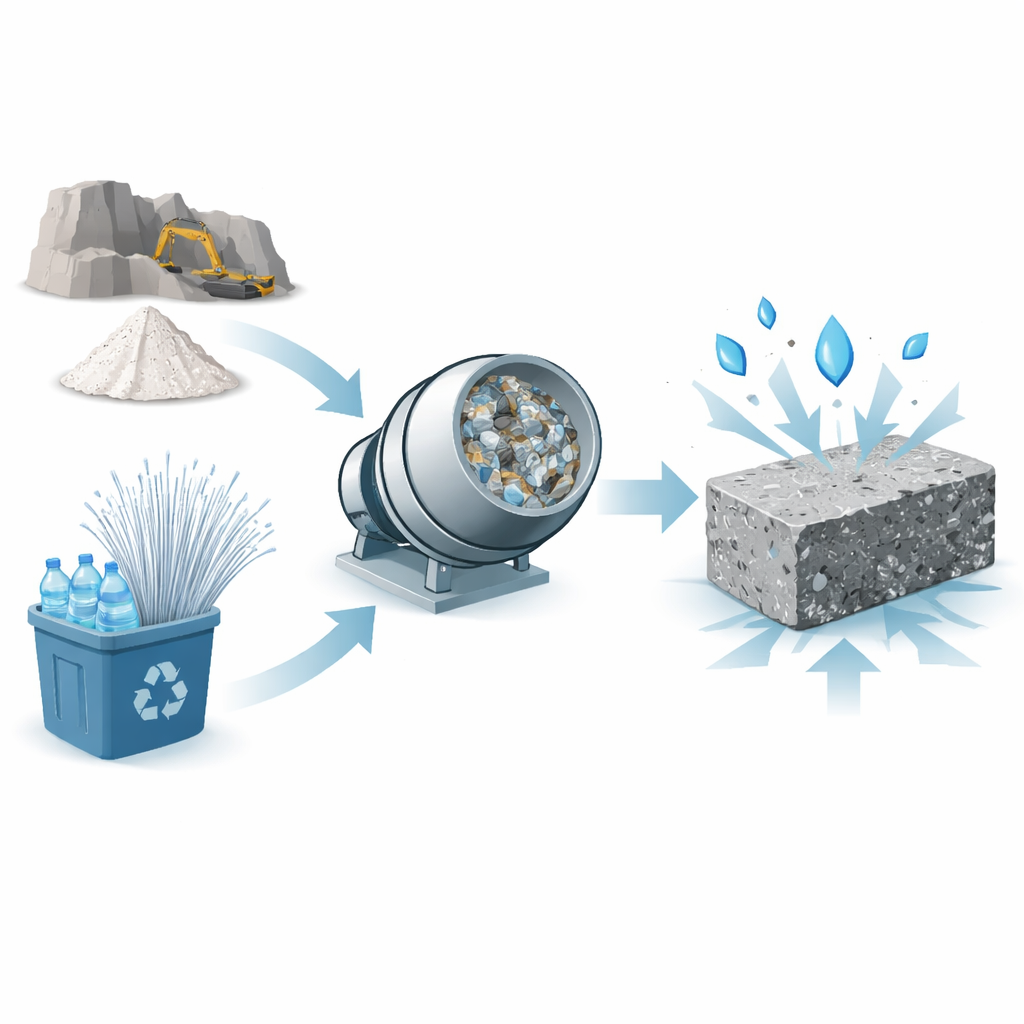
Mixing Stone Powder and Plastic Threads into Concrete
The researchers focused on two waste materials. Marble dust, a fine powder rich in calcium carbonate, comes from cutting and polishing stone. Polypropylene fibers are short strands cut from discarded plastic products. In the study, cement in a standard structural concrete was partially replaced with marble dust at levels from 0 to 20 percent, while the fibers were added in small volume fractions from 0 to 1 percent. This created 25 different mix combinations, all prepared with the same aggregates and water content so that any changes in behavior could be traced back to the dust and fibers.
Testing Strength, Cracking, and Water Resistance
Each mix was put through a full series of tests that mimic the real demands on a building. The team measured how easily the fresh concrete flowed into molds, then checked its weight and compactness. After curing, they tested how much pressure the concrete could withstand before crushing, how well it resisted being pulled apart or bent, and how easily water could soak through or flow across it. They also exposed specimens to acidic solutions to see how quickly they degraded. This broad view allowed the authors to spot not just the strongest mixes, but those that balanced strength with durability and workable consistency.
Finding the Sweet Spot for Performance
The results showed that marble dust and plastic fibers can work together in a complementary way—up to a point. A moderate dust content, around 10 percent of the cement, helped fine particles fill tiny gaps in the concrete, packing it more tightly and boosting strength. At the same time, fibers between about 0.6 and 0.8 percent by volume acted like tiny stitches that held microcracks together under load, raising both splitting and bending strength by roughly a quarter to a third compared with ordinary concrete. These combinations also absorbed less water and allowed it to pass through more slowly, signs of a denser, more durable internal structure. When either ingredient was pushed too high, however, the mix became harder to work with, trapped more air, and gradually lost strength.
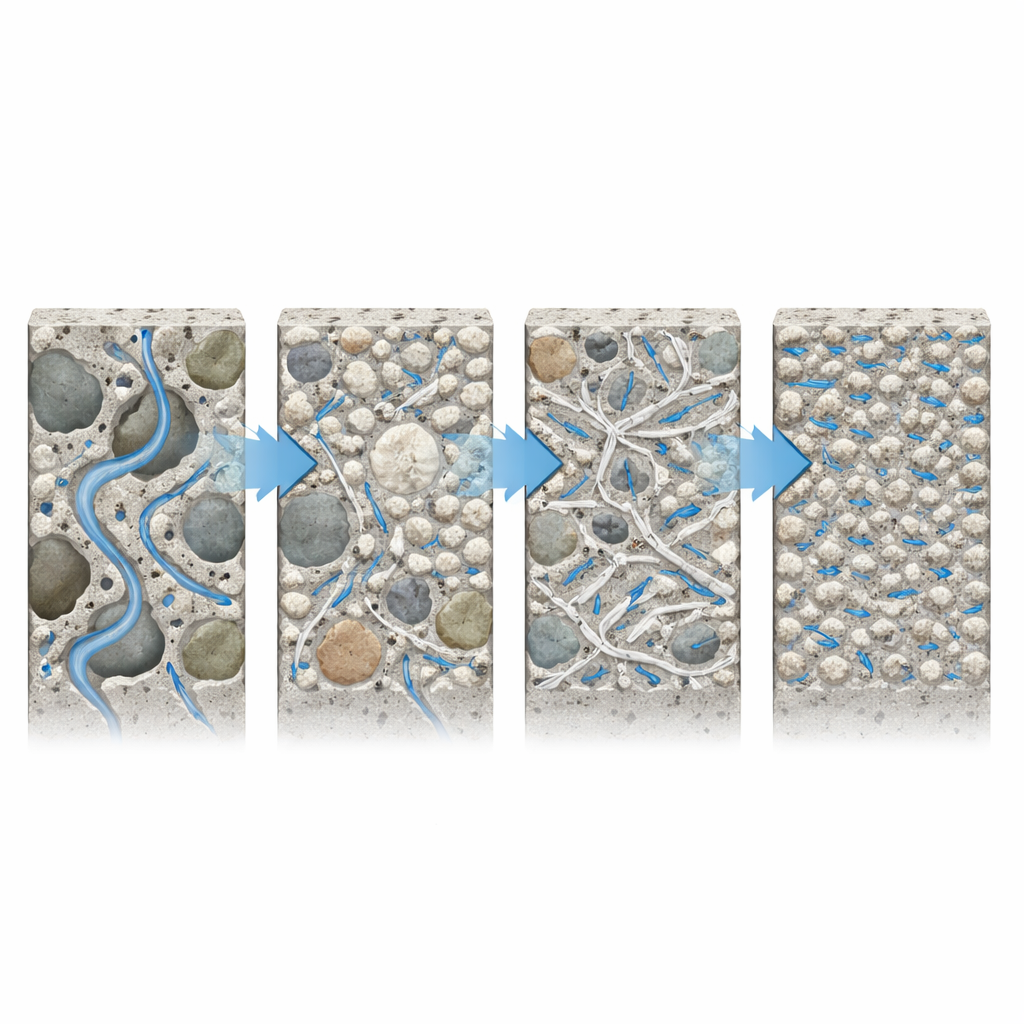
Letting Algorithms Guide Greener Mix Designs
Rather than rely only on trial and error, the team trained several machine‑learning models on their experimental data. These algorithms learned how changes in marble dust, fiber content, and other mix variables affected key properties such as strength, water absorption, and permeability. The best‑performing models, based on artificial neural networks and random forests, reproduced the test results very closely. They were then used inside an optimization routine to search the design space for the most balanced recipe. The model’s suggested optimum—about 10 percent marble dust and 0.6 percent fibers—matched the experimentally observed “sweet spot,” confirming that data‑driven tools can reliably steer future eco‑concrete designs without exhaustive laboratory campaigns.
What This Means for Future Buildings
For non‑specialists, the takeaway is clear: concrete does not have to be a simple mixture of stone, sand, and cement. By smartly incorporating industrial leftovers like marble dust and recycled plastic fibers, engineers can cut down on cement use, make better use of waste, and at the same time create concrete that cracks less and keeps out water more effectively. This study shows that the best results come from carefully balanced proportions, and that artificial intelligence can help pinpoint those balances. If adopted widely, such optimized mixes could gradually lower the environmental footprint of construction while improving the resilience of the structures we depend on every day.
Citation: Sai, A.N., Sakthivel, M., Arunvivek, G.K. et al. Mechanical and durability assessment of marble dust–fiber concrete supported by ML prediction. Sci Rep 16, 10106 (2026). https://doi.org/10.1038/s41598-026-40874-z
Keywords: sustainable concrete, marble dust, recycled plastic fibers, durability, machine learning