Clear Sky Science · en
Broad generalisation of the ventriloquism aftereffect across sound frequencies
Why Your Eyes Can Trick Your Ears
When you watch a movie, you effortlessly believe that voices come from the actors’ moving lips, even though the speakers may be hidden at the sides of the screen. This everyday illusion, known as ventriloquism, reveals that your brain lets vision steer what you hear. The featured study asks a deceptively simple question: when vision shifts where we think a sound comes from, does this shift apply only to that particular kind of sound, or does it spread broadly to many different pitches? The answer tells us where in the brain sight and sound truly meet.
How We Normally Find Where Sounds Come From
To locate a sound around us, the brain compares what reaches the two ears. Tiny differences in arrival time help with low-pitched sounds, while differences in loudness help with higher ones. These cues must be constantly matched to real-world space, and vision provides a powerful yardstick. When a light and a sound come from different spots but at the same time, people tend to point toward the light. Even after the light disappears, they may keep misplacing the sound toward where the light used to be – a lingering shift called the ventriloquism aftereffect. Scientists have debated whether this aftereffect is tied to specific sound frequencies, to particular timing or loudness cues, or to a more general “map” of space shared by several senses.
Testing Whether the Shift Spreads Across Pitches
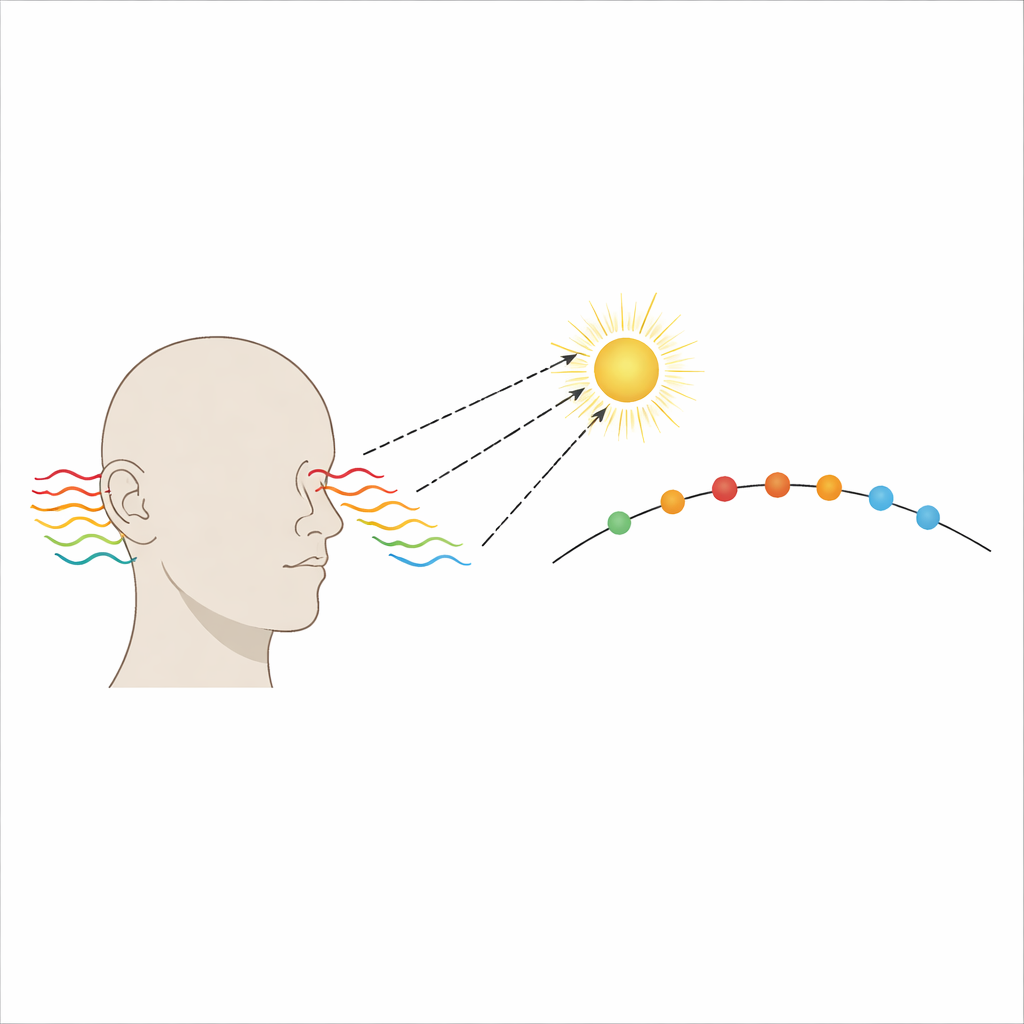
The researchers asked twelve volunteers to sit in a dark, quiet room surrounded by loudspeakers, each with a small green light. Sounds were carefully crafted bands of noise centered on seven different frequencies, from low (500 Hz) to high (8000 Hz), plus a broadband sound that contained a wide range of frequencies. In each of three sessions on separate days, participants first pointed with their head to sounds presented alone, establishing how accurately they could locate each sound in darkness. Then came an exposure phase: one chosen sound (either low, high, or broadband) was played from various horizontal positions, while a light consistently appeared ten degrees to the right of the sound. Participants were told to ignore the light and point to the sound. Finally, in the post-exposure phase, all eight sounds were again presented alone so the team could see whether perceived locations had been durably pulled toward the former light position.
What Happens When Vision Pulls on Hearing
Even before adding light, people did not localise all sounds equally well. The broadband sound was placed quite accurately, while narrow bands—especially very low or very high ones—were often overshot, with responses going farther to the left or right than the true source. When the light was introduced, participants’ responses shifted strongly toward it: on average, about two-thirds of the gap between sound and light was “filled in” by moving their perceived sound location toward the light. This immediate ventriloquism effect was stronger for narrowband sounds, which carried less reliable spatial information, and weaker for the broadband sound, which the brain treated as more trustworthy. The visual signal did not just nudge responses sideways; it also reduced the overshoot for some sounds, suggesting that seeing a clear visual target sharpened the brain’s sense of direction.
A Lasting, Broad Shift in the Brain’s Spatial Map
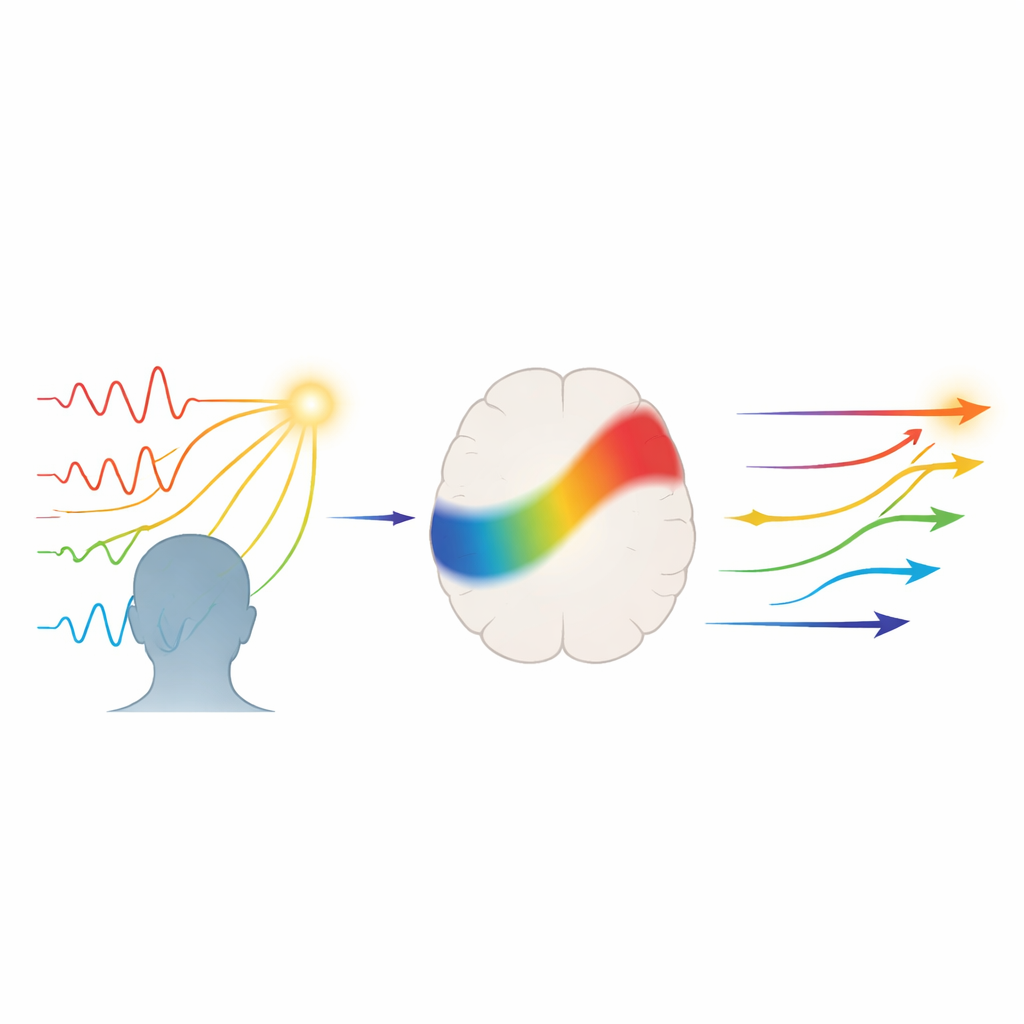
After repeated pairing of sound and displaced light, the light was switched off, but its influence remained. Across all sessions, people’s sound localisations in the dark were shifted by about 12 percent of the earlier mismatch between sound and light – a modest but reliable aftereffect. Crucially, this shift appeared for all tested frequencies, not just for the one used during exposure and not just for sounds that relied on the same ear-to-ear cue. A low-frequency exposure sound, for example, caused similar biases for very high-frequency test sounds. This broad spread runs counter to theories that place adaptation only in early, frequency-tuned hearing areas or that predict little spread at the moderate loudness level used here. Instead, the pattern matches the idea that the brain recalibrates a shared spatial map that already combines information from both ears and from the eyes.
What This Means for How Our Senses Work Together
The study shows that when vision and hearing disagree in a consistent way, the brain does not just correct a narrow slice of the hearing range; it updates a more general internal map of space that affects many kinds of sounds. In daily life, this flexibility helps keep our sense of where things are aligned across noisy rooms, shifting echoes, and changing lighting. At the same time, the work highlights that not all aspects of this process behave alike: the moment-to-moment pull of vision depends on how trustworthy each sound is, whereas the longer-term recalibration seems to operate at a higher, more abstract level. Together, these findings support a view of the brain as a dynamic integrator that uses vision to keep hearing tuned to the outside world across the full spectrum of sounds.
Citation: Ege, R., Haukes, N.C., van Opstal, A.J. et al. Broad generalisation of the ventriloquism aftereffect across sound frequencies. Sci Rep 16, 12547 (2026). https://doi.org/10.1038/s41598-026-40873-0
Keywords: ventriloquism aftereffect, sound localisation, multisensory integration, auditory spatial perception, sensory recalibration