Clear Sky Science · en
Edge-guided multi-scale instance segmentation for railway track
Why clearer train tracks matter
Modern trains increasingly rely on cameras and computers to keep passengers and bystanders safe. For these systems to work, the software must pick out railway tracks precisely from busy, cluttered scenes: crossings full of cars and people, stations, tunnels, and countryside lines in sun, rain, or snow. If the computer misjudges where the rails are, it can miss fallen objects, intruders, or damaged track. This paper presents a new way for computers to “see” railway tracks more sharply and reliably, even when the rails are thin, far away, or partly hidden.
Sharper boundaries for safer journeys
A core problem in track perception is that rails are long, narrow structures whose edges often blur into gravel, sleepers, shadows, and switches. Traditional image-processing tricks or older segmentation programs tend to lose these boundaries, especially under poor lighting or complex backgrounds. The authors focus on a class of techniques called instance segmentation, where the computer must both find objects and outline their exact shapes. Their goal is simple to state but hard to achieve: draw accurate contours around every visible stretch of track in each image, fast enough for real-time use on a moving train.
A smarter view of track edges
To tackle this, the researchers build on a recent fast vision model known as YOLO11n-seg and design an improved framework they call SMDE-YOLO. The first key idea is to feed the network sharper examples of track boundaries during training. They use a tool from classic image processing, the Scharr edge detector, to highlight lines where brightness changes abruptly—precisely where metal rails meet their surroundings. By combining these edge maps with the original images only in the true track regions, the method boosts useful boundary details while avoiding extra background noise. This pre-processing step helps the model learn what real track edges look like across many scenes, from bright open lines to dark tunnels. 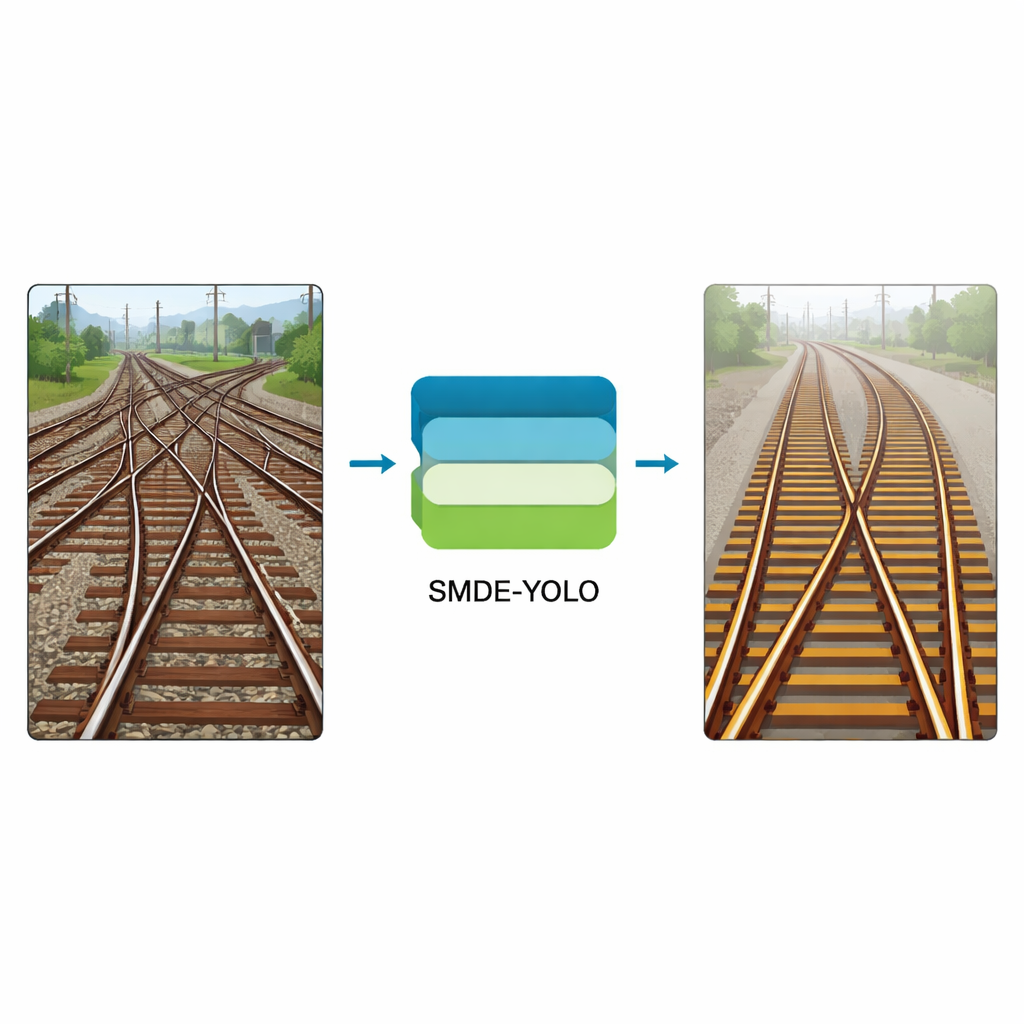
Seeing both the big picture and the fine lines
Edges alone are not enough; the model must also understand track structures at multiple sizes, from close-up sleepers to distant, converging rails. SMDE-YOLO introduces a new feature fusion module that gathers edge cues from several scales and blends them with the usual image features. This module emphasizes small differences in texture that mark where rails begin and end, while a built-in selection mechanism filters out patterns that are irrelevant to the track. At the same time, a redesigned “neck” of the network, called the Dynamic Multi-Branch Feature Pyramid Network, passes information up and down between coarse and fine layers. This design lets the system keep sight of the full rail layout while still preserving the thin, elongated shapes that define track boundaries.
Lightweight design for real-time trains
Autonomous or driver-assist systems on trains cannot afford heavy, slow algorithms. The authors therefore rework the final part of the model—the part that turns features into precise outlines—into a more efficient, dual-purpose head. It separates detection (finding where the track segments are) from segmentation (drawing their shapes), uses streamlined convolutions, and adds a subtle attention mechanism that concentrates on the most informative channels. Overall, these changes actually reduce the number of parameters and computation compared with the baseline model, while improving accuracy on a curated version of the public RailSem19 dataset, renamed Railsem7750. In tests, SMDE-YOLO outperforms a range of popular alternatives, from heavyweight two-stage models like Mask R-CNN to newer real-time systems, achieving crisper track masks with fewer resources. 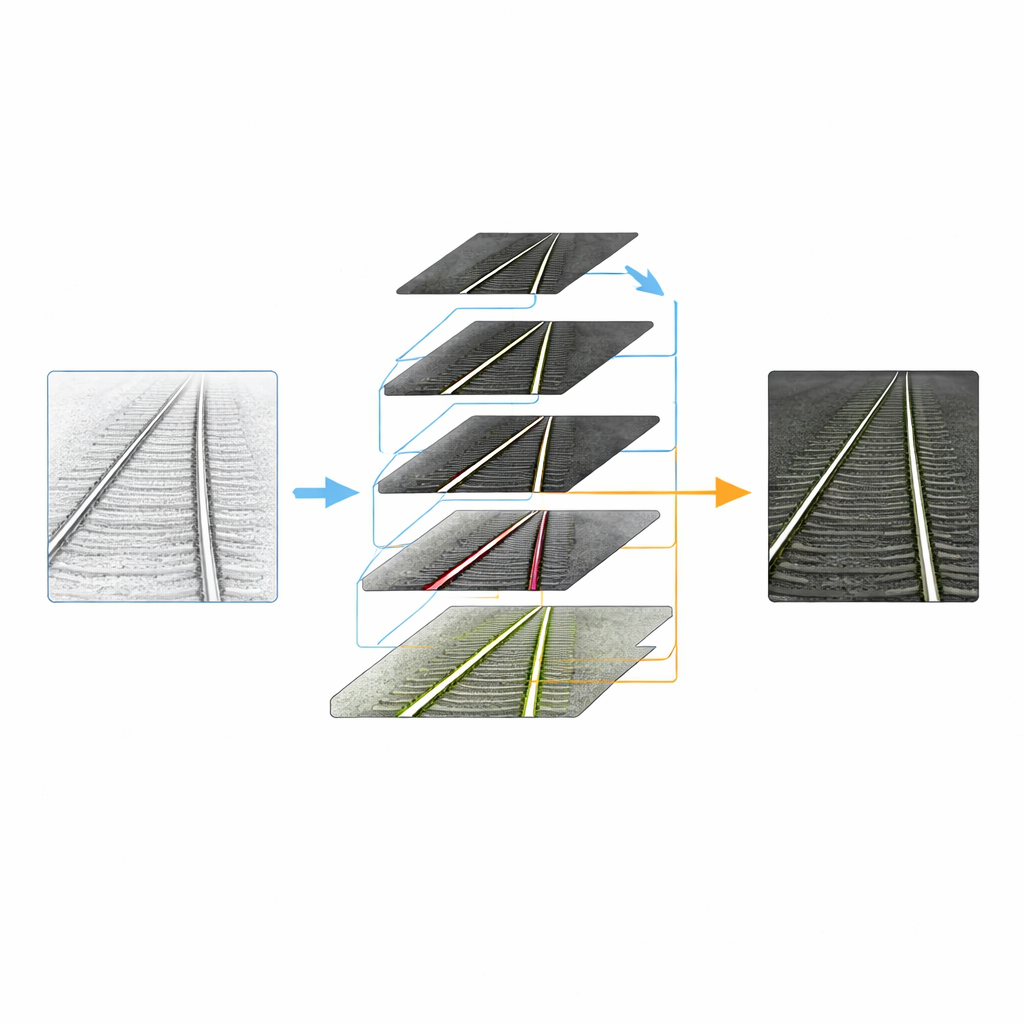
From clearer contours to safer railways
For non-specialists, the main takeaway is that this work teaches computers to trace the outline of railway tracks much more reliably, even when scenes are messy and rails are far away or intersecting. By sharpening edges, carefully mixing information from different scales, and trimming the model’s complexity, SMDE-YOLO delivers both speed and precision. While the method still struggles in the most tangled areas of track switches and crossings, it marks a solid step toward vision systems that can watch long stretches of line continuously, spot intrusions or debris early, and support smarter inspection and maintenance—all of which ultimately contribute to safer, more efficient rail transport.
Citation: Lin, J., Yang, W. & Du, X. Edge-guided multi-scale instance segmentation for railway track. Sci Rep 16, 10325 (2026). https://doi.org/10.1038/s41598-026-40858-z
Keywords: railway safety, computer vision, instance segmentation, autonomous trains, rail track monitoring