Clear Sky Science · en
Workforce restoration time analysis for a two grade manpower system under heavy tail distribution and dual regime decisions latency
Why getting staff back up to strength matters
When a company or public agency suddenly loses people – through resignations, retirements or budget cuts – leaders want to know how long it will take to get operations back to normal. That "restoration time" is tricky to predict because departures and hiring decisions rarely follow a neat, regular pattern. This paper develops a mathematical way to estimate how long it takes a two-level organization, with junior and senior staff, to rebuild its workforce when losses and decisions are uneven and sometimes extreme.
Two levels of staff, one shared problem
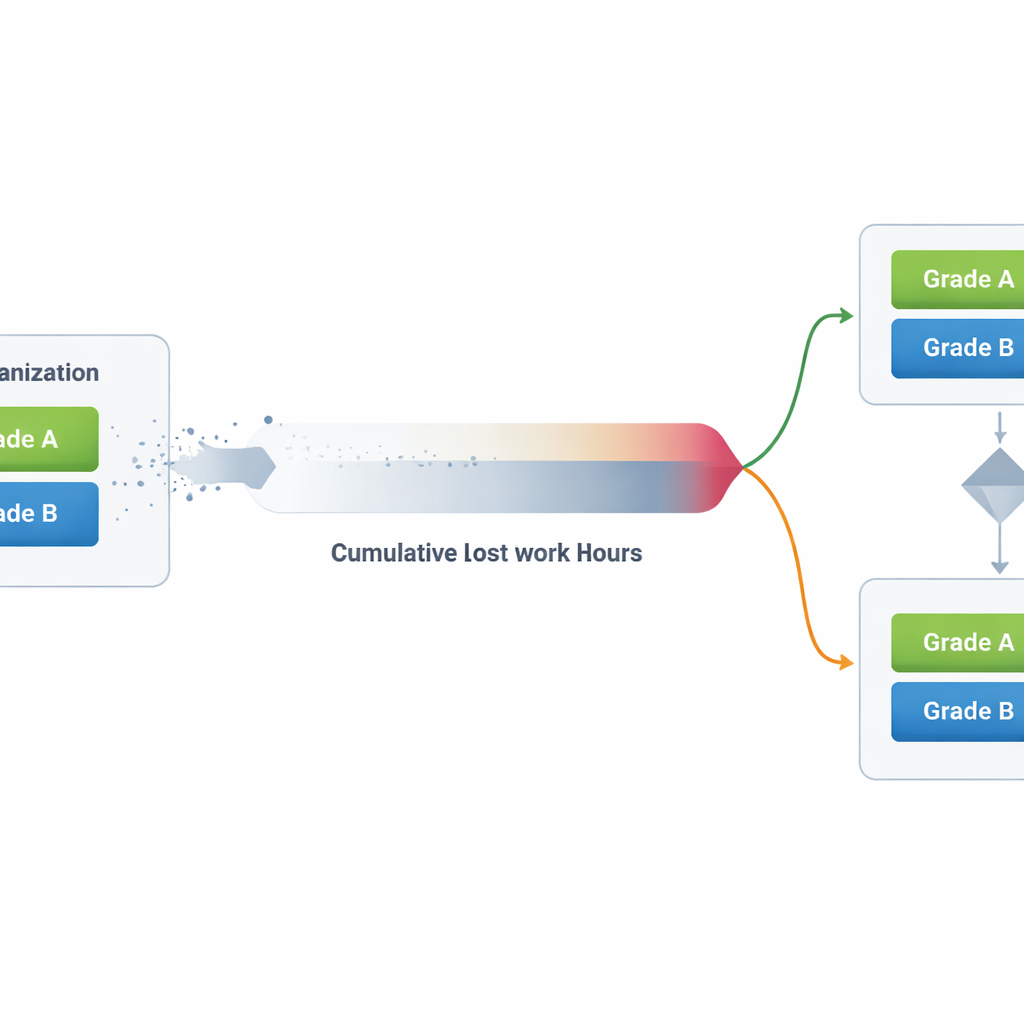
The authors focus on organizations with two distinct grades of workers, such as junior and senior officers or entry-level and experienced employees. In some settings, staff rarely move between grades; in others, promotion and internal transfer are common. The study handles both situations by defining different rules for when the organization decides it has lost “too much” work capacity and must start recruiting. In the strict case, hitting the loss limit in either grade is enough to trigger action. In the flexible case, both grades must cross their limits, reflecting linked career paths and shared planning.
Capturing rare but serious shocks
Real workplaces do not just suffer steady drips of attrition. Occasionally, several valued employees leave at once or management delays replacement decisions longer than expected. To capture these rare but heavy hits, the authors use a statistical tool known as a heavy-tailed distribution. Instead of assuming that all loss or delay events are roughly similar, this approach builds in a small but important chance of very large shocks. Here, it is applied to the thresholds that determine when management finally decides to recruit, allowing the model to reflect situations where leaders tolerate mounting losses longer than usual before acting.
Four ways decisions can play out
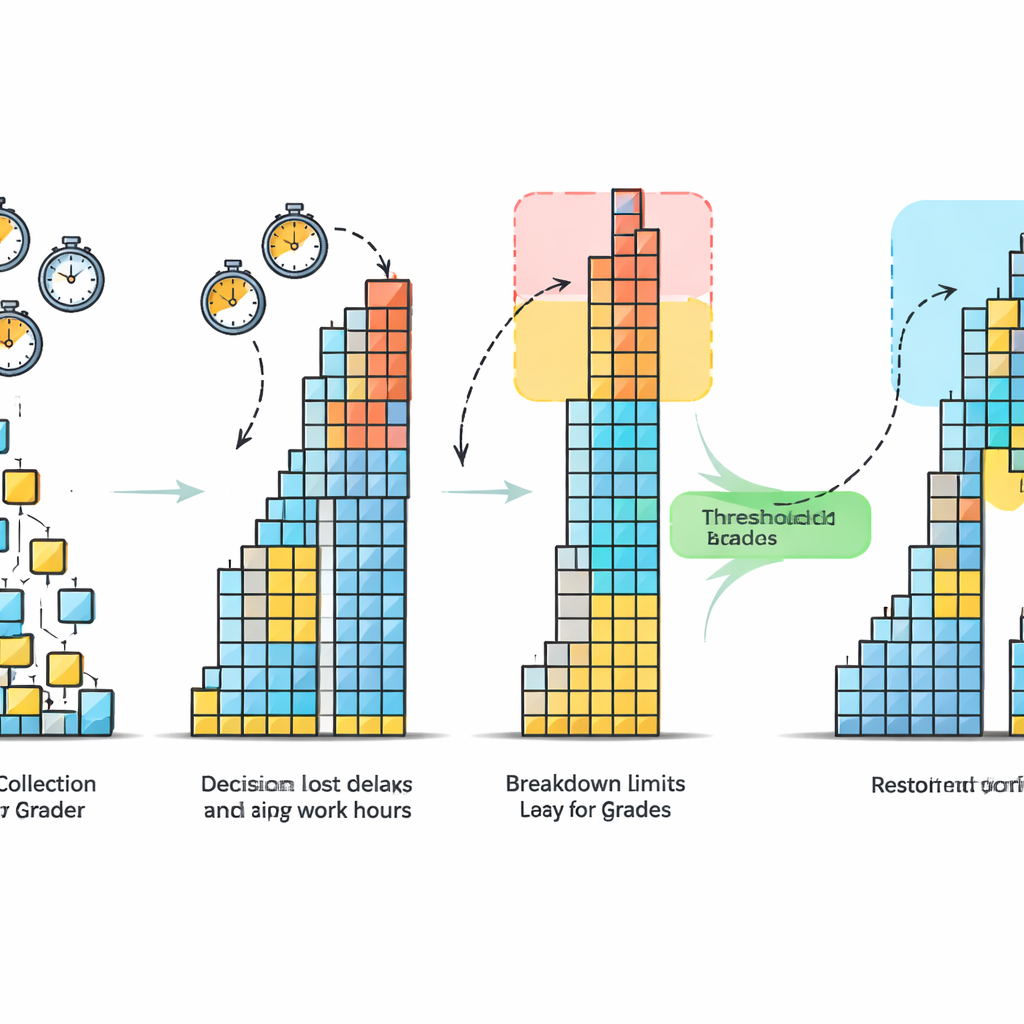
The study then layers on how often decisions are made and how those decisions relate to each other over time. Decision intervals can be independent – each delay between decisions is unrelated to the last – or correlated, meaning that a slow period tends to be followed by more slow periods. Combining these two possibilities with the two threshold rules produces four core models. For each, the authors derive exact formulas for the average time to restore the workforce and the spread around that average. Although the underlying mathematics is intricate, the outcome is practical: closed-form expressions that planners can plug into to explore different policies and conditions.
What drives restoration time
Using simulated data and scenario tests, the authors examine how key levers affect how quickly staff levels recover. They find that the expected restoration time grows almost linearly with the typical size of each loss event and with the typical waiting time between decisions. In simple terms, losing more work hours per decision, or waiting longer to make decisions, predictably stretches recovery. By contrast, increasing the number of decisions taken in a planning window reduces restoration time, but with diminishing returns: early increases help a lot, later ones add only small gains. Correlation between decision delays – a tendency for slow decisions to cluster – also lengthens restoration, but its impact is modest compared with the size and frequency of losses.
From theory to smarter staffing
For non-specialists, the bottom line is that the paper offers a way to turn messy, uncertain patterns of departures and hiring into clear estimates of how long it will take to rebuild a two-tier workforce. It shows that large, occasional shocks and sluggish decision habits can quietly add days or months to recovery, even when average conditions look manageable. By quantifying how loss intensity, decision speed, and decision consistency shape restoration time, the framework helps organizations decide when to trigger recruitment and how aggressively to act. Rather than reacting after shortages become painful, leaders can use these insights to plan earlier, smoother hiring waves that keep services running and staff workloads sustainable.
Citation: Parameswari, K., Kannan, K. & Menaga, A. Workforce restoration time analysis for a two grade manpower system under heavy tail distribution and dual regime decisions latency. Sci Rep 16, 11915 (2026). https://doi.org/10.1038/s41598-026-40851-6
Keywords: workforce planning, staff attrition, recruitment timing, stochastic modeling, decision delays