Clear Sky Science · en
Resilient and verifiable outsourced attribute-based non-interactive oblivious transfer protocol for tactical edge networks
Why battlefield data needs extra protection
Tactical edge networks connect frontline soldiers, drones, and vehicles to command centers in the middle of fast-moving missions. These links are used to send maps, sensor feeds, and intelligence reports to people who need them right now—and to no one else. Yet the radios, tablets, and small drones at the edge are weak computers, often operating in hostile territory where equipment can be captured. This paper asks a simple but pressing question: how can a soldier quickly unlock only the data they are cleared to see, without revealing to higher headquarters exactly which report they are looking at, and without trusting every intermediate device along the way?
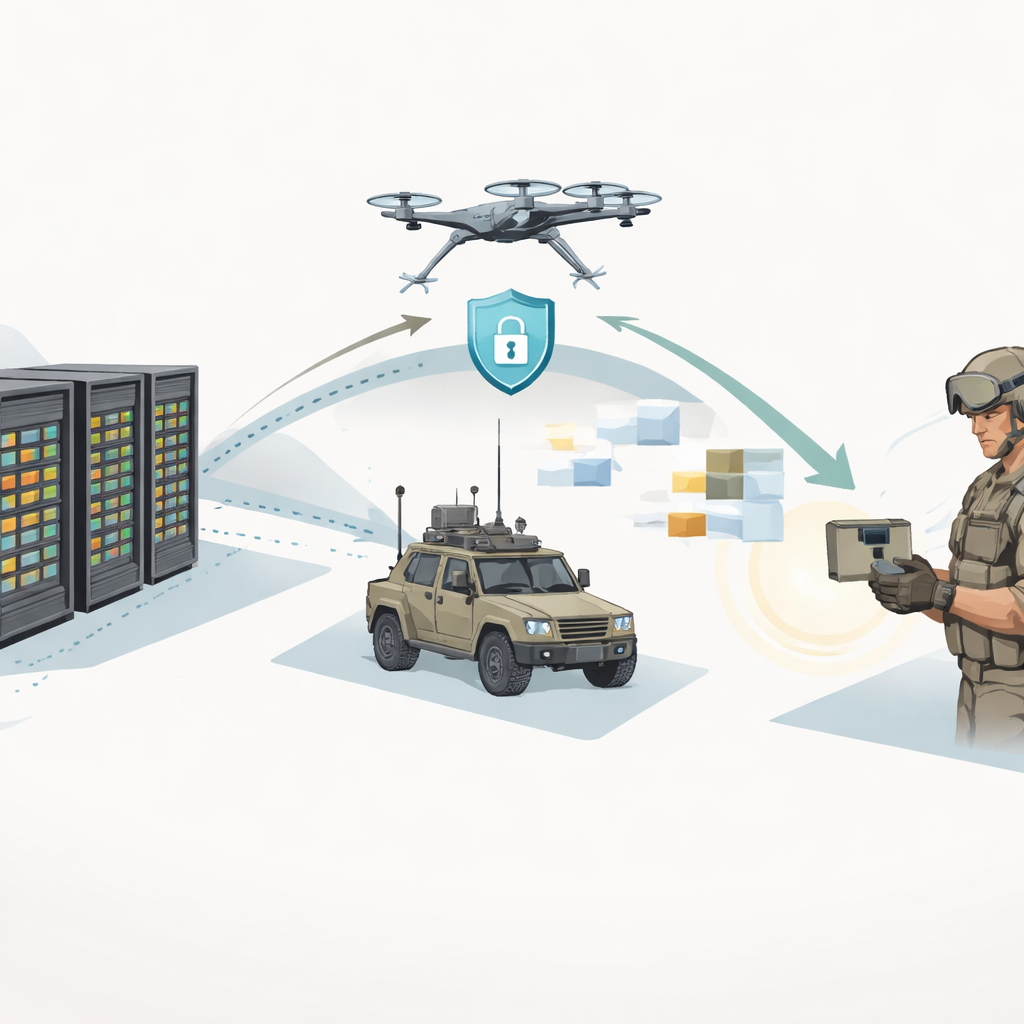
Who is in this digital battlefield
The authors focus on a military setting where several parties interact. A central command center stores large collections of encrypted intelligence. A trusted military certificate authority hands out keys and roles. Tactical cloud nodes—such as relay drones or armored vehicles—sit between command and front line, offering extra computing power close to the action. Finally, the frontline operator carries a constrained device like a handheld radio or tablet. The challenge is to let that operator pull down one chosen record from the command center through a nearby cloud node, while ensuring three things: only properly authorized users can read the content, the helper node cannot fully decrypt if it is captured, and the command center cannot infer which specific item the soldier requested.
Why existing tools are not enough
Today’s fine-grained encryption systems can tie access rules directly to each piece of data, for example “battalion intelligence officer AND current operation X.” This is powerful but computationally heavy: decoding a single message can require many costly mathematical operations that small edge devices struggle to perform in real time. Earlier research suggested offloading most of this work to a nearby server or cloud node. Other work added ways to check that the helper did the math correctly. A separate line of research looked at “oblivious transfer,” where a user retrieves one item from a database without revealing which one. However, no prior solution combined all of these needs at once: low effort for the soldier’s device, verifiable help from an untrusted node, and privacy about which record is being accessed.
A new way to ask for one secret record
The paper introduces a unified protocol called RVO-AB-NIOT that stitches these ideas together for tactical edge networks. When a command center prepares its data, it encrypts each record under attribute-based rules and wraps it in an extra key-and-tag layer. This heavy work happens offline, before anyone is under fire. When the soldier later wants record number σ, their device sends a compact query token that mathematically hides the chosen index from the command center. The command center simply forwards a pre-built bundle of encrypted records and lightweight tags to the tactical cloud node, without learning which one will be used. The cloud node learns which record to process, but only sees keys that have been mathematically “blurred” by a secret factor held solely on the soldier’s device.
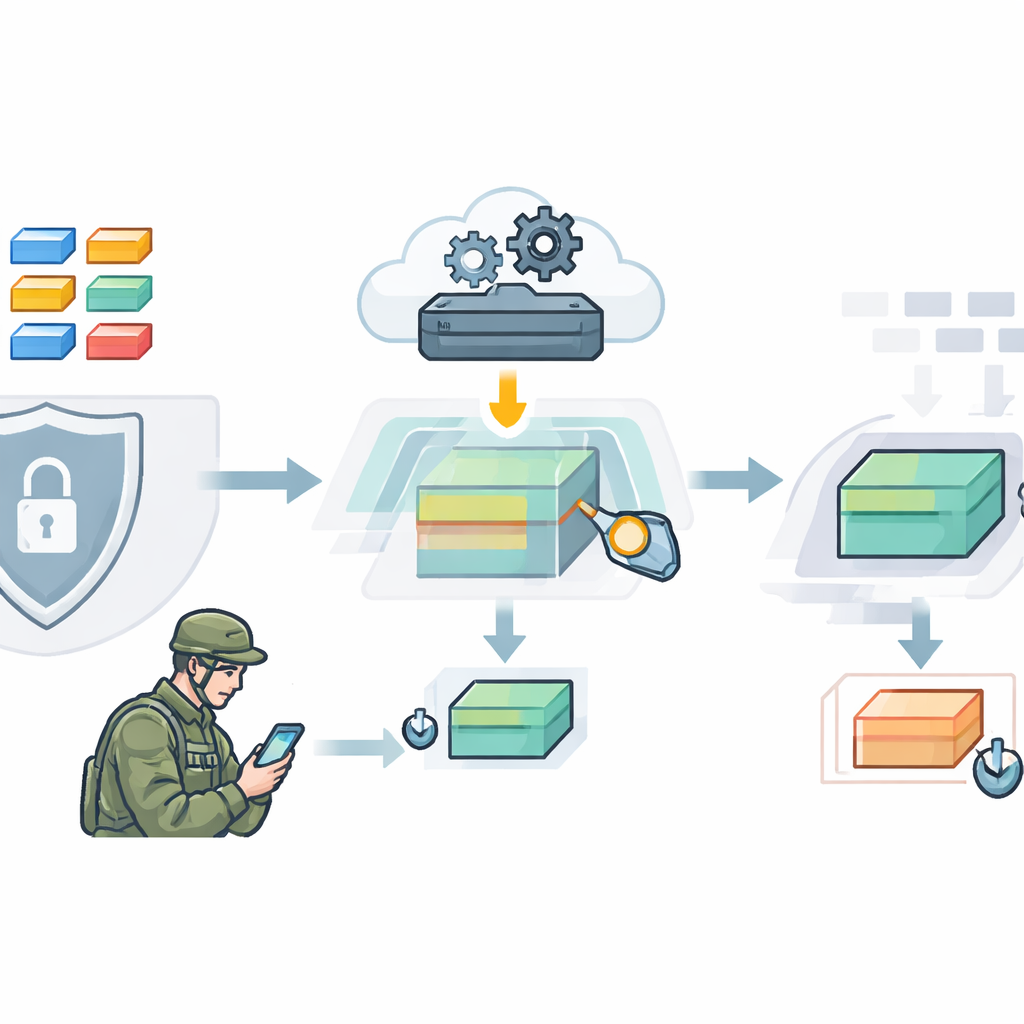
How the helper can be powerful but not all-powerful
At the cloud node, most of the expensive cryptographic work takes place. Using the blurred key material and the chosen ciphertext, the node transforms the data into a partially unlocked form. Because of the blinding factor, even if an adversary captures this node and extracts all of its stored keys, it still cannot finish the decryption on its own. The node also applies an index-hiding mask, derived from the soldier’s query token, so that only the requested record will line up correctly later. It then attaches a lightweight verification tag that is bound to a hidden internal key. This tag allows the frontline device to detect any incorrect or malicious computation with just a couple of hash and message-authentication checks, avoiding extra communication rounds.
Lightweight checks on the soldier’s device
When the soldier’s device receives the response, it first verifies freshness and authenticity using the shared integrity key with the command center. Next, it uses its private blinding factor to remove the cloud node’s blur and recover the true secret key for that record. A local check compares a hash of this key to the verification tag. If anything was tampered with—or if the helper miscomputed—the check fails and the device discards the result. Only if all tests pass does the device perform a final, fast symmetric decryption to reveal the mission data. Importantly, the amount of work done online by the soldier’s device is constant: a couple of exponentiations, some hashes, a single message-authentication verification, and one symmetric decryption, regardless of how complex the access policy is.
What this means for future missions
In plain terms, the protocol lets a soldier pull one authorized report through an untrusted yet powerful helper, without overtaxing their device, without exposing the chosen report to the command center’s gaze, and without handing full decryption power to any intermediate node. The authors prove that unauthorized users cannot read the data, that capturing a cloud node is not enough to break the system, that the command center cannot statistically distinguish which index was requested, and that incorrect computations are detected with very high probability. This combination of efficiency, privacy, and robustness makes the scheme a promising building block for real-time, need-to-know data sharing in modern, highly connected battlefields.
Citation: Liu, W., Fu, B. & Wang, L. Resilient and verifiable outsourced attribute-based non-interactive oblivious transfer protocol for tactical edge networks. Sci Rep 16, 11839 (2026). https://doi.org/10.1038/s41598-026-40842-7
Keywords: tactical edge networks, secure data sharing, attribute-based encryption, oblivious transfer, privacy-preserving access