Clear Sky Science · en
Reveal the deployable solar energy potential and emission reduction benefits in the arid areas of Xinjiang
Sunlight in the Desert
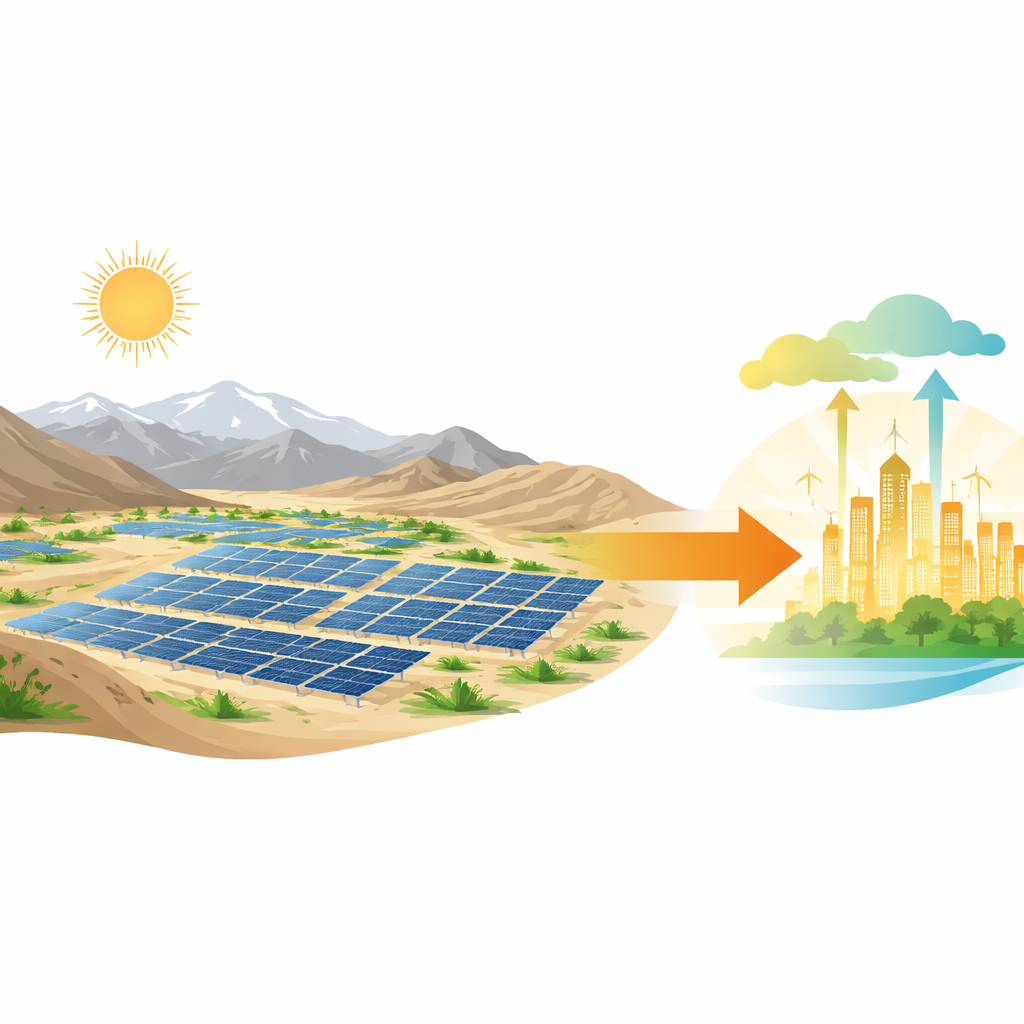
Across the vast deserts and basins of Xinjiang in northwestern China, sunshine is abundant while people and industry are relatively sparse. This combination makes the region a prime candidate to host solar power stations that could supply clean electricity far beyond its borders. The study summarized here asks a simple but vital question: just how much solar power could Xinjiang realistically provide, and how much climate‑warming pollution could that avoid, once we factor in where panels can actually be built and what they cost society?
Finding the Right Ground
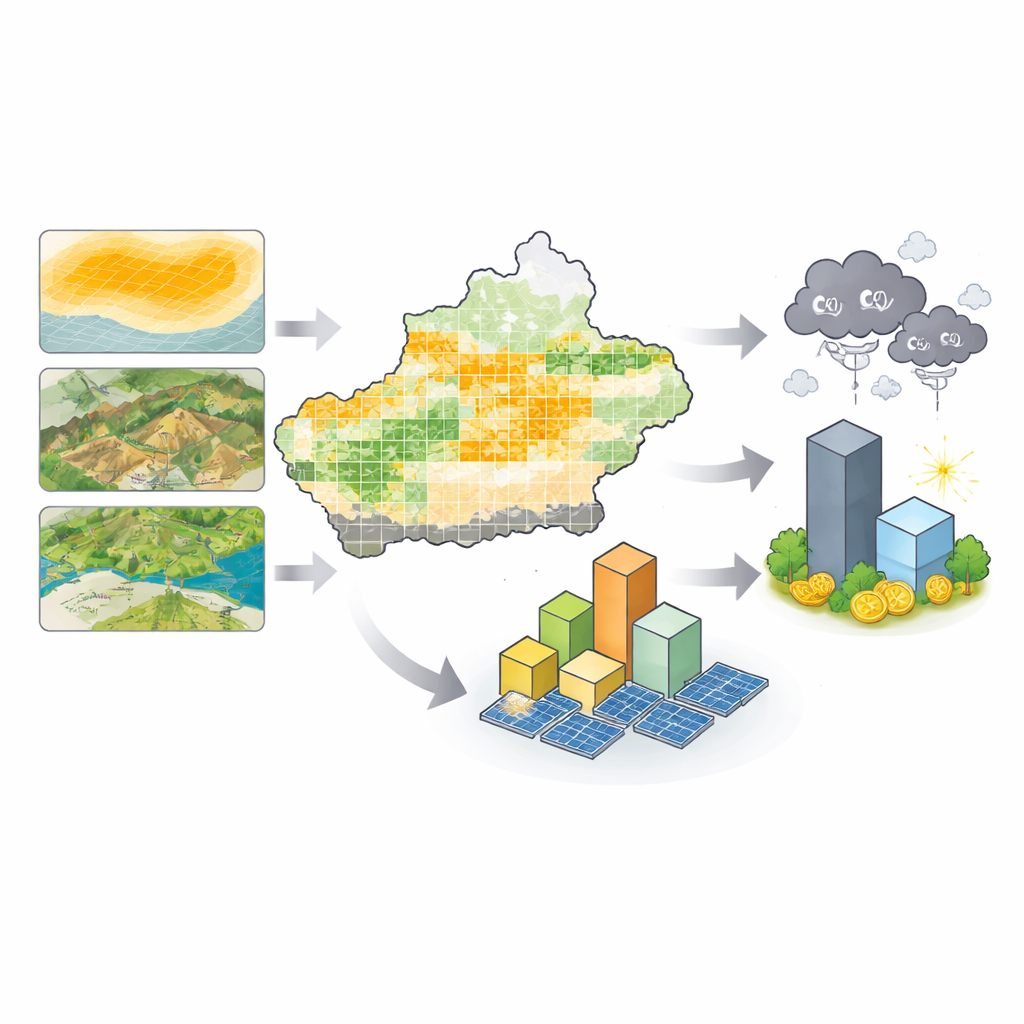
Not every sunny patch of land is a good place for a solar farm. The authors first build a detailed map of how suitable different areas of Xinjiang are for large, ground‑mounted solar power stations. They combine satellite‑based land cover data, digital maps of slopes and mountains, and boundaries of nature reserves. Flat, barren or sparsely vegetated ground scores highest, while forests, wetlands, croplands, and steep slopes score poorly. Ecologically protected zones are ruled out entirely. By weighting these factors, they assign each point on the map a “suitability factor” between 0 and 1, then check their approach by comparing it with the locations of real solar farms already built in the region.
Turning Sunlight into Power Numbers
Next, the team estimates how much electricity solar panels could generate across Xinjiang’s varied landscapes. Instead of relying only on rough averages, they use a physics‑based computer model called PVLIB‑Python together with a high‑resolution weather dataset known as ERA5‑Land. Hour by hour, for each grid cell across the region, the model calculates how the sun’s position, cloudiness, air temperature, wind, and other factors affect the panels’ output. From this they derive a “capacity factor,” which captures how hard a solar plant would work compared with its nameplate rating. They then multiply this performance by a realistic installation density to estimate both the theoretical maximum and the more practical, land‑constrained technical potential.
How Much Power and How Many Emissions
The modeling reveals that, on paper, Xinjiang could generate about 113.5 petawatt‑hours of solar electricity per year if all land were available. Once the land suitability rules are imposed, this falls to a still‑enormous 71.4 petawatt‑hours annually—around 63 percent of the theoretical resource. The best areas cluster in low‑lying basins such as the Tarim and Hami basins and the southern edge of the Junggar Basin, where sunshine is strong, slopes are gentle, and ecological conflicts are minor. Mountain regions and protected oases are less favorable. Over time, both solar radiation and average system performance show slight increases, suggesting a stable and gradually improving solar resource.
Cleaner Air and Cheaper Power for Society
To connect this technical potential to real‑world impacts, the authors estimate how much pollution would be avoided if this solar electricity displaced fossil‑fuel‑based power on the regional grid. Using official carbon and air‑pollutant emission factors, they find that fully using Xinjiang’s solar potential could cut roughly 53.5 billion tonnes of carbon dioxide per year, plus large amounts of sulfur and nitrogen pollutants. In many local areas, the avoided emissions would be many times higher than current local emissions, underscoring Xinjiang’s role as a potential “clean power exporter.” They then place a monetary value on these avoided damages using a standard social cost of carbon. When this environmental benefit is counted, the effective lifetime cost of solar electricity becomes negative—meaning that, from society’s perspective, the health and climate gains more than pay for the investment.
What This Means for the Future
In plain terms, the study concludes that Xinjiang’s sunny deserts and basins could host enough well‑placed solar farms to supply huge amounts of clean power while sharply cutting greenhouse gas emissions at a net benefit to society. Careful siting—favoring flat, barren land outside of sensitive ecosystems—turns an already rich solar resource into a practical blueprint for deployment. Although the results represent an upper limit that does not yet include all real‑world bottlenecks, such as grid capacity or water supply, they offer a powerful argument: with thoughtful planning, arid regions like Xinjiang can become major engines of the clean energy transition and a cornerstone of long‑term climate solutions.
Citation: Li, N., Yu, W., Liu, K. et al. Reveal the deployable solar energy potential and emission reduction benefits in the arid areas of Xinjiang. Sci Rep 16, 10437 (2026). https://doi.org/10.1038/s41598-026-40841-8
Keywords: solar energy, photovoltaic power, Xinjiang, carbon emissions, renewable energy planning