Clear Sky Science · en
AI-augmented geothermal model for scalable energy uncertainties in buildings
Why smarter heating and cooling matter
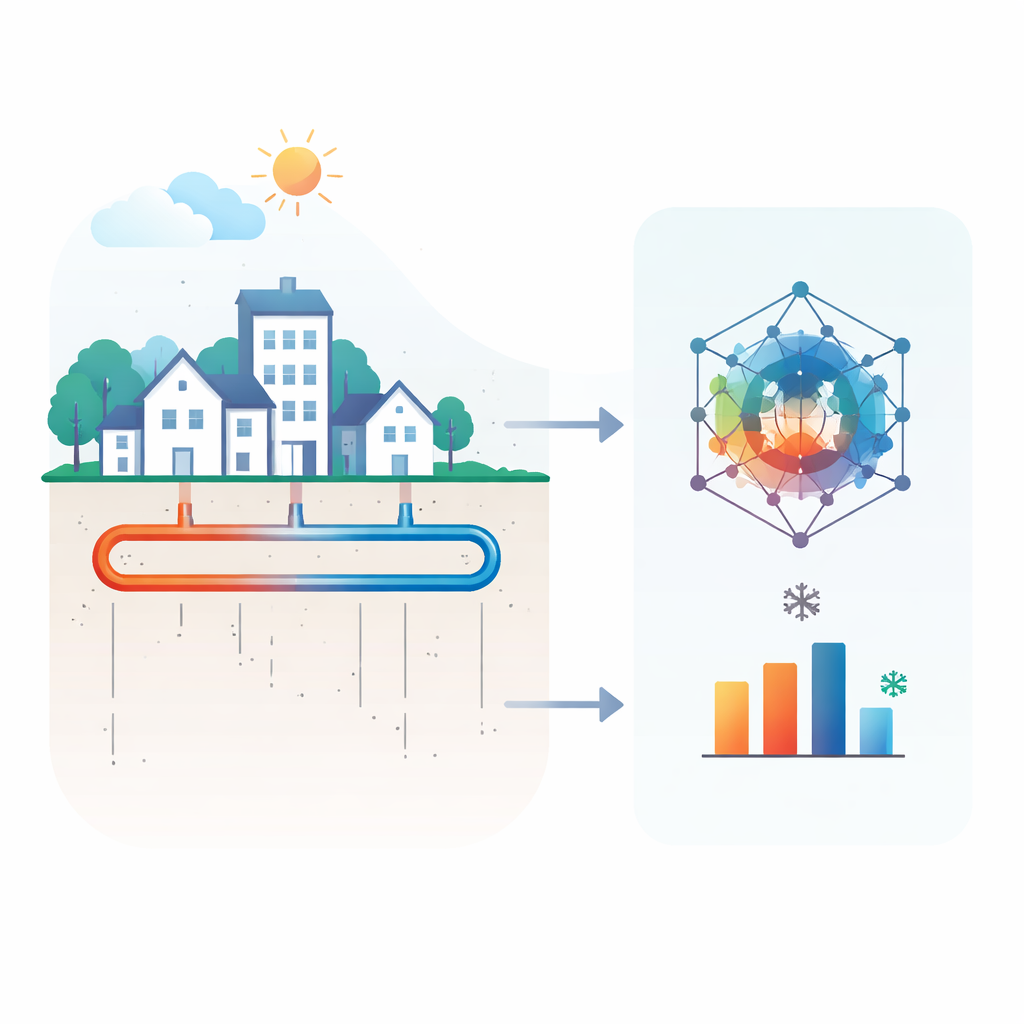
Cities use most of the world’s energy, and a big share of that goes into heating and cooling homes. As extreme weather and power shortages become more common, planners need better ways to predict how much energy buildings will use, and how new technologies like geothermal heat pumps can cut both bills and emissions. This study introduces a fast, AI‑ready modeling tool that can estimate the energy use of geothermal systems in homes and neighborhoods, helping communities decide which upgrades give the biggest environmental and financial payoff.
A simple model for a complex building
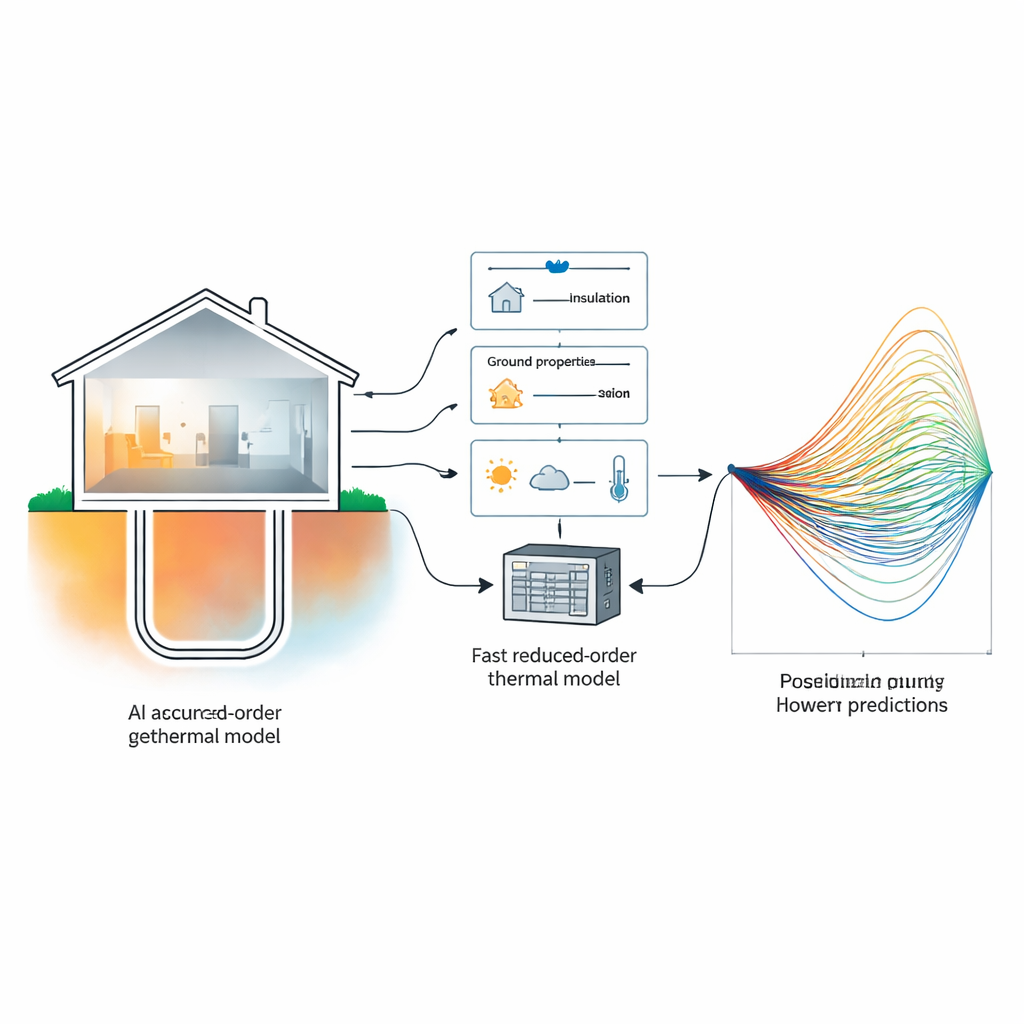
Instead of relying on traditional, very detailed simulation engines that can take a long time to run, the authors build on a streamlined “thermal circuit” model. In this approach, a house is treated like an electrical circuit for heat: walls, windows, and indoor air are represented as a small set of resistances and heat-storage elements. Weather data, building materials, and indoor gains from people and equipment feed into this model, which then calculates how much heating or cooling a geothermal heat pump would need over time. The model is implemented in the Julia programming language and wrapped into new software called the Building Energy Replica Tool (BERT), designed from the ground up to be fast, scalable, and easy to connect with machine‑learning algorithms.
Checking against a trusted standard
To see whether this lightweight model is trustworthy, the team compares BERT’s results with those from EnergyPlus, an industry‑standard building simulator. They use a 650‑square‑foot house on the New Mexico State University campus, carefully reproducing its size, materials, and local weather. For both a hot summer day and a cold winter day, the timing of peak heating and cooling demands lines up closely between the two tools, even though the exact peak values differ by about 20–30 percent. BERT tends to smooth out sharp spikes because of how it represents stored heat, but overall it tracks when the building needs energy and how loads change through the day. Crucially, BERT runs several times faster than EnergyPlus, and many tens of times faster than some other engineering tools, making large numbers of runs feasible.
Finding what really drives energy use
Speed matters because the authors don’t just want a single prediction—they want to understand uncertainty and which design choices matter most. They vary key inputs using advanced sampling methods and then apply global sensitivity analyses to see which parameters have the biggest impact on energy use. Across multiple techniques, the same message emerges: for buildings with geothermal systems, the design of the ground loop and the heat pump itself dominates the uncertainty in energy demand. Factors like the heat-transfer rate between soil and pipes, the length of buried piping, and the efficiency of the heat pump outrank changes in wall insulation or concrete properties within realistic ranges. Further statistical analysis shows how different combinations of parameters can produce nearly the same daily power curve, highlighting where designers have flexibility and where they do not.
Putting dollars and data science to work
Because the model is so fast, the team can extend their analysis to economics and artificial intelligence. Using full‑year simulations, they compare a geothermal heat pump system to a conventional gas furnace and standard air conditioner, under different wall insulation scenarios and local utility prices and incentives for Las Cruces, New Mexico. Geothermal options consistently cut annual heating and cooling energy by roughly half and often pay back their extra upfront cost within a few to about fifteen years once rebates and tax credits are counted—well within the expected lifetime of the equipment. On the AI side, they train an Extreme Gradient Boosting (XGBoost) machine‑learning model on thousands of BERT simulations. With only a modest training set, the algorithm learns to reproduce BERT’s energy predictions with near‑perfect accuracy in seconds, demonstrating that a physics‑based model can be distilled into an ultra‑fast surrogate suitable for real‑time control and city‑scale planning.
What this means for future cities
For non‑specialists, the main takeaway is that a carefully designed, simplified model can be accurate enough to guide real decisions while being fast enough to explore thousands of “what‑if” scenarios. The study shows that, in geothermal homes, getting the underground system and heat pump right matters more than fine‑tuning every wall detail, and that these systems can be both greener and cost‑effective over their lifetime. By combining such physics‑aware models with machine learning, the authors lay the groundwork for an UrbanAI platform that could help planners test policies, utilities forecast demand, and homeowners or developers see the long‑term benefits of cleaner heating and cooling before breaking ground.
Citation: Markowitz, A., Abuaamoud, R., Ben Ayed, S. et al. AI-augmented geothermal model for scalable energy uncertainties in buildings. Sci Rep 16, 11907 (2026). https://doi.org/10.1038/s41598-026-40837-4
Keywords: geothermal heat pumps, building energy modeling, urban energy planning, machine learning, renewable heating and cooling