Clear Sky Science · en
Intelligent hybrid optimization of tuned inerter dampers in base-isolated multi-storey structures under near-fault pulse-like ground motions
Why protecting buildings from nearby quakes matters
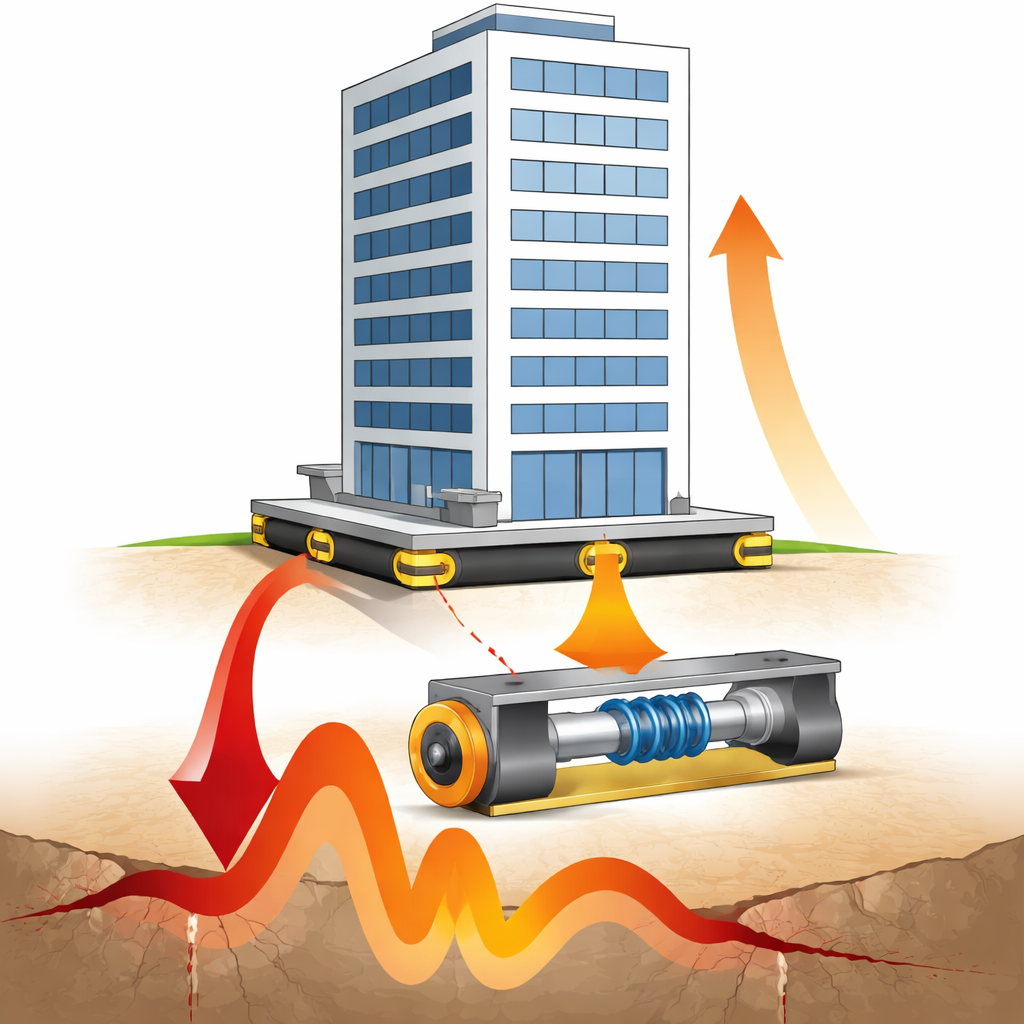
Many modern hospitals, bridges, and high‑rise offices rest on special devices that allow them to “float” during an earthquake. These base‑isolation systems can greatly reduce shaking inside the building, but when a powerful quake occurs very close to the fault, they can still move so far that joints, utilities, or even neighboring structures are put at risk. This paper explores a smarter way to fine‑tune an advanced type of vibration damper so that base‑isolated buildings stay safer during these intense, pulse‑like earthquakes.
A new kind of helper for shaking buildings
Traditional tuned mass dampers calm a building by attaching a heavy auxiliary mass that swings or slides in opposition to the motion of the main structure. Tuned inerter dampers achieve a similar effect without adding large physical masses: instead, they use mechanical devices that create forces proportional to relative acceleration, effectively “amplifying” inertia. When installed in the isolation layer at the base of a building, these devices can reduce both sideways drift and internal shaking. However, their performance depends sensitively on three tuning choices—the apparent mass they provide, the frequency at which they are tuned, and how strongly they are damped—choices that are especially tricky when the earthquake motion comes from nearby faults and contains strong, long‑period pulses.
Why near‑fault pulses are so challenging
Ground motions recorded close to major faults often show a single, large velocity pulse that carries a great deal of energy at relatively long periods, roughly matching the natural swaying period of base‑isolated structures. When that pulse period lines up with the isolation system, the whole building can lurch many tens of centimeters despite otherwise modest accelerations. Conventional design approaches often assume a simplified, “white‑noise” type of shaking that spreads energy across many frequencies and does not capture this pulse behavior. As a result, dampers tuned using those assumptions may perform well in distant earthquakes but lose much of their effectiveness when a nearby fault ruptures.
Blending smart search with learned patterns
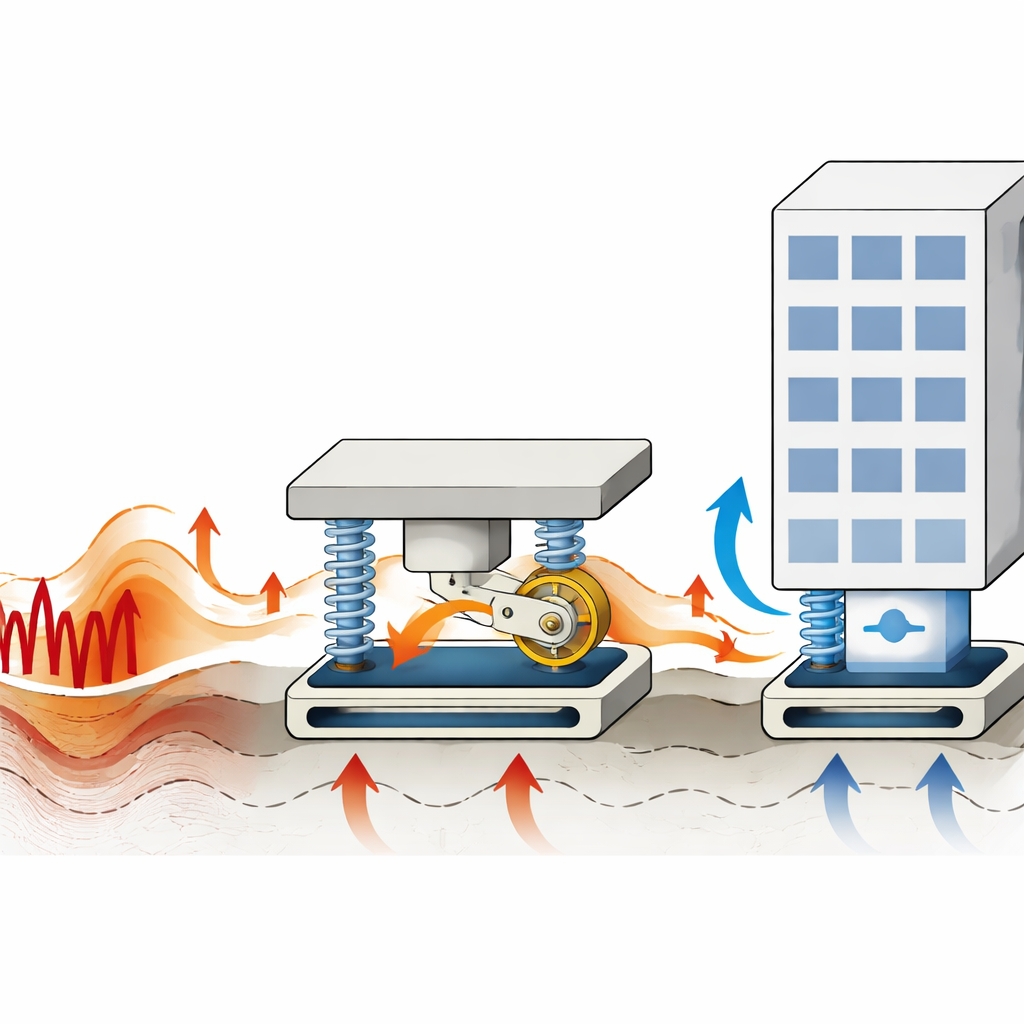
The authors introduce an intelligent hybrid optimization framework that combines two population‑based search methods—genetic algorithms and particle swarm optimization—with a feedforward neural network trained on over 150 real and simulated near‑fault records. The neural network first predicts promising damper settings based on features such as the isolation period and the strength and pulse period of the expected shaking. Those near‑optimal guesses seed the search, which then explores and refines the settings to balance three goals: limiting average base drift, capping peak base displacement, and reducing floor accelerations. Instead of relying on crude assumptions about the shaking, the framework uses a physics‑based description of the earthquake’s frequency content that is calibrated directly to recorded near‑fault motions.
How much improvement the smart tuning delivers
To test their method, the researchers applied it to three benchmark buildings—five, ten, and fifteen stories tall—each equipped with base isolation and a tuned inerter damper at the base. They drove these models with 42 recorded earthquakes, divided into far‑fault, near‑fault without strong pulses, and near‑fault with clear pulses, and carried out detailed time‑history simulations. For intense pulse‑like events, the pulse‑optimized dampers cut the average base displacement by up to about one‑quarter, peak base drift by more than one‑fifth, and peak floor accelerations by roughly one‑fifth compared with conventional designs. Gains were strongest for low‑ and mid‑rise buildings, where the first swaying mode dominates; even relatively modest apparent mass ratios delivered most of the benefit, while much larger devices produced only diminishing returns.
What this means for real buildings
From a layperson’s perspective, the key message is that not all earthquakes are alike, and devices that protect buildings must be tuned with those differences in mind. By using data‑driven learning guided by physical insight, this study shows how to select damper settings that specifically target the long, powerful pulses produced by nearby faults, without sacrificing performance in more ordinary shaking. The result is a practical recipe for designing compact mechanical “shock absorbers” in the isolation layer of critical structures, helping to keep both movement and internal shaking within safer limits when the closest and most damaging earthquakes strike.
Citation: Li, J., Duan, L., Zhou, Q. et al. Intelligent hybrid optimization of tuned inerter dampers in base-isolated multi-storey structures under near-fault pulse-like ground motions. Sci Rep 16, 10051 (2026). https://doi.org/10.1038/s41598-026-40831-w
Keywords: seismic isolation, tuned inerter damper, near-fault earthquakes, structural vibration control, hybrid optimization