Clear Sky Science · en
Metatranscriptomics analysis reveals the cotton virome in the southern United States
Why the hidden world in cotton matters
Cotton is woven into our shirts, sheets, and many everyday products, and much of it is grown in the southern United States. Yet, like people, cotton plants don’t get sick from just one germ at a time. They can host entire communities of viruses—some harmful, some harmless, and some that might even help by weakening other pests. This study set out to map that hidden viral world, or “virome,” inside cotton plants across the Cotton Belt, using modern genetic tools that can detect viruses even when we don’t know what we’re looking for.
Looking beyond a single disease
Growers and scientists have been worried about a virus called cotton leafroll dwarf virus, or CLRDV, which has spread through nearly all U.S. cotton-growing states and can stunt plants and deform leaves. But farmers often see confusing and inconsistent symptoms: some plants look sick but test negative for CLRDV, while others look healthy yet test positive. The researchers suspected that other, overlooked viruses might be present, alone or alongside CLRDV, and that these viral combinations could help explain why disease in the field is so variable. Understanding this broader cast of viral characters is key to better diagnosis and management.
Reading the RNA messages
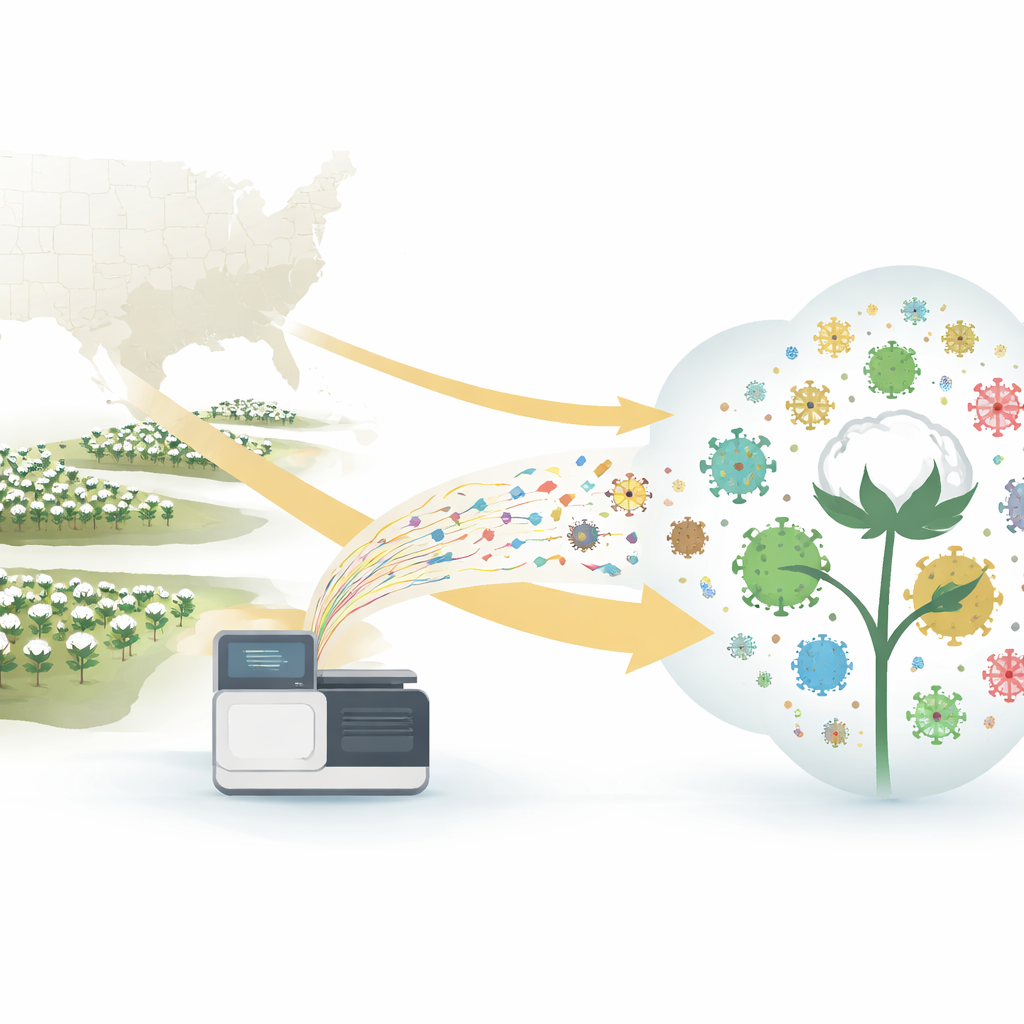
To reveal this hidden viral community, the team used a method called metatranscriptomics, which reads all the RNA molecules present in plant tissue. In 2021–2022 they collected leaves and leaf stems from both healthy-looking and symptomatic cotton plants at research farms in six states, from Alabama to North Carolina and Louisiana. After freezing and grinding the tissue, they extracted RNA, removed the plant’s own ribosomal RNA, and sequenced the remaining material using a high-throughput Illumina platform. They first filtered out sequences that matched the cotton genome, then pieced together the leftover fragments into longer stretches and compared those to virus databases to see which organisms were present.
A crowded community of viruses
The analysis showed that CLRDV was indeed present in all sampled locations, and the scientists were able to assemble nearly complete genomes of this virus from most sites, confirming both its widespread distribution and the strength of their approach. But CLRDV was only the tip of the iceberg. In total, they found evidence for 29 different virus families—both RNA and DNA viruses—coexisting in cotton fields. Seven RNA virus families showed up most consistently across locations. Some, like Solemoviridae, include known plant pathogens. Others, such as Mitoviridae, Narnaviridae, Hypoviridae, Partitiviridae, Botourmiaviridae, and Totiviridae, are usually associated with fungi or other microscopic organisms that live in or on plant tissues. This means that cotton leaves are not just infected by plant viruses; they also carry viruses of fungal partners and other microbes that form part of the crop’s broader microbiome.
Checking, comparing, and rethinking
To be sure they were seeing real viruses and not just computer artifacts, the researchers selected several of the detected virus sequences and confirmed their presence using targeted PCR tests and traditional Sanger sequencing. They also used evolutionary tree-building methods to compare the cotton-associated viruses with previously known relatives. For CLRDV, the U.S. isolates formed a tight group distinct from South American strains, supporting earlier hints that the American variant is genetically different and possibly less aggressive. For some of the fungal-associated virus families, the cotton-derived sequences grouped within known fungal lineages, suggesting that many of the viruses detected likely reside in fungi living on or inside cotton rather than in the plant itself.

What this means for cotton and its caretakers
This work shows that cotton fields in the southern United States harbor a rich and complex viral community, not just one troublesome virus. By cataloging these many viruses, scientists gain a more realistic picture of how cotton interacts with both disease-causing and potentially beneficial microbes. Mixed infections may help explain why symptoms vary from place to place and year to year, and some fungal viruses could even be harnessed to soften the impact of harmful fungi. For farmers and breeders, the message is that modern genetic surveillance can move diagnosis beyond “one virus, one disease” and toward managing cotton health in the context of an entire microscopic ecosystem.
Citation: Escalante, C., Reyes, A.M., Zhao, C. et al. Metatranscriptomics analysis reveals the cotton virome in the southern United States. Sci Rep 16, 10229 (2026). https://doi.org/10.1038/s41598-026-40828-5
Keywords: cotton virome, plant viruses, metatranscriptomics, crop disease, high-throughput sequencing