Clear Sky Science · en
Smart control of soil temperature to optimize root-zone conditions for enhancing the physiological performance, growth, and productivity of greenhouse-grown cucumber
Warming the Ground for Better Cucumbers
For anyone who enjoys fresh cucumbers in winter, a big challenge happens out of sight, just below the soil surface. In cool seasons, the roots of greenhouse plants can sit in cold, sluggish soil even when the air feels comfortable. This study explores a smart way to gently warm the underground “home” of cucumber roots so they can breathe, drink, and feed more efficiently—boosting harvests while using less energy and helping farmers move toward more sustainable food production.
Why the Soil Under Our Feet Matters
Plant roots are highly sensitive to temperature. If the soil is too cold, roots struggle to take up water and nutrients, and the plant’s internal engines slow down. In cucumbers—a crop that “likes warm feet”—chilly soil can stunt growth, invite disease, and lower yields even inside a greenhouse. The researchers wanted to pinpoint a sweet spot for soil warmth in the root zone and test whether a smart, controlled heating system could create that ideal underground climate through the entire growing season.
A Smart Underground Heating System
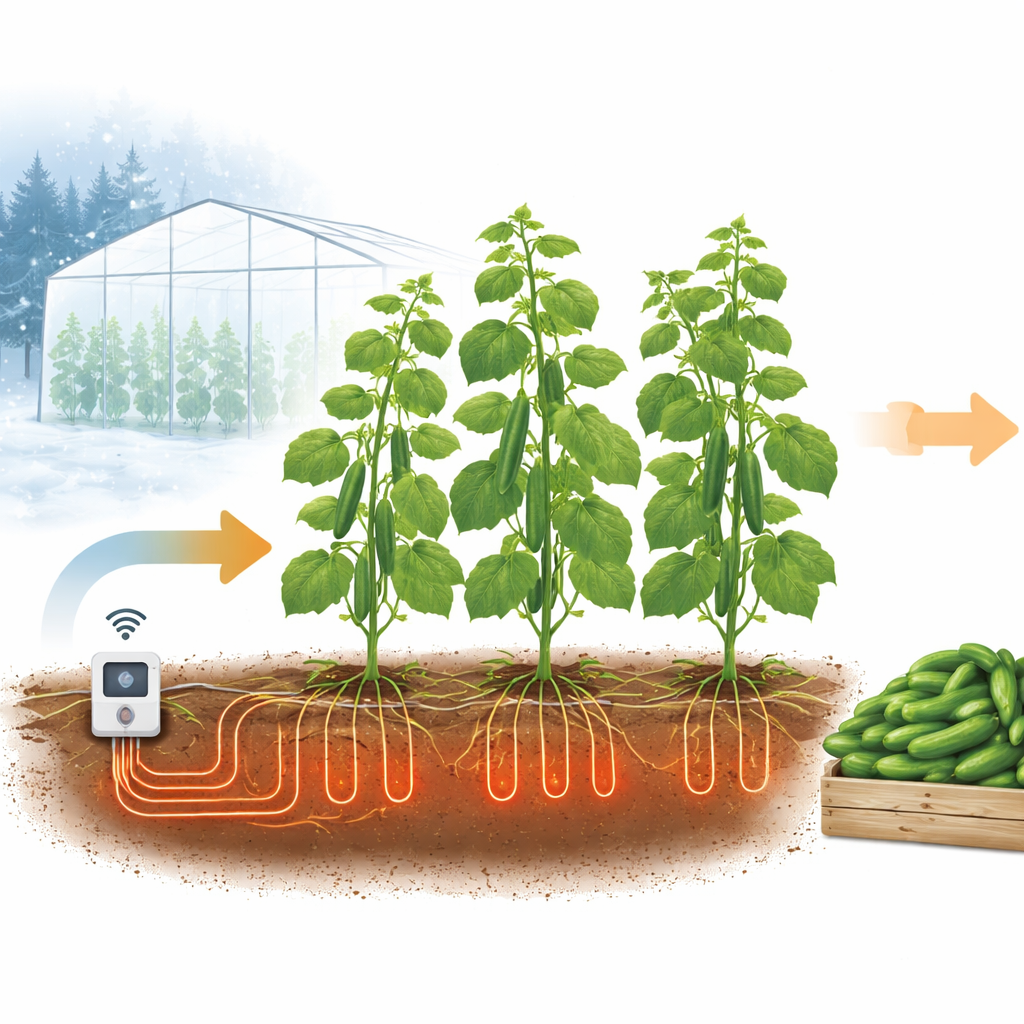
To do this, the team installed carbon-fiber heating cables about ten centimeters below the soil in large plastic greenhouses in Egypt. The cables were linked to metal thermostats that could keep the soil at set temperatures. Cucumber plants were grown at five different soil settings—13 °C (unheated control), 16, 19, 22, and 25 °C—over two winter seasons. Everything else, from irrigation to fertilizer, was managed as in a commercial greenhouse. The researchers then tracked how the plants responded: how fast they photosynthesized, how wide their leaves spread, how dense their roots became, and how many fruits of good quality they produced. They also measured how easy it was for plants to “breathe” water vapor, a balance known as vapor pressure deficit, which influences plant stress and water loss.
Healthier Roots, Leaves, and Fruits
The warmed soil had clear effects. Plants grown at 19 and especially 22 °C showed stronger photosynthesis, meaning they converted more sunlight and carbon dioxide into sugars to fuel growth. Their stomata—the tiny pores on leaves that regulate gas and water exchange—worked more effectively, and the surrounding air stayed in a humidity range that favors plant comfort rather than stress. In the soil, key nutrients such as nitrogen, phosphorus, and potassium became more available as temperature rose, with the 22–25 °C range showing the richest “pantry” for roots. These underground gains translated into taller plants with more leaves, larger total leaf area, denser root systems, and greener foliage. When harvest time came, cucumbers grown at 22 °C produced the highest yields per plant and more early fruits, along with firmer texture and higher natural sweetness (measured as soluble solids). Plants at 19 °C were close behind, while those at 13 and 16 °C lagged in both growth and productivity. Very warm soil at 25 °C supported good growth but did not outperform the 22 °C treatment.

More Food with Less Energy
Beyond plant biology, the study also examined costs and energy use. The smart soil-heating setup was compared with a traditional gas-fired air heating system. Although the total money earned from crop sales was similar for both, the smart system needed less fuel and hardware, leading to a much higher net return and a better benefit–cost ratio. By targeting heat right where it matters most—around the roots—the smart system cut greenhouse heat demand by about 30 percent over the season. Statistical analyses showed tight links between soil temperature, photosynthesis, root density, and yield, underscoring that fine-tuning the root-zone climate is a powerful lever for both productivity and resource savings.
What This Means for Growers and Consumers
In simple terms, gently warming the soil around cucumber roots to about 22 °C during the beginning and middle of the season helps plants grow faster, stay healthier, and bear more and better fruit, while using less energy than conventional heating. Toward the end of the season, growers can dial the soil warmth back to around 19 °C to save additional energy without harming yields. For greenhouse producers, this smart soil temperature control offers a practical way to stabilize production in cold nights and seasons and to move closer to climate-friendly farming. For consumers, it means a more reliable supply of high-quality cucumbers grown with smarter use of heat and electricity.
Citation: Refaie, K.M., Saad, S.A.H. & Hussein, N.S. Smart control of soil temperature to optimize root-zone conditions for enhancing the physiological performance, growth, and productivity of greenhouse-grown cucumber. Sci Rep 16, 10351 (2026). https://doi.org/10.1038/s41598-026-40825-8
Keywords: greenhouse cucumbers, soil heating, root zone temperature, smart farming, energy efficient agriculture