Clear Sky Science · en
Removal of lead from groundwater using carbide-derived carbon
Why Cleaning Lead from Water Matters
Lead in drinking water is a largely invisible threat. It has no taste or smell, yet long-term exposure can damage the brain, kidneys, and heart, and is especially harmful to children. Around the world, wells and pipes can leach this metal into water supplies. The article describes a new way to pull lead out of groundwater using a highly porous form of carbon, offering a fast and efficient option for safer drinking water.
A New Kind of Sponge-Like Carbon
The study focuses on an advanced material called carbide-derived carbon, or CDC. Unlike ordinary charcoal or activated carbon, CDC is engineered to have an enormous internal surface area—about 1,600 square meters in just one gram—full of tiny pores. The researchers first examined what CDC looks like and what it is made of, using powerful microscopes and other tools. They found a network of irregularly shaped particles with both very small and somewhat larger pores, and a mostly carbon structure with small amounts of oxygen and other elements. This sponge-like architecture makes CDC particularly suited to grabbing dissolved substances from water.
Testing How Well CDC Grabs Lead
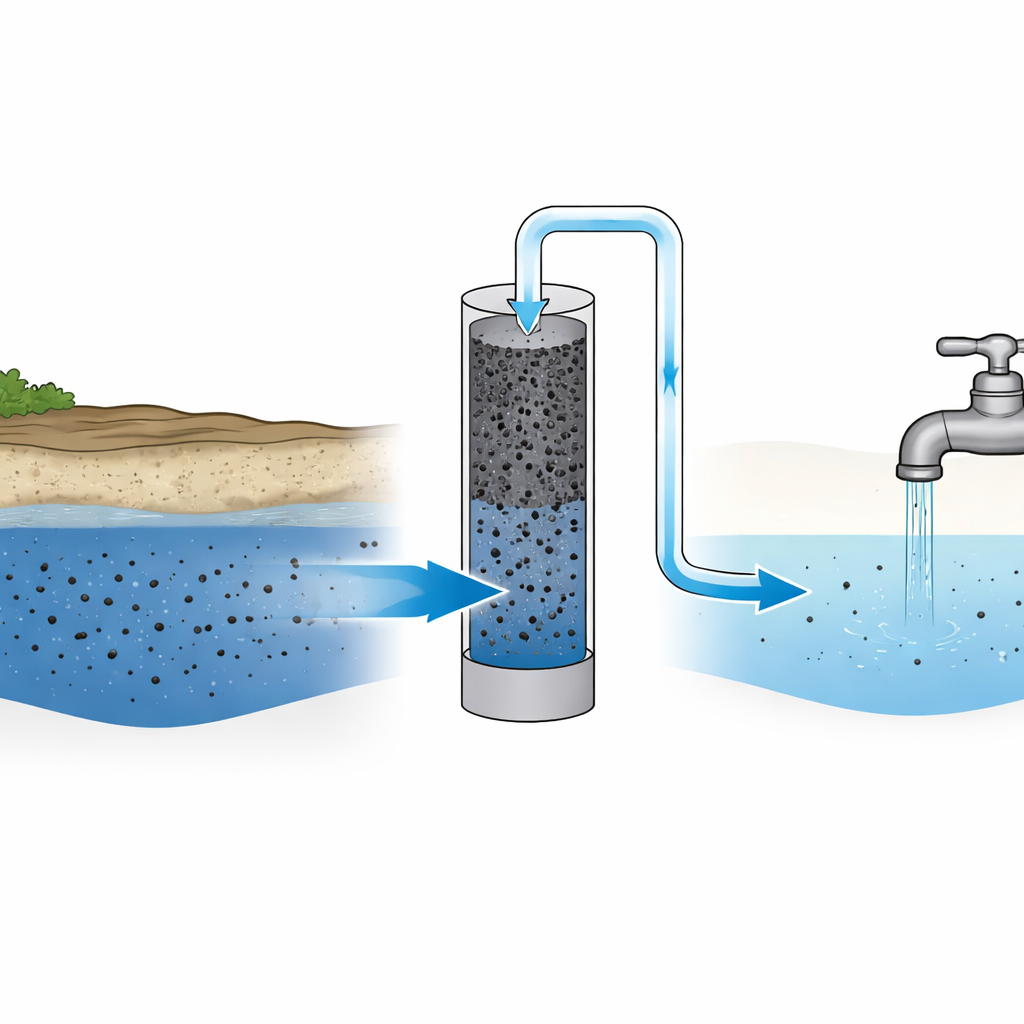
To see how effectively CDC can remove lead, the team ran a series of tank experiments. They mixed small amounts of CDC with water containing known lead levels, then tracked how much lead remained. Even with a low CDC dose, nearly all lead was removed, and more than 98 percent of the metal disappeared from the water within just five minutes. As they changed the amount of CDC, the contact time, the starting lead concentration, and the water’s acidity, they saw predictable shifts: more CDC meant more total lead removed, while higher starting lead levels gave each gram of CDC more to hold but left a greater fraction of lead in the water. The material worked best in neutral to slightly basic water, where its surface holds a negative charge that helps attract positively charged lead ions.
How the Material Holds On to Lead
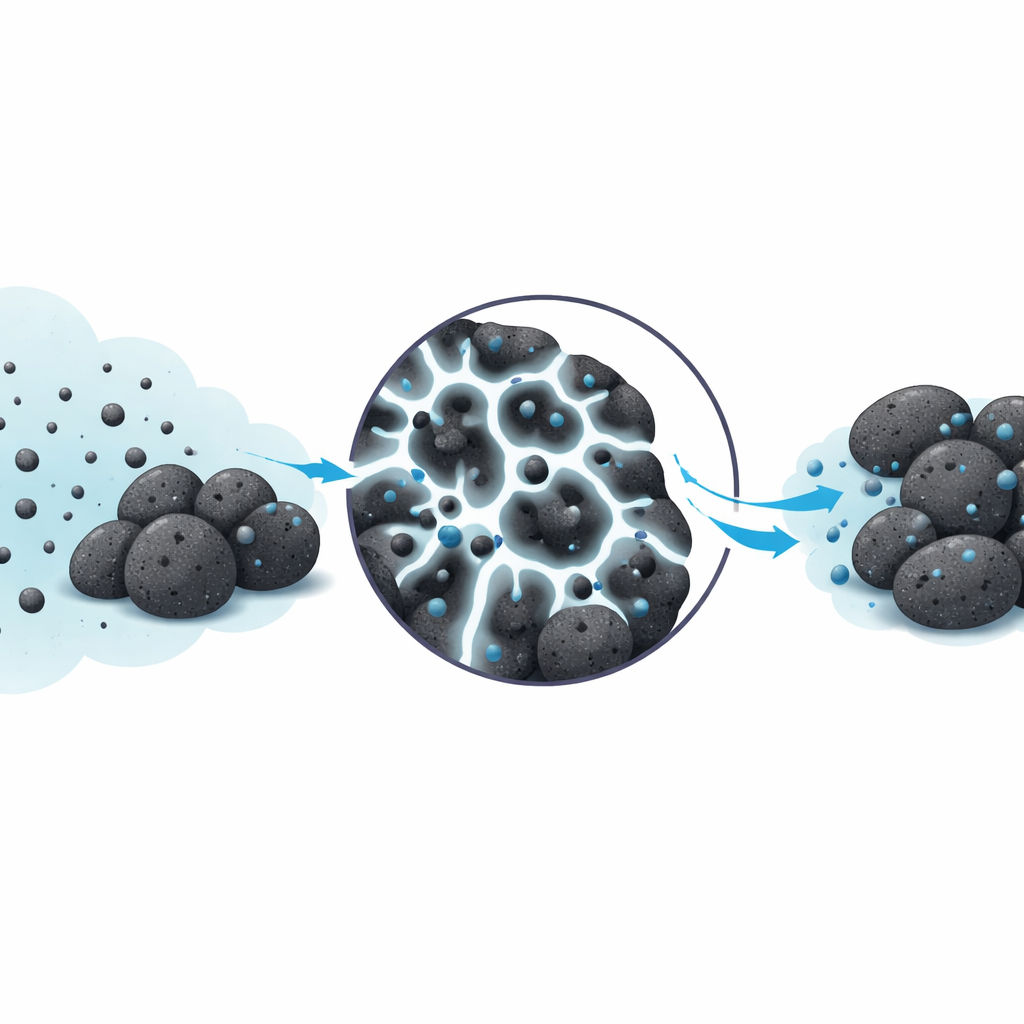
Beyond simple performance, the scientists wanted to know how CDC actually captures lead. By analyzing the material’s surface before and after treatment, they saw clear signs that lead bonds to oxygen-containing chemical groups on the carbon, forming stable surface complexes. The charge on the CDC also plays a role: at higher pH, its surface becomes more negatively charged, strengthening the pull on lead. When they added salt to make the water more like real groundwater, the extra dissolved sodium and chloride ions partially shielded this attraction, slightly lowering the amount of lead CDC could hold. Still, even in salty water, CDC removed more than 99 percent of the lead, showing that its many pores and binding sites make it robust under realistic conditions.
Speed, Capacity, and Reuse
Detailed data analysis showed that lead sticks to CDC in an orderly, single-layer fashion on its surfaces and that the rate of uptake is controlled by how quickly lead ions react with the available sites. The maximum amount of lead CDC could store reached about 89 milligrams per gram of material, a value that matches or exceeds many other carbon-based sorbents reported in the literature. Importantly, the process is thermodynamically favorable, meaning it tends to happen spontaneously and becomes slightly stronger at higher temperatures. The team also tested whether lead could be washed off so that CDC could be used again. By rinsing with a mild acid, they were able to strip the lead and restore much of the material’s capacity over several cycles, while surface measurements confirmed that virtually no lead remained after regeneration.
From Laboratory Tests to Real Groundwater
To move beyond idealized test solutions, the researchers collected real groundwater from Qatar, which contained many dissolved salts and minerals. They spiked this water with a realistic level of lead and treated it with CDC. At relatively low doses, the material brought lead levels below the strict safety limits set for drinking water, and at a moderate dose it removed lead completely. Taken together, the results suggest that CDC is not just a high-performance sorbent on paper—it is a practical candidate for cleaning contaminated wells and aquifers.
What This Means for Safer Water
This work shows that carefully engineered carbon can act as a powerful filter for one of the most dangerous metals in drinking water. CDC’s immense internal surface, fast action, ability to work in salty groundwater, and potential for reuse give it an edge over many existing materials. While full-scale systems would still need to be designed and tested, the study provides strong evidence that CDC could become an important tool for communities seeking reliable, low-waste methods to strip lead from groundwater and protect public health.
Citation: Manawi, Y., Abdel-Hadi, I., Tong, Y. et al. Removal of lead from groundwater using carbide-derived carbon. Sci Rep 16, 12678 (2026). https://doi.org/10.1038/s41598-026-40810-1
Keywords: lead in drinking water, groundwater treatment, porous carbon, heavy metal removal, water purification materials