Clear Sky Science · en
A novel approach to reliable and flexible distributed computing with virtualization in smart healthcare applications
Why smarter computing matters for your health
Modern healthcare increasingly relies on a web of connected devices—from smart watches and home monitors to hospital machines—that constantly collect and process data. Making sense of all this information quickly and reliably can literally be a matter of life and death. This paper explores how a behind‑the‑scenes technology called virtualization can help hospitals and clinics run these digital workloads faster, more reliably, and with less energy, especially when care is delivered through connected and remote systems.

From single machines to shared digital helpers
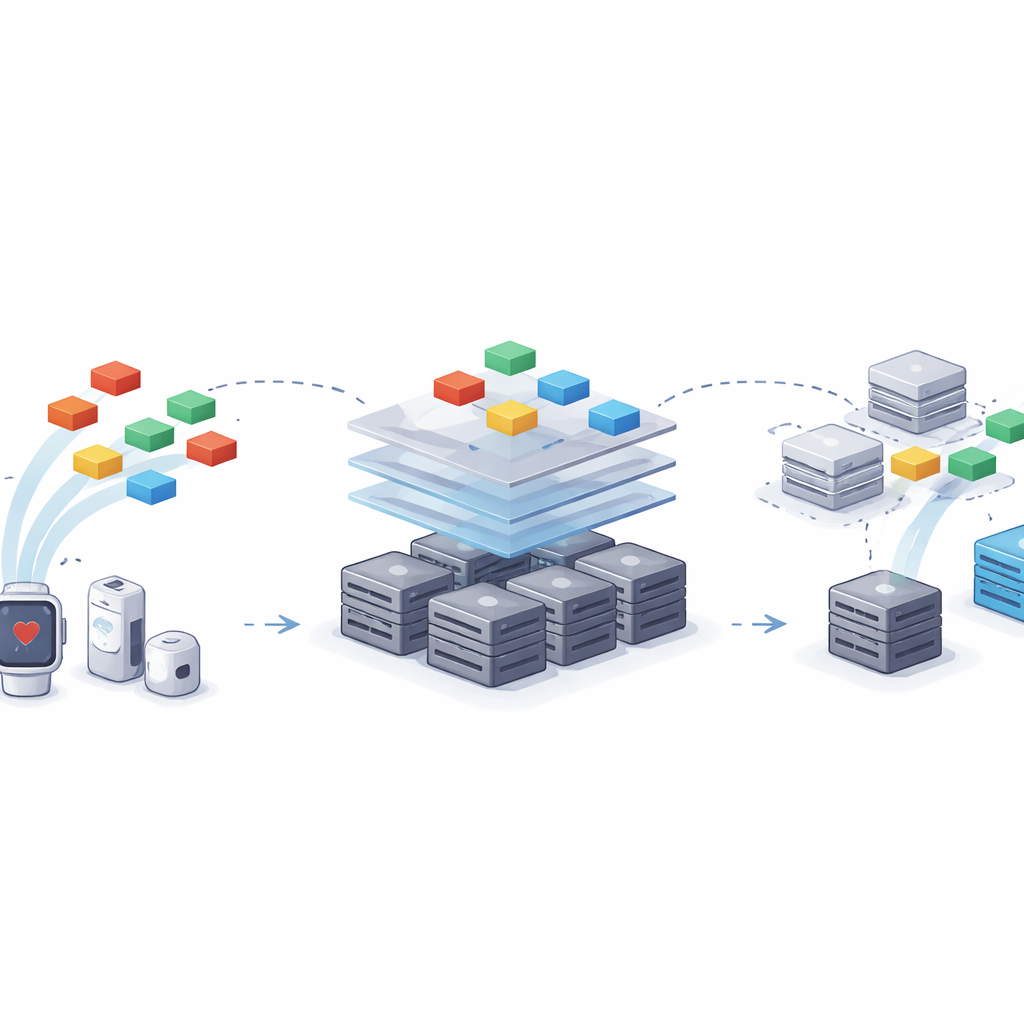
Traditional hospital computers are often set up in a rigid way: each machine is tied to a particular job, and when that machine is overloaded or fails, the whole service can slow down or stop. The authors look at a different approach where many physical computers are wrapped in a flexible digital layer. This layer creates virtual machines—software-based “mini computers” that can be moved and resized as needed. In a smart healthcare setting, where heart monitors, imaging scanners, and mobile apps all send data at unpredictable times, this flexibility allows work to be spread across many servers instead of piling up on a few.
Sharing the load without dropping critical tasks
The core challenge the study examines is called task offloading: deciding which computer should handle each incoming job from medical devices and applications. The authors design a model that treats this as a balancing act between three needs: finishing tasks quickly, keeping energy use low, and making sure equipment is used efficiently. Their system keeps track of how demanding each task is, how powerful each computer is, and how much extra delay the virtual layer adds. Using this information, a new scheduling method assigns tasks to the most suitable machines and can even move tasks around if failures or bottlenecks appear, all while respecting time limits that are especially important in healthcare.
Putting the model to the test in a digital sandbox
Instead of experimenting directly in hospitals, the researchers build a detailed simulation using a software tool that mimics events over time. They create virtual healthcare devices, network links, and computing nodes, then let hundreds of tasks arrive randomly, much like real patient data would. They compare two worlds: one where tasks are simply rotated through machines in order, and another where the virtualization‑aware scheduler makes smarter choices. They repeat each scenario many times, deliberately introduce computer failures, and measure how long tasks take, how busy the machines are, how often the system recovers from problems, and how much power it would consume.
Faster responses, better use of machines, lower energy
The simulated results show clear advantages for the virtualization‑aware setup. On average, tasks finish roughly a third faster under moderate to heavy loads. The system keeps servers working in a healthy range—about 85–90% active—rather than leaving some idle while others are overwhelmed. When individual machines fail, tasks are quickly moved to others, keeping overall reliability high even as failure rates increase. Because the system can concentrate work on fewer active machines and let others sleep, total energy use drops by about a quarter to a third. At the same time, more tasks can be completed in a given period, and the system stays efficient as the number of tasks grows, an important feature for data‑hungry applications like continuous monitoring or big‑data analysis of medical records.
What this means for future digital care
For non‑specialists, the takeaway is that building an extra layer of smart coordination on top of hospital computers can make digital healthcare services both faster and more dependable. While virtualization adds some overhead, the study shows that, when managed carefully, its benefits in speed, reliability, and energy savings outweigh the costs. In practical terms, this could support more responsive remote monitoring, smoother telemedicine visits, and better use of expensive hospital hardware. The authors suggest that the next steps include feeding real hospital workloads into their framework and combining it with learning algorithms, so that future systems can automatically adapt as patient needs and network conditions change.
Citation: Dhiman, G., Singh, K.D., Singh, P.D. et al. A novel approach to reliable and flexible distributed computing with virtualization in smart healthcare applications. Sci Rep 16, 12325 (2026). https://doi.org/10.1038/s41598-026-40801-2
Keywords: smart healthcare, edge computing, virtualization, task offloading, fault tolerance