Clear Sky Science · en
Reconstitution of DNA fragments on HAC/MAC via the fragment-assembly system
Building Custom DNA on Mini Chromosomes
Imagine being able to plug together many DNA pieces inside a living cell the way you might snap bricks into a custom model. That is essentially what this study sets out to do. The researchers created a new way to assemble multiple gene fragments directly on artificial chromosomes designed to live inside mammalian cells. This approach could make it easier to build complex genetic programs for future therapies, engineered tissues, or high‑performance cell factories.
Why Tiny Extra Chromosomes Matter
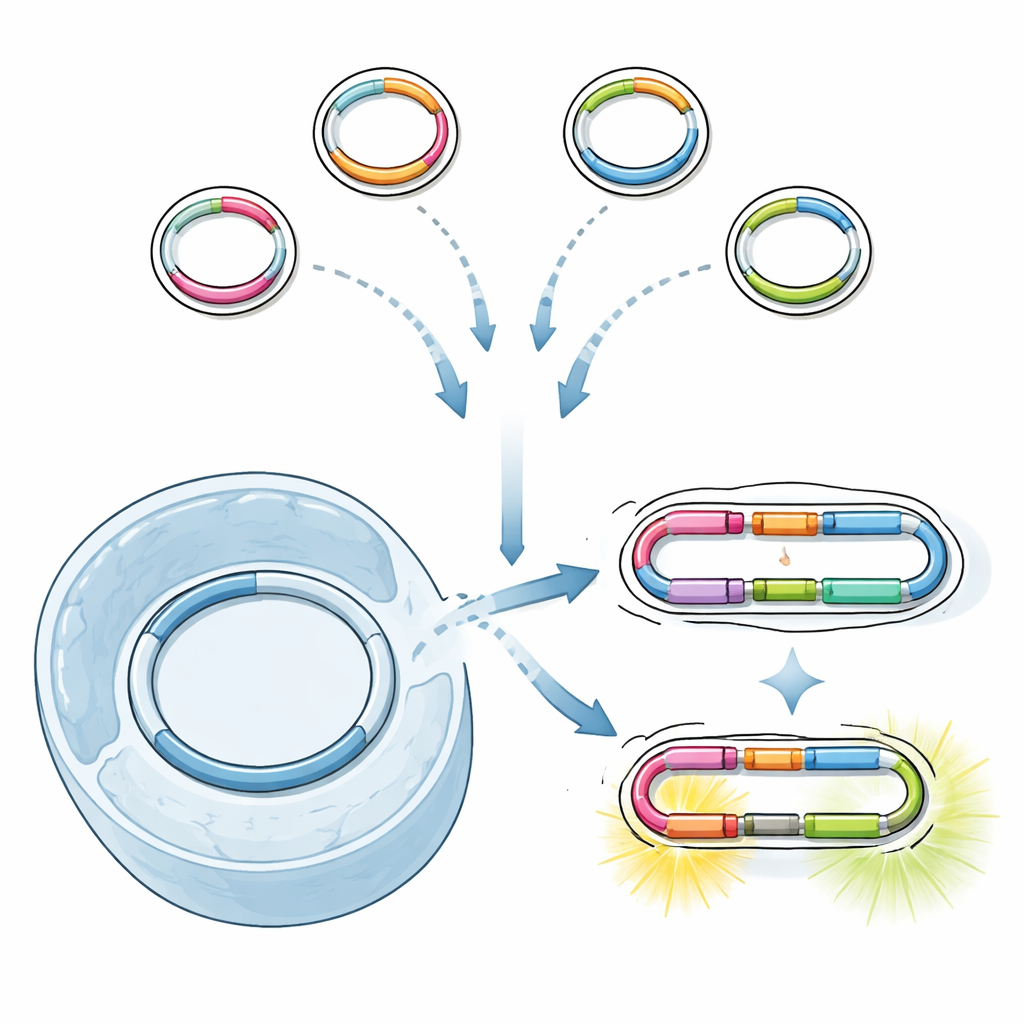
Human and mouse artificial chromosomes are lab‑made carriers that behave like normal chromosomes inside a cell, but they can be filled with DNA of our choosing. Scientists already use them to deliver very large genes, such as the huge dystrophin gene involved in muscular dystrophy, or clusters of drug‑processing genes. However, loading many separate genes onto these artificial chromosomes has been awkward. Older methods could usually add only one large DNA package at a time, or just a few steps before running out of selectable markers, and they tended to drag along unwanted vector backbone sequences—extra DNA used only for cloning—which clutter the construct and can interfere with how genes work.
A New Way to Snap Fragments Together
The authors designed a “fragment‑assembly” system that treats an artificial chromosome like a docking pad for many incoming DNA pieces. Each piece is carried on a gene‑loading vector and flanked by special short sequences recognized by enzymes called integrases and recombinases. These enzymes act like precision scissors and glue, cutting and joining DNA only at matching sites. In the first loading step, up to three fragments are brought together in a defined order on the artificial chromosome. The clever part is that the bulky vector backbones are tucked into a disposable stretch within a split drug‑resistance gene, so the cell can survive drug treatment only when the fragments have been assembled correctly.
Cleaning Up the Extra DNA
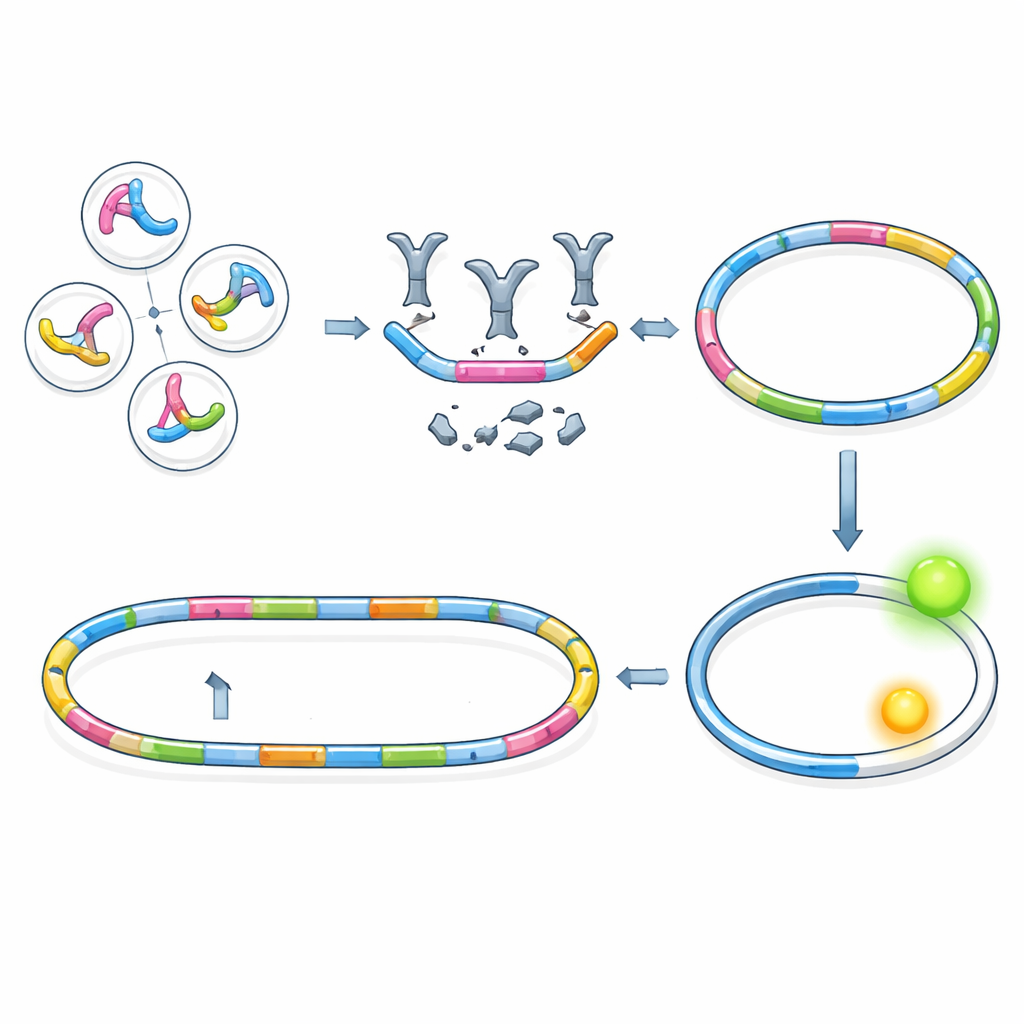
Once the first set of fragments is in place, a second set of enzymes removes most of the unneeded vector DNA without disturbing the assembled gene. This also swaps one drug‑resistance gene for another, so researchers can repeat the process with new fragments while reusing the same drugs for selection. By alternating between two pairs of enzymes, the team can cycle through loading rounds: assemble new fragments, cut away the backbone, switch drug resistance, and prepare the chromosome for the next addition. In this study, they demonstrated three such steps in sequence.
Putting the System to the Test
To prove the method works, the researchers split two different gene expression units into six separate pieces. In living hamster cells carrying a mouse artificial chromosome outfitted with their docking pad, they first assembled a gene that makes a red fluorescent protein along with a tagged enzyme called RTCB. In later rounds they built a second unit that produces a green fluorescent protein. Cells that successfully completed each stage survived the appropriate drugs and glowed red and green under the microscope, showing that the reassembled genes were active. The artificial chromosome carrying both reconstructed gene units could then be transferred into mouse fibroblast cells, where it again directed production of the same proteins. Further tests showed that the RTCB enzyme made from the artificial chromosome was functional, helping cells respond properly to stress in the endoplasmic reticulum.
What This Means for Future Cell Engineering
This fragment‑assembly system lets scientists join multiple DNA pieces into complete genes directly on artificial chromosomes while stripping away most of the unwanted helper DNA. Because the approach is modular and repeatable, it offers a path toward building long, custom‑designed stretches of genetic material—essentially synthetic chromosomes—that can be moved between cell lines. In the long run, this could simplify the design of cells that manufacture therapeutic proteins, model human diseases more faithfully, or even carry engineered mini‑genomes with new combinations of biological functions.
Citation: Suzuki, T., Yamakawa, M., Sasaki, S. et al. Reconstitution of DNA fragments on HAC/MAC via the fragment-assembly system. Sci Rep 16, 10142 (2026). https://doi.org/10.1038/s41598-026-40789-9
Keywords: artificial chromosomes, gene loading, synthetic biology, DNA assembly, genome engineering