Clear Sky Science · en
The influence of sequential drilling and machining parameters on uncut fiber formation and delamination damage in fiber-reinforced composites
Why tiny holes matter in big structures
Modern airplanes, cars, and wind turbines rely on fiber‑reinforced plastics—lightweight materials made from glass or carbon fibers glued together with resin. These materials are strong, but they are also delicate when it comes to making bolt holes and fastener openings. A simple drilling step can tear layers apart or leave strands of fiber hanging inside the hole, quietly weakening a critical part. This study explores how to drill cleaner, stronger holes in fiberglass plates by carefully choosing drill size, drilling sequence, and machine settings.
Layers, fibers, and unwanted damage
Fiber‑reinforced composites are built like a stack of thin cloth sheets soaked in glue. When a spinning drill pushes through this stack, it can pry the layers apart, a problem called delamination, and it can also leave bundles of fibers uncut inside the hole. Both types of damage reduce how much load a part can carry before it breaks. The authors focused on a common fiberglass laminate made of seven woven glass‑fiber layers bonded with epoxy. They fabricated large flat panels, cut them into test strips, and then drilled holes under many different conditions, mimicking the way real parts are made in industry.
Trying a step‑by‑step drilling approach
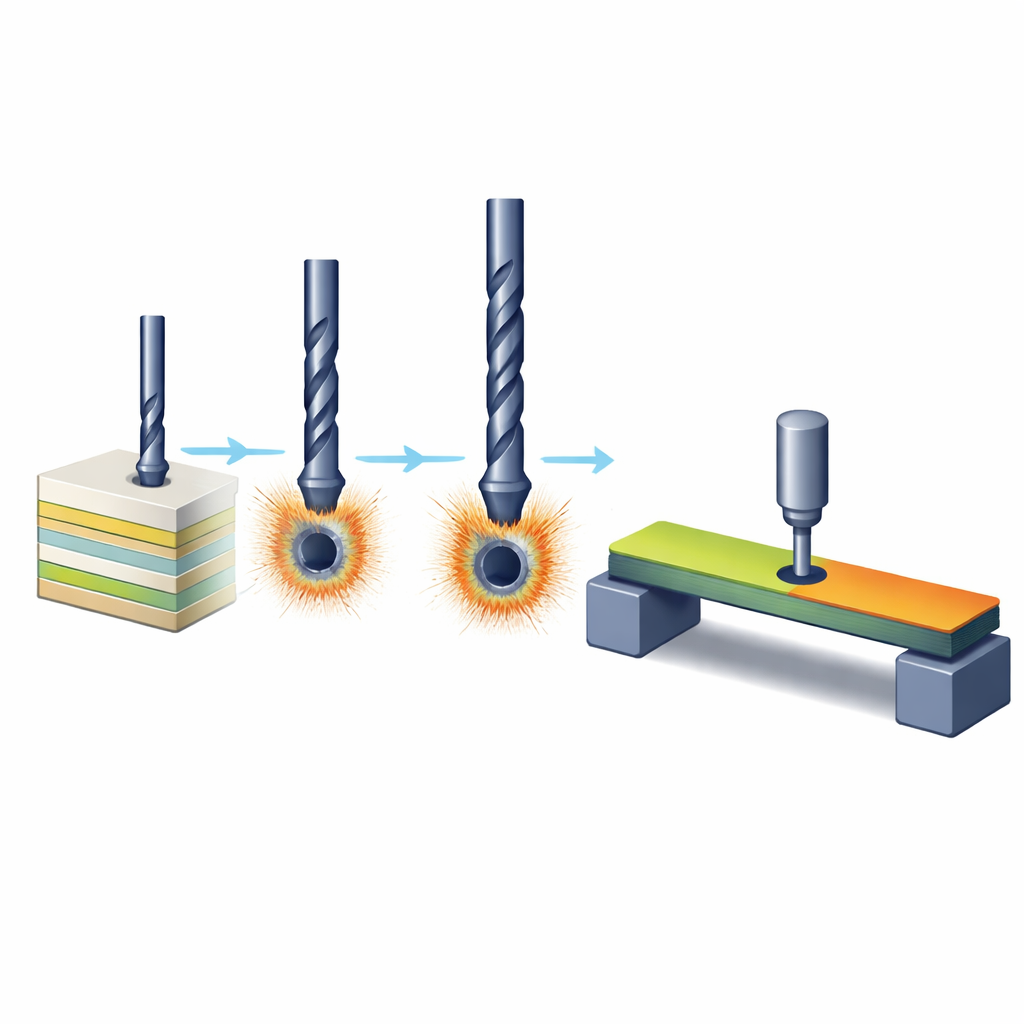
The first question was whether "sequential" drilling—using a series of small, then medium, then final‑size drill bits—could reduce damage compared with drilling to full size in a single pass. Using a computer‑controlled milling machine, the team drilled holes of 7 and 10.1 millimeters in diameter with one, two, or three drills in sequence, while keeping feed rate and rotation speed fixed. They then photographed the front and back of each hole and used image‑analysis software to measure how much of the surrounding area had peeled apart, and how much of the hole surface was covered by uncut fibers.
How speed and push change the quality of a hole
Next, the researchers varied the key machine settings: the feed rate (how fast the drill is pushed into the material) and the spindle speed (how fast it spins). They tested three feed levels from very slow to quite fast and three rotation speeds from low to high, for both hole sizes. For each combination, they again measured delamination and uncut fibers at the entrance and exit of the hole. They also performed three‑point bending tests—supporting each strip at its ends and pushing down in the middle—to see how much force the drilled parts could withstand before breaking, and how this related to the damage around the hole.
What the images and bending tests revealed
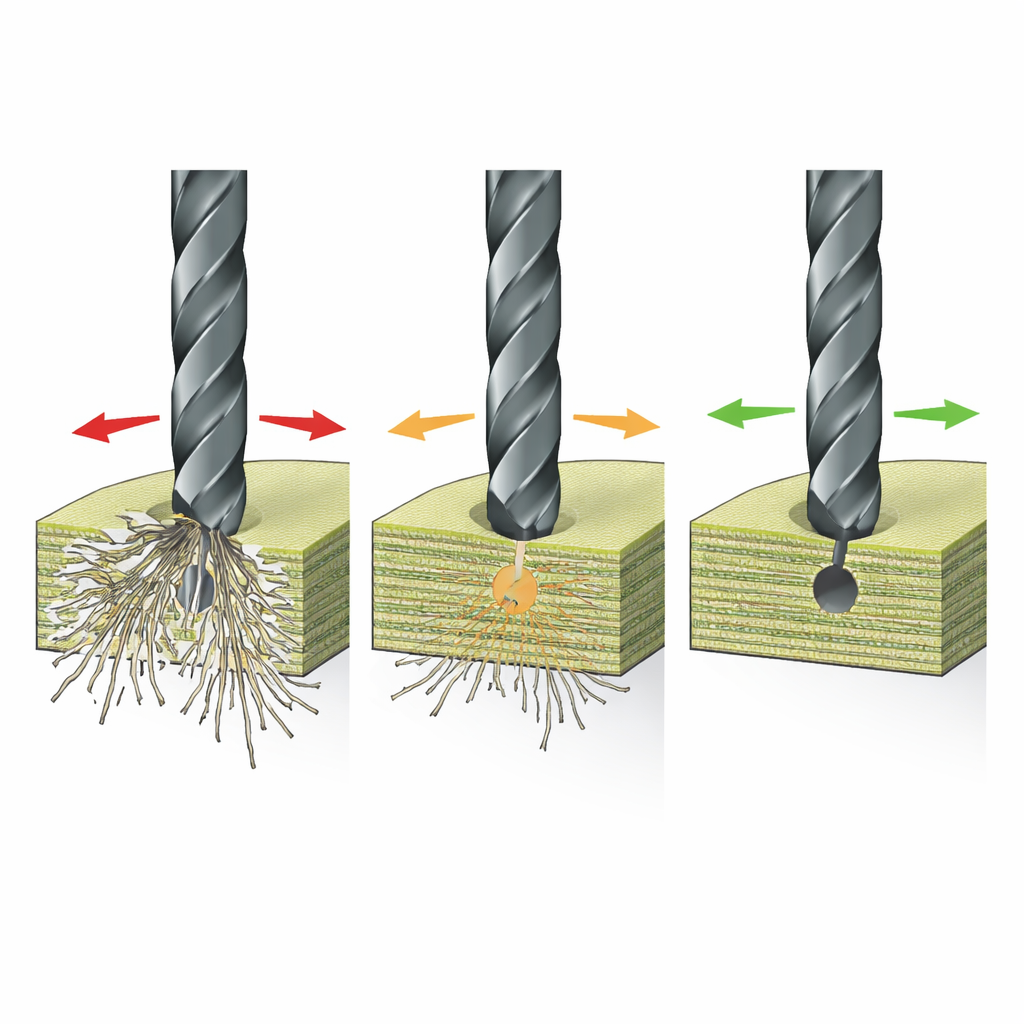
The visual measurements showed a clear pattern. Drilling in steps with several increasingly large bits reduced delamination at both the front and back faces of the plate. However, this strategy tended to increase the amount of uncut fibers at the entrance, where repeatedly pulling the tool out seemed to tug fibers upward and leave them unsupported. At the exit side, the same step‑by‑step approach helped remove fibers more completely and reduced uncut fiber damage. Separately, higher feed rates—pushing the drill in faster—consistently made both delamination and uncut fibers worse, while higher spindle speeds—spinning the drill faster—reduced both kinds of damage. When the team compared these measures with the bending tests, samples with less damage around the holes carried higher loads, with fracture force improving by up to about 18 percent under better drilling conditions.
Practical lessons for safer, lighter parts
In everyday terms, the study shows that how you drill a hole in a fiberglass part strongly affects how strong that part will be. Using several drill sizes in sequence can protect the layered structure from peeling apart, especially at the back face, though it may leave more loose fibers at the front. Pushing the drill too hard (high feed) is harmful, while letting it spin faster tends to be gentler on the material. By combining a step‑by‑step drilling strategy with moderate feed rates and higher rotation speeds, manufacturers can make cleaner holes that preserve more of the composite’s strength—an important gain for aircraft, vehicles, and other structures where every gram and every safety margin counts.
Citation: Izadi, S.M.H., Mozaffari, A. The influence of sequential drilling and machining parameters on uncut fiber formation and delamination damage in fiber-reinforced composites. Sci Rep 16, 10132 (2026). https://doi.org/10.1038/s41598-026-40786-y
Keywords: composite drilling, fiberglass laminates, delamination damage, machining parameters, uncut fibers