Clear Sky Science · en
A synergistic acid–base tandem co-sensitization approach using pyrimidine fluorescent dyes achieves 22% indoor efficiency
Bringing Clean Power Indoors
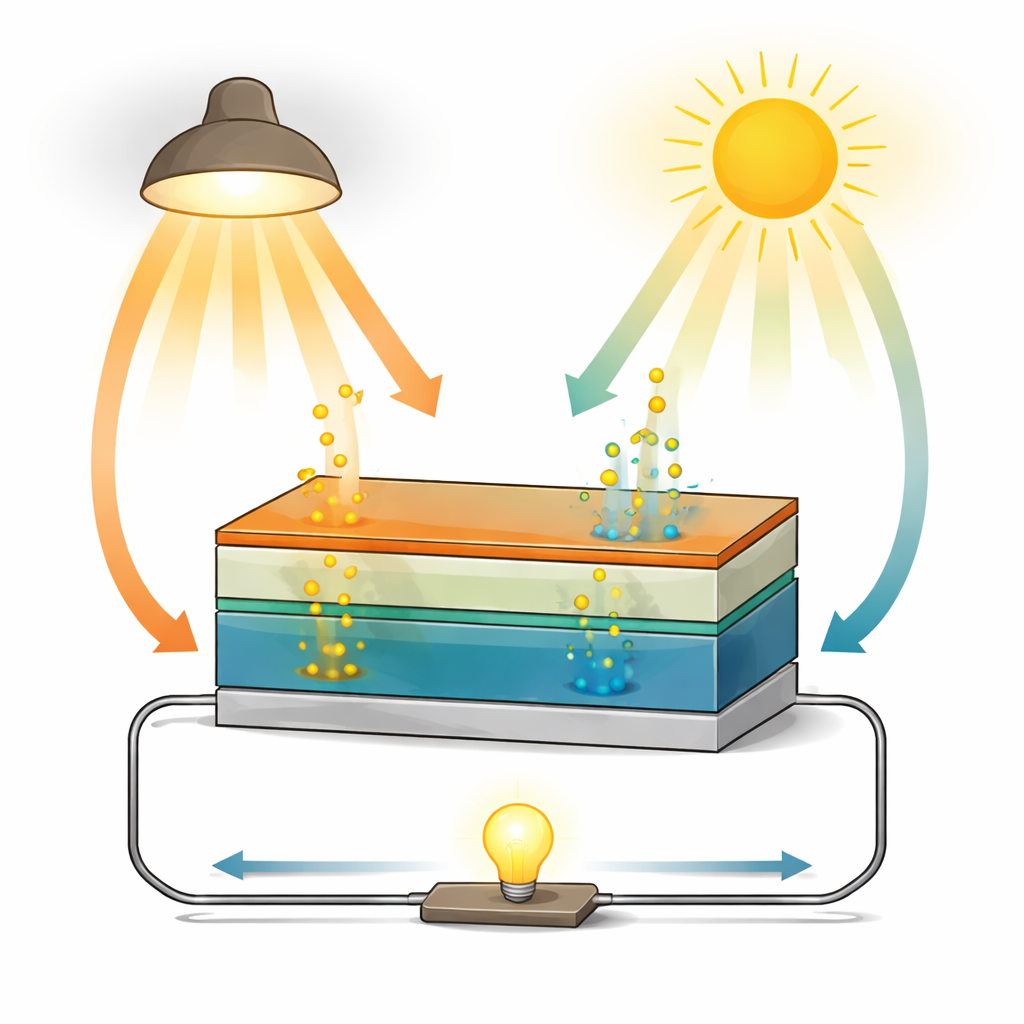
Much of the energy we use every day comes from dim, scattered light: the glow of office lamps, supermarket panels, and home LEDs. Conventional rooftop solar panels struggle in these conditions, wasting a huge opportunity for quiet, ever-present power. This study explores a new type of solar technology—dye-sensitized solar cells—that are specially tailored to sip electricity from indoor light with surprisingly high efficiency, using a clever pairing of colorful, fluorescent molecules.
Colorful Solar Cells in Simple Terms
Dye-sensitized solar cells work a bit like artificial leaves. Instead of a thick block of silicon, they use a thin, white layer of titanium dioxide coated with light-absorbing dyes. When light hits these dyes, they kick electrons into the titanium dioxide, creating an electrical current. A liquid electrolyte and a counter electrode complete the circuit and shuttle charges back, so the process can run again and again. These cells are attractive because they are relatively cheap, easy to make, and can be tuned to different lighting conditions simply by changing the dye molecules.
Why Pair Two Different Dyes?
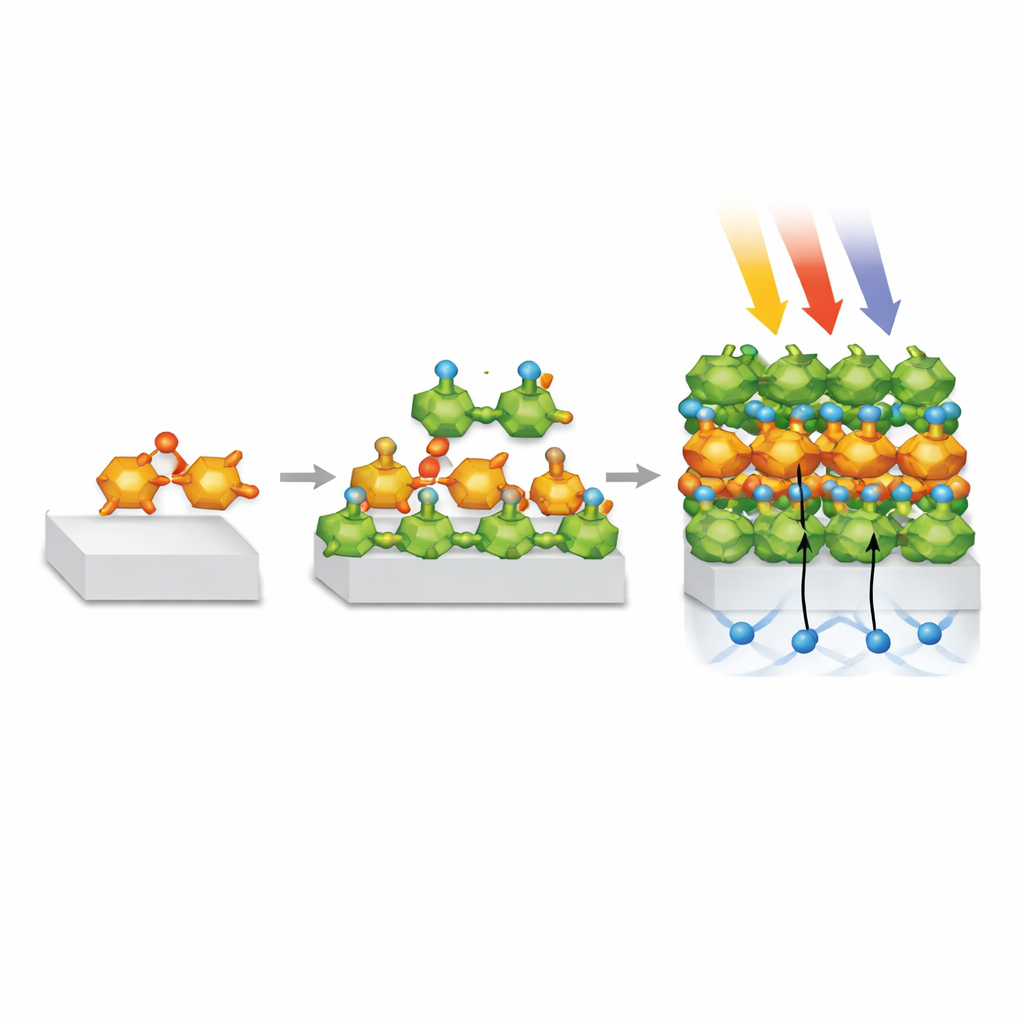
No single dye is perfect. A classic ruthenium-based dye known as N3 is very stable and good at catching red light, but it contains a rare metal and misses some colors. Metal-free organic dyes, on the other hand, can be designed to shine and absorb strongly in specific parts of the spectrum but may clump together or lose efficiency on their own. The authors use a strategy called “co-sensitization,” coating the titanium dioxide with two different dyes that complement each other. In this work, N3 acts as an acidic dye, while a set of newly designed fluorescent pyrimidine dyes (called AS-1 to AS-4) act as basic partners. Because acidic and basic groups like to bind to different spots on the surface, they can form an ordered, cooperative layer instead of fighting for the same sites.
Building a Smart Two-Layer Stack
The team synthesized four pyrimidine-based dyes with different “donor” groups that push electrons toward a common accepting unit. They then carefully examined how these dyes absorb and emit light, how their energy levels align with titanium dioxide, and how they behave when anchored to the surface. Among them, dye AS-1—built around a strong triphenylamine donor—stood out. It absorbed light over a broad range, injected electrons efficiently, and resisted unwanted back transfer of charges. When N3 and AS-1 were used together, the researchers went one step further: instead of simply mixing them, they arranged them in a tandem stack, placing AS-1 directly on the titanium dioxide and N3 as a top layer. This bottom–top architecture allowed both dyes to capture different colors of light while creating a more uniform, well-packed coating.
From Light Capture to Stable Power
By measuring current–voltage curves, light-to-current spectra, and electrical resistance inside the cells, the authors showed that this tandem arrangement does more than just darken the film. It boosts the number of photons absorbed, eases the flow of electrons into and through the titanium dioxide, and reduces the chance that electrons will leak back into the electrolyte. Compared with a cell using N3 alone, the best tandem device (AS-1 at the bottom, N3 on top) increased power output by about two-thirds under standard sunlight, reaching 11.12% efficiency. Under typical indoor lighting at 1000 lux, the same device achieved an impressive 22.02% efficiency, a level especially relevant for powering small electronics and sensors. Long-term tests showed that the cells kept more than 92% of their initial performance after 300 hours of continuous illumination, a sign of robust chemical bonding and resistance to photodegradation.
What This Means for Everyday Life
For a non-specialist, the key message is straightforward: by carefully pairing an acidic metal-based dye with a basic fluorescent organic dye and stacking them in the right order, the researchers created solar cells that are both efficient and durable, especially under low, indoor light. This “acid–base tandem” design lets each dye do what it does best—one grabs blue–green light, the other redder light—while their opposite binding preferences lock them onto the surface in a stable, cooperative film. The result is a promising route toward thin, colorful solar sheets that could one day power indoor sensors, smart-home devices, and portable gadgets using nothing more than the light already around us.
Citation: Badawy, S.A., Shehta, W., Masry, A.A. et al. A synergistic acid–base tandem co-sensitization approach using pyrimidine fluorescent dyes achieves 22% indoor efficiency. Sci Rep 16, 9806 (2026). https://doi.org/10.1038/s41598-026-40785-z
Keywords: dye-sensitized solar cells, indoor photovoltaics, co-sensitization, organic dyes, tandem solar design