Clear Sky Science · en
Light-assisted drying enables vaccine stabilization and supports cold-chain-independent distribution
Why drying vaccines could change global health
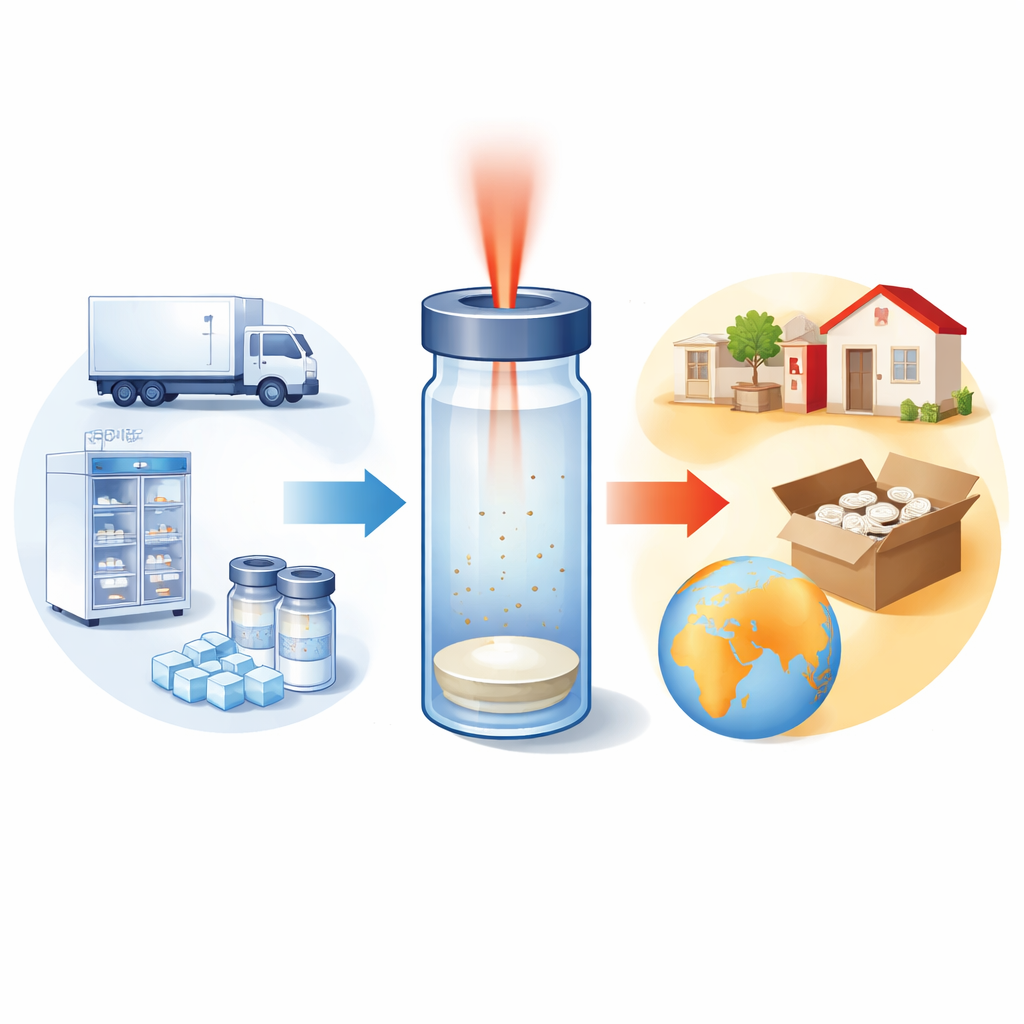
Many of the world’s vaccines are fragile and must be kept cold every step of the way, from factory to clinic. Maintaining this “cold chain” is expensive, technically demanding, and often unreliable in regions with limited electricity or infrastructure. The paper summarized here explores a new way to dry vaccines into a stable, sugar-based glass using light, so they can be stored at room temperature without losing their protective power. If successful, this approach could make it easier and cheaper to get life‑saving vaccines to people everywhere.
A new way to keep vaccines safe
Today, most vaccines are shipped and stored between just above freezing and standard refrigerator temperatures, and some must be kept far colder. Breaks in this cold chain can damage the delicate proteins or virus particles that teach our immune systems to recognize disease. A common workaround is freeze‑drying, which turns liquid vaccines into powders. But freeze‑drying is slow, complex, and, crucially, involves freezing, which itself can harm certain vaccine ingredients. The authors investigate an alternative called light‑assisted drying (LAD). In LAD, a near‑infrared laser gently heats a vaccine that has been mixed with the sugar trehalose, driving off water without ever freezing the sample. As the water evaporates, the trehalose forms a solid, glassy matrix that locks the vaccine in place and helps it resist damage at room temperature.
How the light‑drying process works
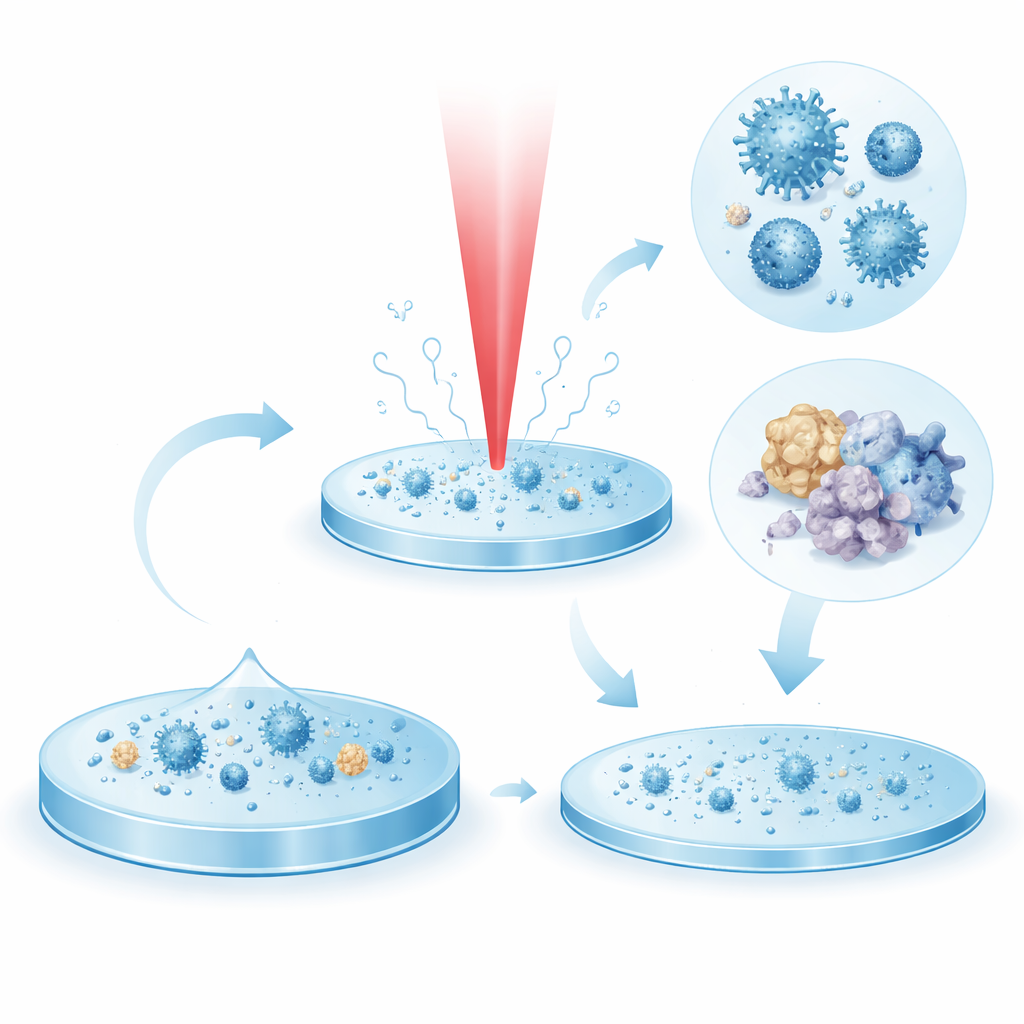
To test this method, the researchers mixed commercial vaccines with a trehalose solution and placed small volumes inside glass vials in very dry air. A 1064‑nanometer laser shone from above, warming the liquid and speeding water loss. By monitoring temperature over time, they saw a repeatable pattern: an initial warm‑up, a cooling phase driven by evaporation, and finally a stable plateau indicating that most water was gone. Larger sample volumes took longer to dry but did not require a proportionally longer time, suggesting that the process is efficient and mainly governed by how much water must be removed, not by the specific vaccine formula. This consistency hints that LAD could be applied broadly across many biologic products with relatively minor adjustments.
Checking the dried vaccine under the microscope
The team studied two very different vaccines. One, called 4CMenB, is a multicomponent shot against meningococcal group B disease that includes protein pieces and tiny outer membrane bubbles from bacteria, all attached to aluminum‑based particles that act as immune boosters. The other is an inactivated polio vaccine (IPV) containing whole, killed polioviruses. After LAD processing, they used polarized light imaging to look for tiny crystals in the sugar matrix, which would signal instability. Unlike air‑dried controls, the LAD‑treated samples showed no bright crystalline regions, indicating a smooth, amorphous glass. Transmission electron microscopy then revealed that the detailed shapes of the aluminum particles, membrane bubbles, and viral shells remained intact after LAD, while harsh heat treatment caused obvious clumping and damage.
Putting function to the test
Structural preservation matters only if the vaccines still work biologically, so the researchers turned to laboratory assays and animal studies. Using ELISA tests—chemical reactions that measure how well antibodies bind to vaccine components—they found that dried 4CMenB retained nearly the same “antigenicity” as the original liquid, meaning key protein targets were still recognizable. For IPV, LAD‑treated samples not only matched but in some cases outperformed untreated vaccine in maintaining the form of the viral surface that antibodies detect. Finally, in a mouse study, animals vaccinated with LAD‑dried 4CMenB produced robust levels of several classes of antibodies, indistinguishable from those in mice receiving the standard liquid vaccine. Control animals that received only buffer showed no such response.
What this could mean for future vaccinations
Overall, the work shows that shining near‑infrared light on vaccines mixed with trehalose can reliably dry them into a glassy solid without freezing, while keeping their structure and immune‑stimulating ability intact—at least in the short term. By removing the need for constant refrigeration, this light‑assisted drying method could ease distribution, reduce waste from spoiled doses, and help close immunization gaps in places where cold storage is scarce. Further studies on long‑term storage and other types of vaccines are needed, but the results point toward a promising path for making vaccines more accessible and resilient worldwide.
Citation: Tsegaye, A.A., Suptela, A.J., Marriott, I. et al. Light-assisted drying enables vaccine stabilization and supports cold-chain-independent distribution. Sci Rep 16, 11104 (2026). https://doi.org/10.1038/s41598-026-40775-1
Keywords: vaccine stability, cold chain, trehalose, light-assisted drying, polio and meningococcal vaccines