Clear Sky Science · en
Effect of moisture content on N₂ injection displacement efficiency of methane in bituminous coal
Why Coal Seam Water Matters for Clean Energy
As the world looks for ways to cut greenhouse gas emissions, methane trapped in coal seams—known as coalbed methane—has become both a hazard and a potential energy resource. One promising method to extract this gas more efficiently is to inject nitrogen into coal seams to push methane out. But coal seams are rarely dry. They often contain significant amounts of water, especially after hydraulic fracturing, a technique widely used to increase permeability. This study asks a deceptively simple but crucial question: how does the amount of water in coal change the success of nitrogen injection in driving out methane?
Setting Up a Clean Comparison
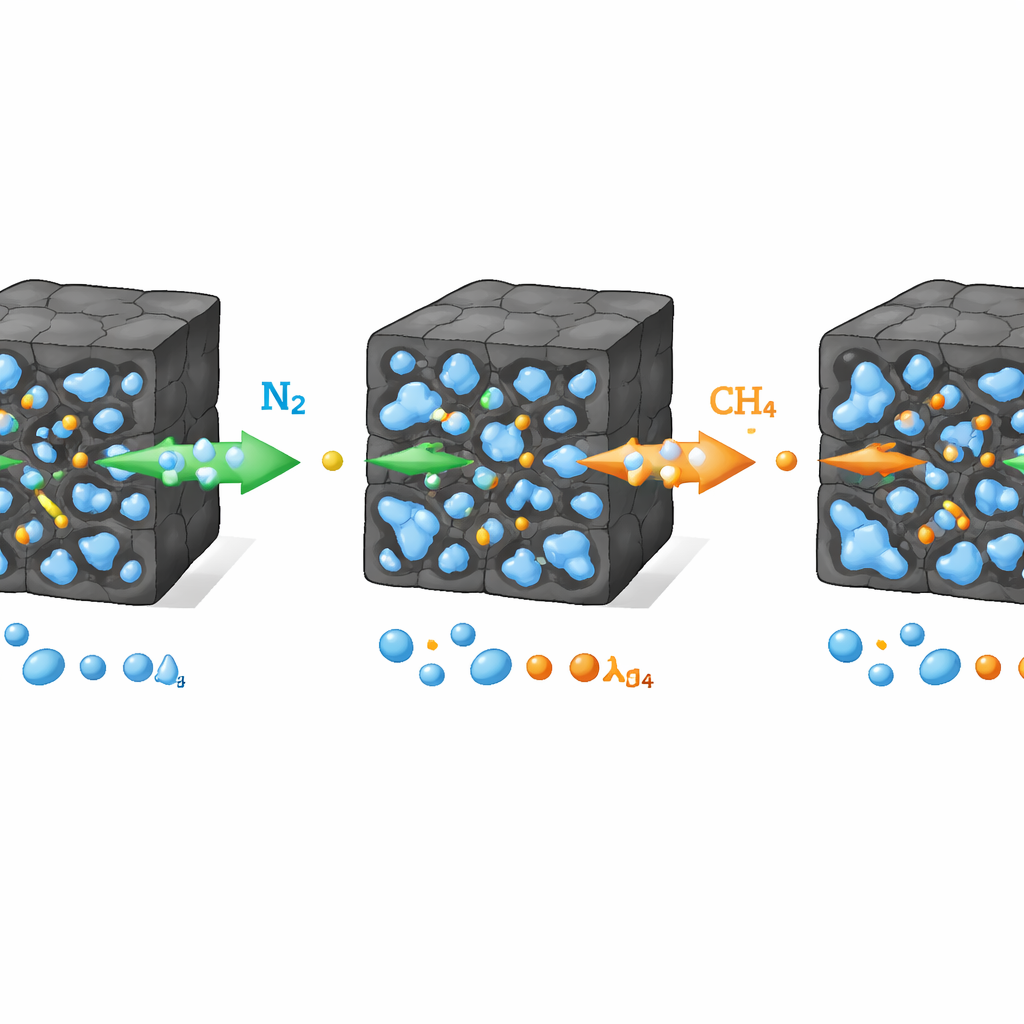
The researchers focused on a common type of coal, bituminous coal, taken from a mine in eastern China. To isolate the role of moisture, they prepared the very same coal samples in three conditions: completely dry, moderately moist, and nearly water-saturated. Each sample was first saturated with methane under conditions similar to those found hundreds of meters underground. Then nitrogen gas was injected at a slightly higher pressure to displace the methane while instruments continuously tracked how much of each gas emerged, how fast it flowed, and how pressures changed inside the sample. This careful design allowed the team to watch the entire displacement process unfold in real time rather than only comparing before-and-after states.
A Surprising V-Shaped Performance Curve
One of the most striking findings is that the efficiency of nitrogen in displacing methane does not simply get worse as the coal becomes wetter. Instead, it follows a V-shaped pattern over time. Compared with the dry coal, samples with moderate moisture showed the slowest displacement: it took longer for nitrogen to break through and for gas compositions to stabilize. Yet in the very wet, nearly saturated samples, the displacement sped up again and, in the middle stage of the process, even outpaced the moderately moist coal. This non‑linear behavior shows that water can both hinder and help, depending on how much is present and which stage of the gas flow process is being observed.
How Water Blocks Paths and Frees Gas
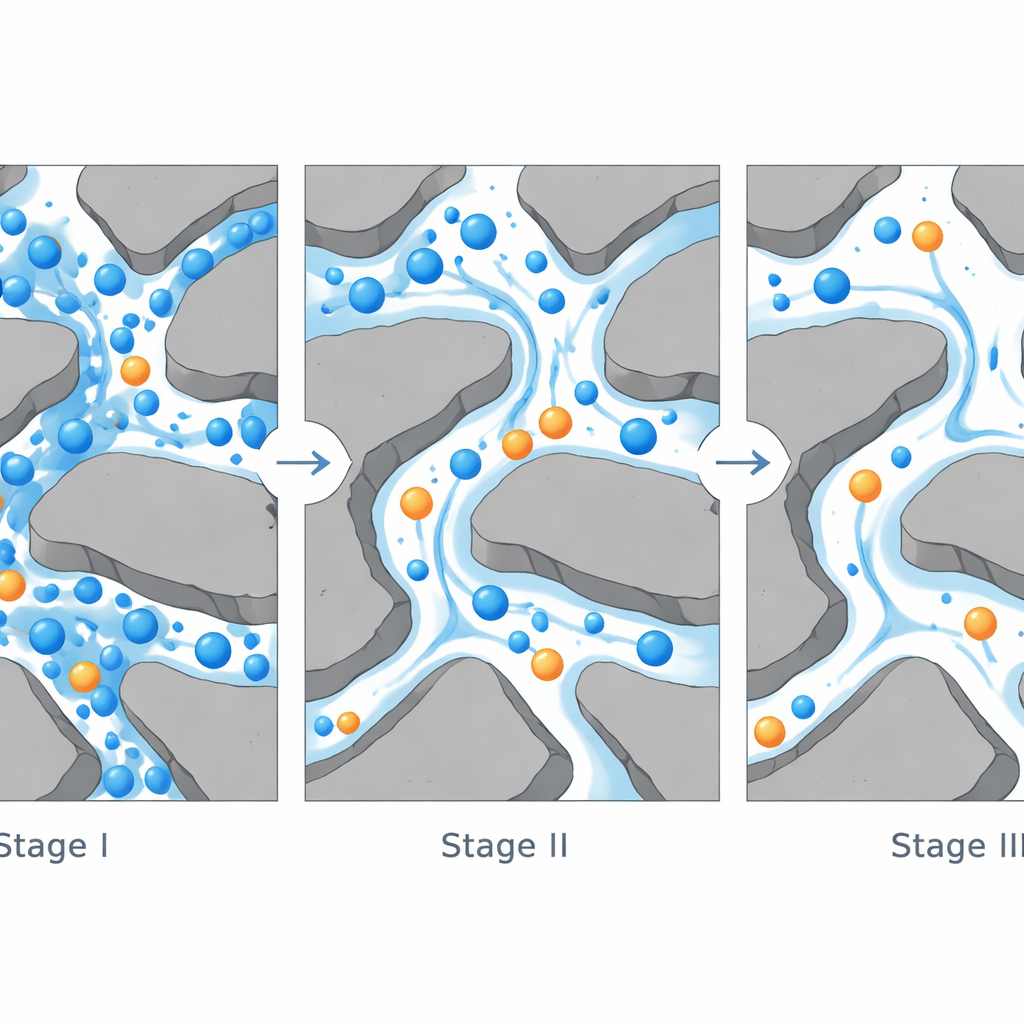
To understand this paradox, the team examined how gas flow rates and adsorption behavior changed with moisture. In the early stage of nitrogen injection, gas leaving the coal is mostly free methane residing in open cracks and pores. Here, water acts mainly as a physical barrier. In moderately moist coal, water forms droplets and partial films that clog many narrow passages, forcing gas to take longer, more tortuous routes. This produces the strongest slowdown in flow. In nearly saturated coal, however, water fills many pores as a continuous phase. Under pressure, nitrogen can more quickly carve a few preferred channels through this water-rich network, so the initial slowdown is less severe than in the moderately moist case.
When Water Starts Helping Instead of Hurting
As the process continues, the role of water shifts from blocking to competing. Methane is held to coal surfaces by weak attractive forces; water molecules, which are polar, bind even more strongly to many of those same sites. With higher moisture, more of these high‑energy sites are already occupied by water, which reduces how much methane the coal can hold in the first place. In the middle stage of displacement, when nitrogen must strip adsorbed methane from the coal surface, this reduced binding actually helps: nitrogen meets methane that is more loosely attached and can dislodge it more easily. This is why the very wet samples, despite their strong initial flow resistance, show faster desorption and displacement later on compared with the moderately moist samples. The authors describe this as a dynamic balance between a “hindering” flow effect and a “promoting” desorption effect that shifts over time.
What This Means for Safer, Cleaner Gas Recovery
From a practical standpoint, the study shows that, overall, dry coal still delivers the best outcome: the highest total methane production, the highest share of stored methane recovered, and the lowest volume of nitrogen needed per unit of methane. Yet the work also overturns the simplistic view that water is always bad. Instead, moisture exerts a dual influence—blocking gas pathways at first but later helping to free methane from the coal surface. The authors propose a three‑stage framework for nitrogen injection in wet coal seams, in which early operations should focus on overcoming flow resistance, while later stages should exploit the weakened methane binding caused by water. Their findings offer a more nuanced scientific basis for designing gas‑injection strategies in real, water‑bearing coal seams, helping to make methane recovery more efficient while improving safety and reducing climate‑warming emissions.
Citation: Miao, K., Guo, L., Wang, H. et al. Effect of moisture content on N₂ injection displacement efficiency of methane in bituminous coal. Sci Rep 16, 11890 (2026). https://doi.org/10.1038/s41598-026-40773-3
Keywords: coalbed methane, nitrogen injection, moisture in coal, gas displacement, hydraulic fracturing