Clear Sky Science · en
Integrated site selection framework for origin-based cold storage using GIS-MCDM and improved Harris Hawks optimization
Keeping Harvests Fresh from the Very Start
Much of the world’s fruits and vegetables spoil before they ever reach a store shelf, especially in the “first kilometer” between the farm and the nearest cold room. This paper tackles a practical question with big consequences for food waste, farmer income, and climate impact: where should cold storage buildings be placed in a farming region, and how big should they be, so that fresh produce can be cooled quickly and cheaply while respecting local land and environmental limits?
Why Early Cooling Matters
Fresh produce is highly sensitive to heat and time. If crops cannot be cooled soon after harvest, they lose quality, rot more quickly, and earn less for farmers. China, now the world’s largest producer and consumer of fresh farm goods, is expanding its “cold chain” network of refrigerated storage and transport. Yet the country has far fewer cold rooms in production areas than near cities, so produce often travels a long distance before it ever reaches proper storage. The study focuses on solving this weak link at the farm end, aiming to guide governments and businesses as they decide where to build new origin-based cold storage facilities.
Choosing the Best Land
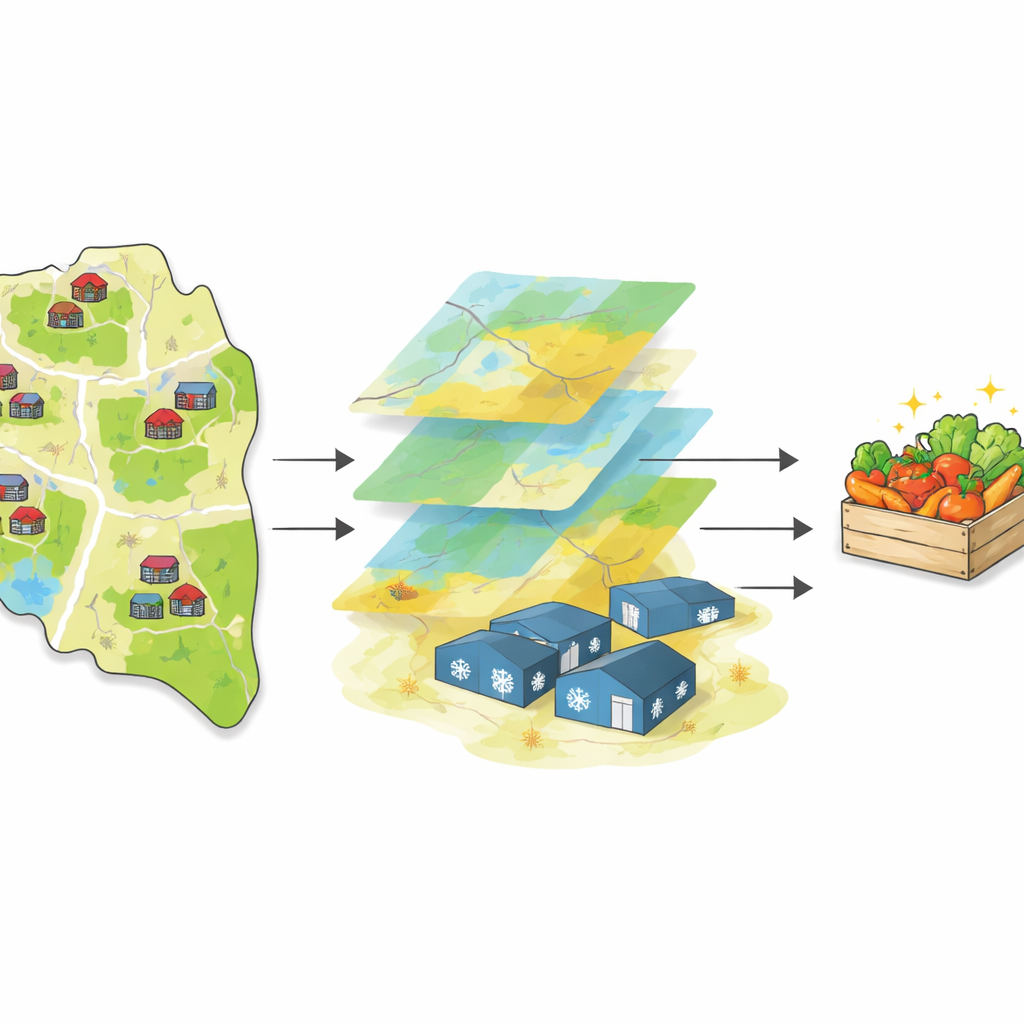
The researchers build a two-step decision system and test it in Helan County, a major agricultural area in Ningxia, China. In the first step, they use digital maps and a structured scoring method to judge how suitable each patch of land is for cold storage. They combine three kinds of information: how good the roads and logistics connections are, how strong local farming activity is, and how friendly the terrain and natural environment are to construction. At the same time, they exclude areas that simply should not be built on, such as nature reserves, water bodies, protected farmland, parks, and dense housing. Each remaining area is graded from “highly suitable” to “unsuitable,” so planners can instantly see where building makes sense and where it does not.
Finding Smart Clusters, Not Random Spots
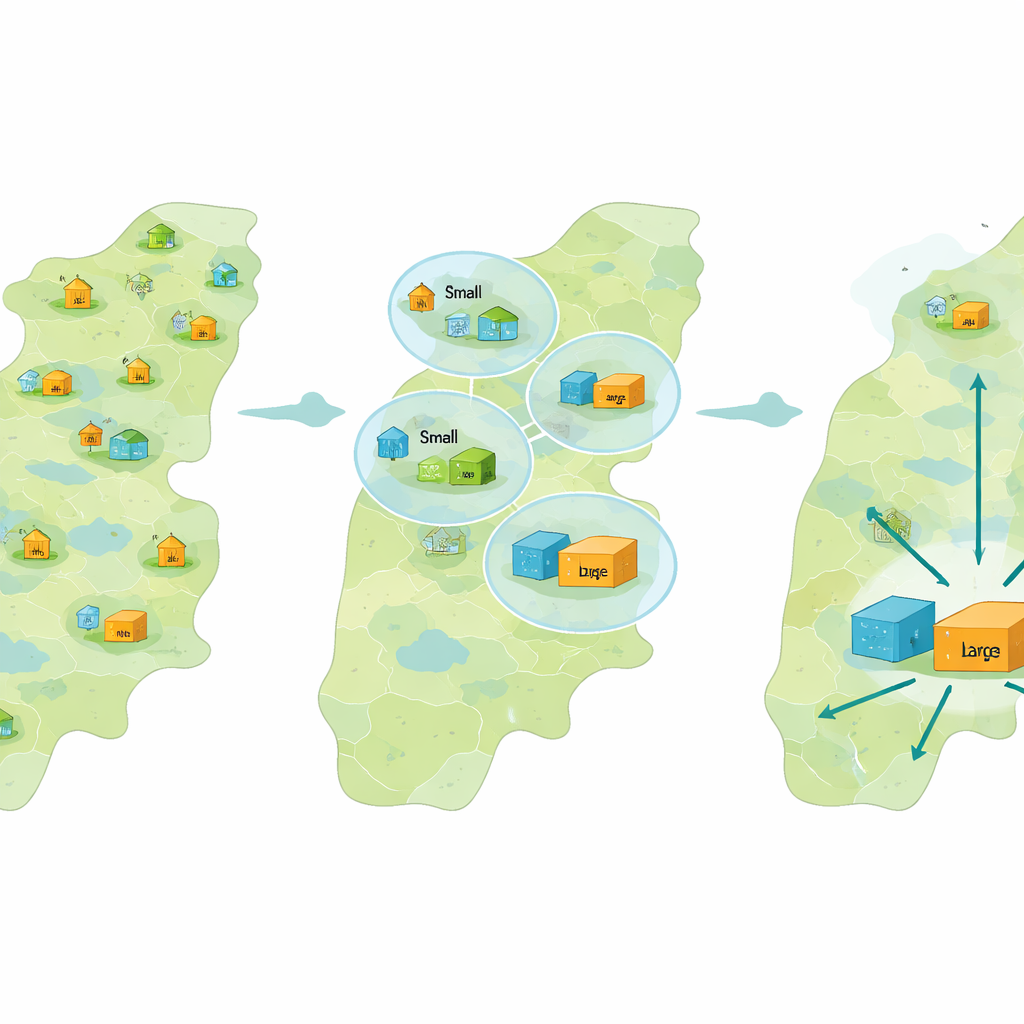
Once the most promising zones are known, the second step looks more closely at how many cold rooms are needed, exactly where they should go, and what size each one should be. The team divides the highly suitable land into many small grid cells and then groups nearby cells into clusters using a method that picks real locations rather than abstract points. Each cluster center is treated as a potential site. A cost model then weighs three major expenses: building and operating the facilities, transporting produce from farms to cold rooms, and the value lost when food spoils during longer or slower trips. Larger cold rooms tend to be more expensive to build but cheaper to run per ton of produce, thanks to economies of scale. To search through all the possible combinations of sites and sizes, the authors use an improved version of a “swarm intelligence” algorithm inspired by the hunting behavior of Harris’s hawks, which is well suited to exploring complex option spaces.
What Happened in the Test County
Applying this framework to Helan County, the authors find that only about 1.25% of the land is truly ideal for origin-based cold storage, and these pockets are concentrated in the south where roads, logistics parks, and agricultural enterprises are densest. From nine promising clusters, their optimization model selects six final sites, all within these high-suitability zones. The recommended network consists mainly of medium-sized facilities plus a single large hub in a logistics park, together providing 33,000 tons of capacity for 34 farm production bases. All facilities are used at over 90% of their capacity, and the total cost is minimized when the system relies on larger, well-used cold rooms rather than many small, scattered ones. When the researchers test different what-if scenarios—such as changing construction costs or increasing demand—they consistently find that higher demand and cheaper big buildings both push the solution toward fewer, larger facilities.
What This Means for Farmers and Planners
In plain terms, the study shows that smart planning can turn scattered farm output and uneven infrastructure into a coherent, efficient cold chain. By first mapping where cold storage can safely and sensibly be built, and then using a cost-conscious search to decide how many facilities to build and how large they should be, the framework helps ensure that harvested crops get cooled quickly and economically. The main takeaway is that well-placed, high-capacity cold rooms in production areas can cut waste, strengthen farmer incomes, and reduce unnecessary trips and energy use—offering a practical blueprint for regions worldwide that aim to build or upgrade their farm-side cold storage networks.
Citation: Li, Y., Li, F., Yang, X. et al. Integrated site selection framework for origin-based cold storage using GIS-MCDM and improved Harris Hawks optimization. Sci Rep 16, 11560 (2026). https://doi.org/10.1038/s41598-026-40766-2
Keywords: cold chain logistics, origin-based cold storage, facility location planning, food loss reduction, agricultural infrastructure