Clear Sky Science · en
A multimodal data framework for motorcyclist injury severity on rural undivided roads
Why this matters for everyday riders
For many people, a motorcycle represents freedom, especially on open country roads. But that sense of freedom can hide a harsh reality: riders on rural two-lane roads face a much higher risk of being badly hurt or killed in a crash than riders in cities. This study digs into thousands of real crashes on Texas’s rural undivided roads to understand exactly when, where, and how motorcyclists are most likely to be seriously injured, and what can be done to keep them safer.
Looking closely at country road dangers
The researchers examined 12,753 motorcycle crashes that occurred between 2017 and 2023 on rural two-way, undivided roads across Texas. These roads often have higher speed limits, little or no separation between opposing traffic, few protective barriers, and longer emergency response times. The team combined traditional crash records—things like speed, road type, lighting, and helmet use—with written police narratives that describe what happened. By blending numbers with real-world stories, they could see patterns that would be invisible in either source alone. 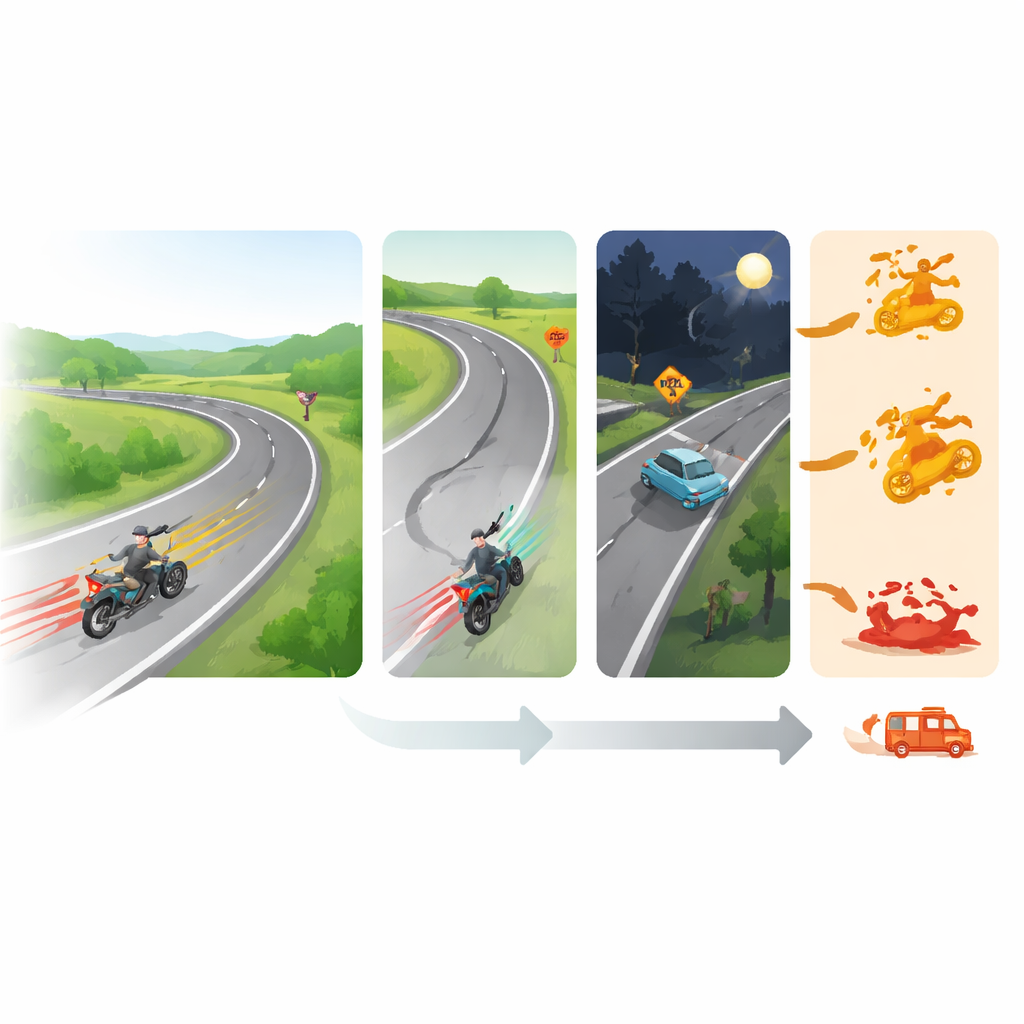
Finding groups of risky situations
Instead of treating all crashes as alike, the study sorted them into five main “situations” with shared features. One large group involved riders losing control at high speed on straight sections and running off the road or overturning. Another group centered on curves, where riders going too fast left the roadway and hit fixed objects such as trees or posts. A third set involved a mix of rear-end, head-on, and turning crashes on straight roads, often tied to problems with judging gaps or controlling the bike. A fourth group focused on intersections and complex layouts, where unsafe speeds, lane restrictions, and turning conflicts combined with imperfect traffic control. The smallest but particularly worrying group involved nighttime, unlit rural segments with animals in the roadway and riders often traveling fast, leaving little time to react.
Peering under the hood of injury risk
To see how these situations translated into injury severity, the team used advanced statistical tools that allow the influence of each factor—such as speed, helmet use, or lighting—to vary from crash to crash. They found that not wearing a helmet strongly increased the chances of being killed or seriously injured, especially in the high-speed and curve-related groups. Speeds above about 65 miles per hour sharply raised the odds of life‑threatening injury in every situation. Moderate speeds around 30–45 miles per hour, in contrast, tended to be linked with less severe harm. Road design also mattered: tight or graded curves, straight but unforgiving segments, missing or poorly placed signs, and narrow shoulders all shaped how bad a crash became once something went wrong. 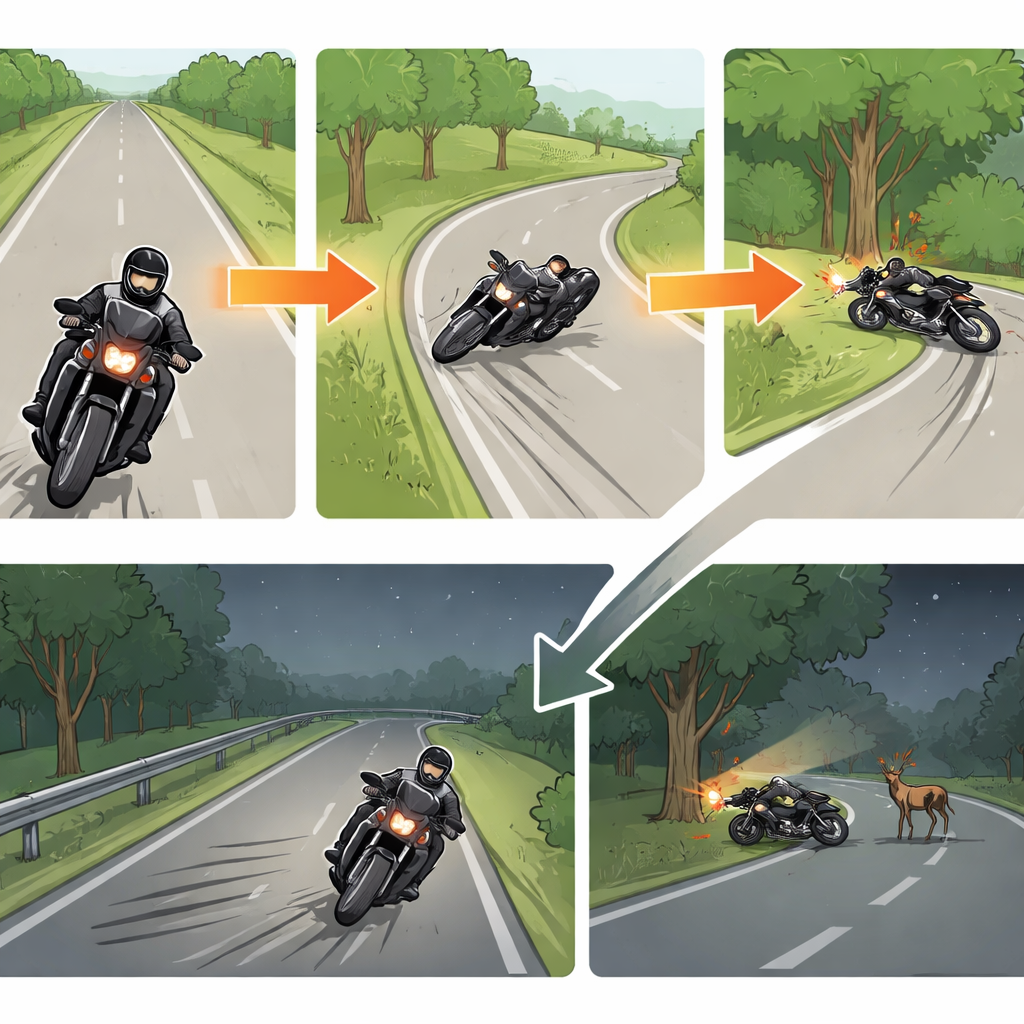
What the crash stories add
The written narratives from officers reinforced these patterns in plain language. When the researchers applied text‑mining techniques, common themes surfaced: speeding into curves and leaving the pavement, single‑vehicle run‑off‑road crashes on narrow or poorly maintained roads, turning and yielding problems at intersections, lane changes and speed mismatches on multi‑lane segments, and rural crashes where a rider lost control and struck fences or other roadside features. Frequent mentions of animal crossings, especially at night, underlined how limited visibility and high speeds turn brief surprises into serious emergencies for motorcyclists.
Turning insight into safer rides
For non‑specialists, the key message is straightforward: on rural two‑lane roads, severe motorcycle injuries are less about freak accidents and more about repeatable, recognizable patterns. High speed, loss of control, unprotected roadside objects, poor lighting, and the absence of a helmet repeatedly show up in the most serious cases. The authors argue for a “Safe System” approach that does not rely only on perfect rider behavior. Instead, they call for better-matched speed limits and enforcement, improved curve and intersection design, more forgiving roadsides and markings, strong promotion and enforcement of helmet use, quicker emergency response, and measures to reduce animal‑vehicle conflicts. Together, these steps could turn some of the most dangerous stretches of rural roadway into far more forgiving places for people who choose to ride.
Citation: Barua, S., Dutta, A.K. & Das, S. A multimodal data framework for motorcyclist injury severity on rural undivided roads. Sci Rep 16, 11511 (2026). https://doi.org/10.1038/s41598-026-40755-5
Keywords: motorcycle safety, rural roads, traffic crashes, injury severity, road design