Clear Sky Science · en
Cerebro Wave Bee transformer to leverage EEG based hand movement classification using optimized bio-inspired learning rates
Reading Brainwaves to Move a Hand
Imagine being able to move a prosthetic hand, control a wheelchair, or operate a computer game simply by thinking about moving your own hand. This study explores how to more accurately read tiny electrical signals from the brain and translate them into distinct hand actions. The researchers present a new computer model that combines a powerful pattern‑recognition system with a strategy inspired by honey bees, all to make brain‑controlled devices more accurate, reliable, and ready for real‑world use.
Why Brain Signals Are Hard to Decode
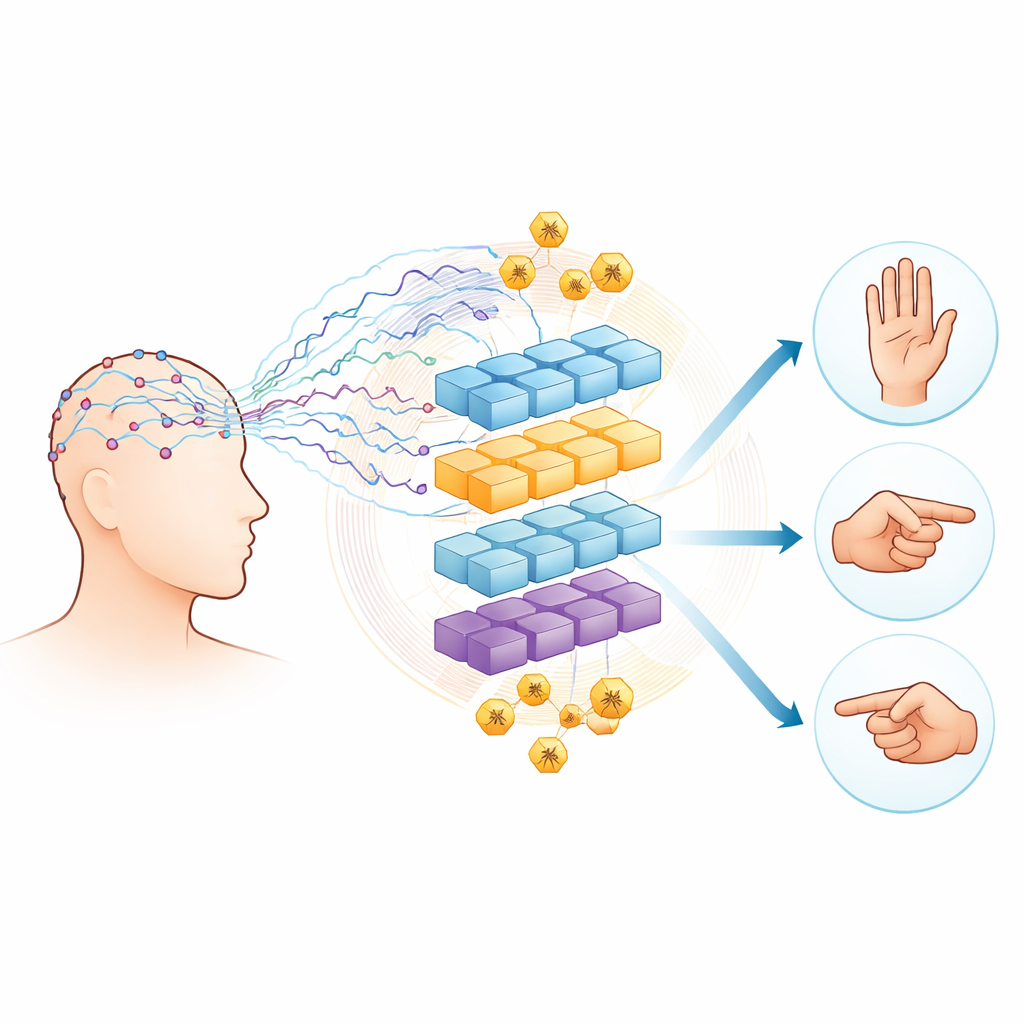
Our brains constantly generate faint electrical signals that can be picked up on the scalp using a technique called EEG, where small sensors record brainwaves in real time. These signals change when we imagine or perform movements, such as lifting or turning a hand. However, EEG data are extremely noisy and vary widely from person to person, making it difficult to distinguish, for example, a left‑hand movement from a right‑hand movement or simple rest. Traditional computer methods either rely on hand‑crafted features or simpler neural networks, which often struggle to capture the full complexity of these brain patterns, especially across different people and recording setups.
A New Model That Learns Like a Careful Reader
The authors introduce a model they call the Cerebro‑Wave Bee Transformer. At its core is a “transformer,” a type of deep‑learning architecture originally developed for language translation that excels at spotting relationships across many inputs at once. In this case, each EEG channel is treated like a “token,” similar to a word in a sentence, and the model learns how different regions of the brain work together when a person moves or imagines moving a hand. Instead of processing the raw time‑based signals, the system first converts each trial into a compact table of brainwave power across four key frequency bands and 14 electrode locations, giving the model a standardized and efficient view of the data.
Letting Bee‑Like Search Find the Sweet Spot
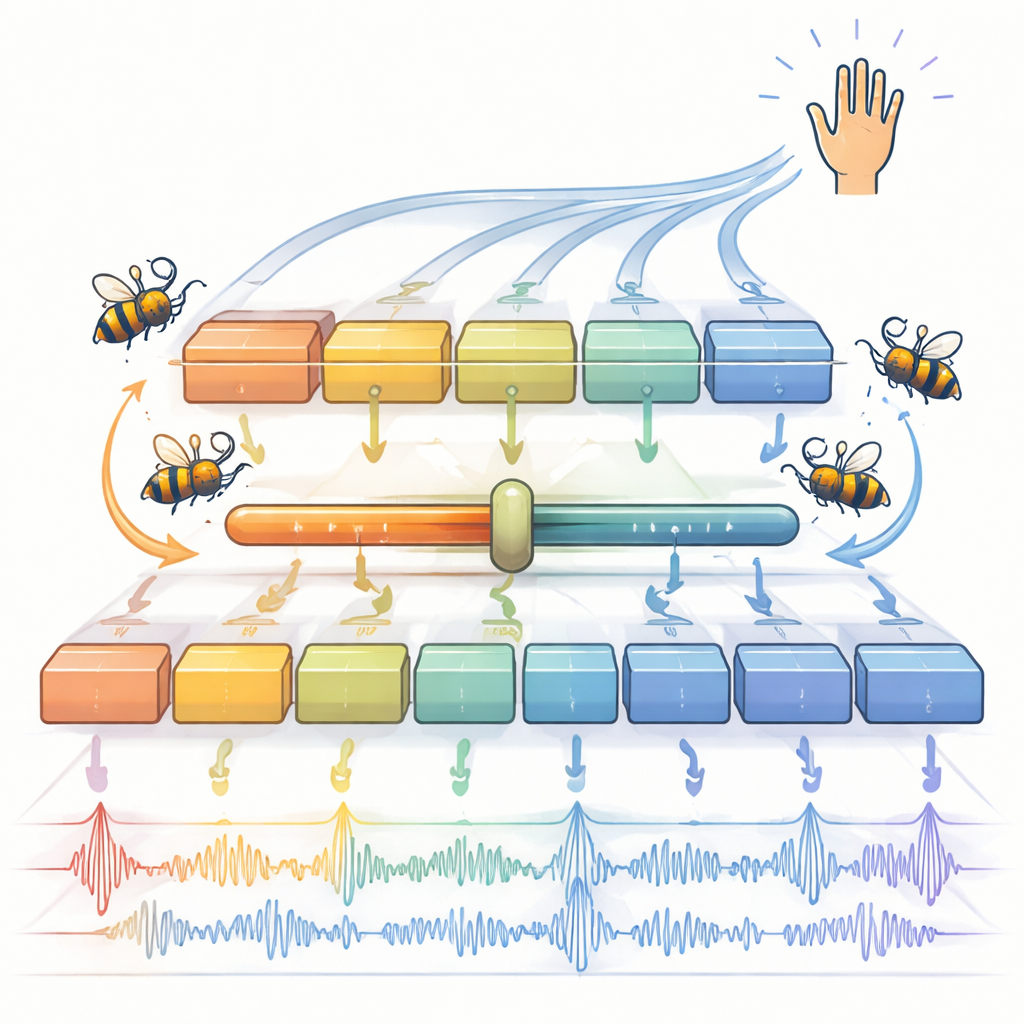
Deep‑learning models are sensitive to a key training setting called the learning rate, which controls how big a step the model takes each time it updates itself. If this step is too large, learning becomes unstable; if too small, training is slow and may never reach a good solution. Rather than guessing this value or sweeping through many options, the researchers borrow a strategy from honey bee foraging. They imagine a swarm of virtual bees, each testing a different learning rate for a short training run. The more promising rates are explored more thoroughly, while a “temperature” parameter gradually cools, shifting the search from broad exploration to fine‑tuned adjustments. In the end, the system homes in on a learning rate that gives the most reliable performance before full training begins.
Putting the System to the Test
To see how well their approach works, the team trained and evaluated the Cerebro‑Wave Bee Transformer on two independent EEG datasets. One came from a consumer‑grade headset capturing three classes: left‑hand movement, right‑hand movement, and rest. The other was a widely used research dataset with different hardware, sampling rates, and electrode layouts. In both cases, the EEG signals were converted into the same 14‑by‑4 format so the same model architecture could be applied fairly. Using ten‑fold cross‑validation to guard against chance results, the new method reached an accuracy of about 95.6% on the main dataset and only slightly lower on the second, outperforming traditional machine‑learning models, simpler neural networks, and transformer versions that used standard learning‑rate schedules instead of the bee‑inspired search.
What This Means for Future Brain‑Computer Tools
The study shows that carefully tuning how a powerful model learns can pay off as much as changing the model itself. By pairing a transformer with a honey‑bee‑style optimization process, the researchers created a system that classifies hand‑related brain activity with high accuracy and good robustness across different datasets, all without slowing down real‑time use once training is complete. While the current work relies on pre‑processed snapshots of brainwave power rather than raw continuous signals, it provides a strong proof‑of‑concept: nature‑inspired search strategies can help unlock the full potential of advanced neural networks in brain‑computer interfaces, bringing thought‑controlled prosthetics and assistive technologies closer to everyday practicality.
Citation: Jayadurga, N.P., Chandralekha, M. & Subramaniam, H. Cerebro Wave Bee transformer to leverage EEG based hand movement classification using optimized bio-inspired learning rates. Sci Rep 16, 14640 (2026). https://doi.org/10.1038/s41598-026-40739-5
Keywords: brain-computer interface, EEG hand movement, transformer neural network, bio-inspired optimization, honey bee algorithm