Clear Sky Science · en
Sustainable lightweight polymer concrete composite through partial replacement of aggregates with ABS plastic waste and aerogel
Turning Trash into Stronger, Lighter Buildings
Concrete is everywhere—in our homes, bridges, and roads—but it comes with hidden costs: it is heavy, and it consumes vast amounts of sand and stone while plastic waste piles up in landfills. This study explores whether a common plastic from old electronics, along with an ultra-light material called aerogel, can be blended into ordinary concrete to make it lighter, more durable, and more environmentally friendly, all without sacrificing strength. 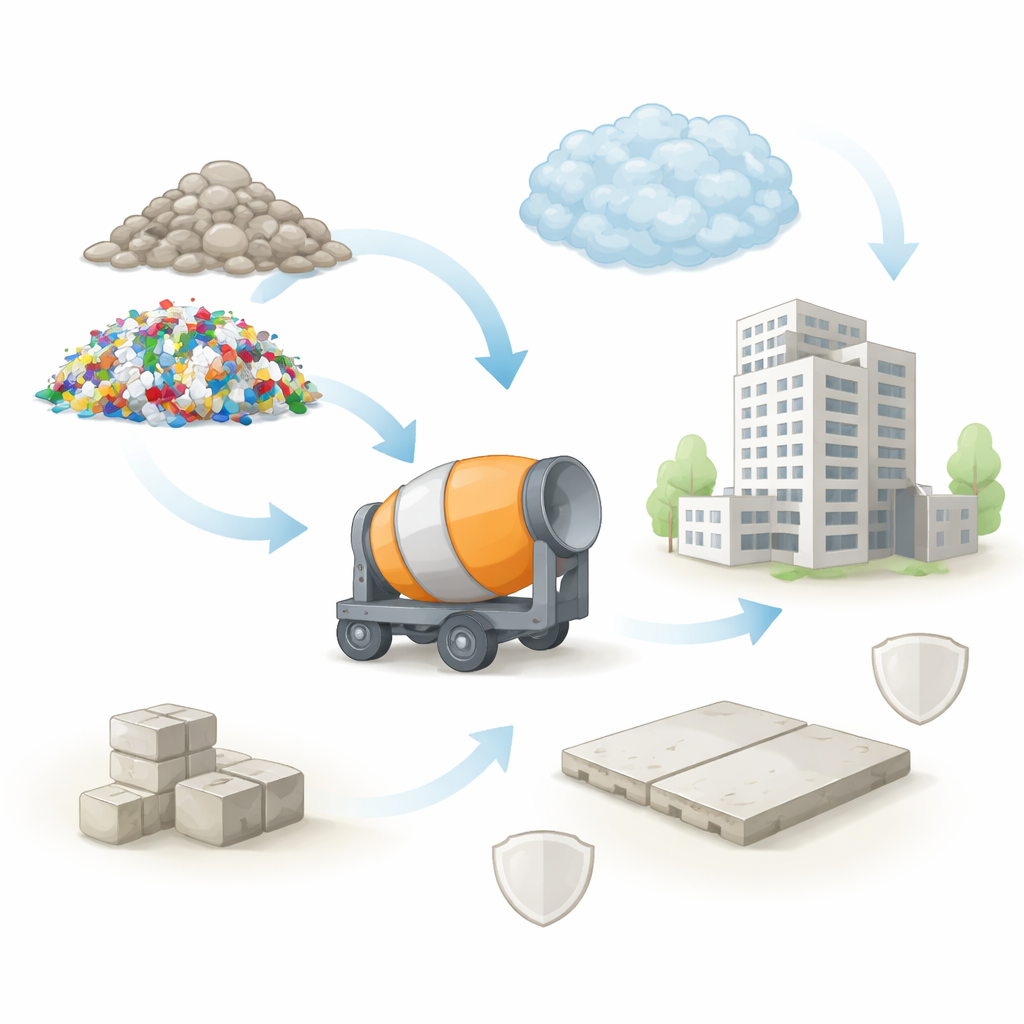
Why Mix Plastic and Airy Powders into Concrete?
Traditional concrete relies on crushed stone and sand as its backbone. The researchers asked a simple question: what if part of those rocks and sand grains were swapped for waste plastic and feather-light aerogel? They focused on ABS plastic, widely found in discarded electronics and car parts, and silica aerogel, a sponge-like material made mostly of air. By doing so, they aimed to reduce the use of natural aggregates and turn difficult-to-recycle plastic into a useful ingredient, while at the same time trimming the weight of the concrete and improving how it resists water and salts that can damage steel reinforcement inside structures.
Designing a Family of Green Concrete Mixes
To test this idea, the team created ten different batches of everyday structural concrete, all with the same amount of cement and water so that only the aggregates changed. In some mixes, up to 15% of the coarse stone was replaced by ABS plastic pieces; in others, up to 15% of the fine sand was swapped for aerogel grains, and several mixes used both together in different proportions. They checked how easy each mix was to place using slump tests over an hour and a half, then cast cubes, beams, and cylinders to measure how well the hardened concrete could resist squeezing, bending, and splitting. Finally, they measured how much water the concrete absorbed and how easily aggressive chloride ions could pass through, a key sign of long-term durability near de-icing salts or coastal environments.
The Sweet Spot: Stronger, Easier to Pour, and More Durable
One combination clearly stood out: a mix with 10% of the coarse stone replaced by ABS plastic and 5% of the sand replaced by aerogel. This blend not only kept the fresh concrete highly workable over 90 minutes, it actually became slightly stronger than normal concrete in compression, bending, and splitting tests over 7 to 90 days. The plastic pieces helped by not soaking up water and by improving how cracks spread, while the aerogel acted like a tiny filler that smoothed out the internal structure and reduced unwanted voids. As a result, this mix absorbed less water and allowed fewer chloride ions to pass through, edging it toward the “low” permeability category used in building standards. It also weighed about 4–5% less than conventional concrete, trimming the dead load on foundations and supporting elements. 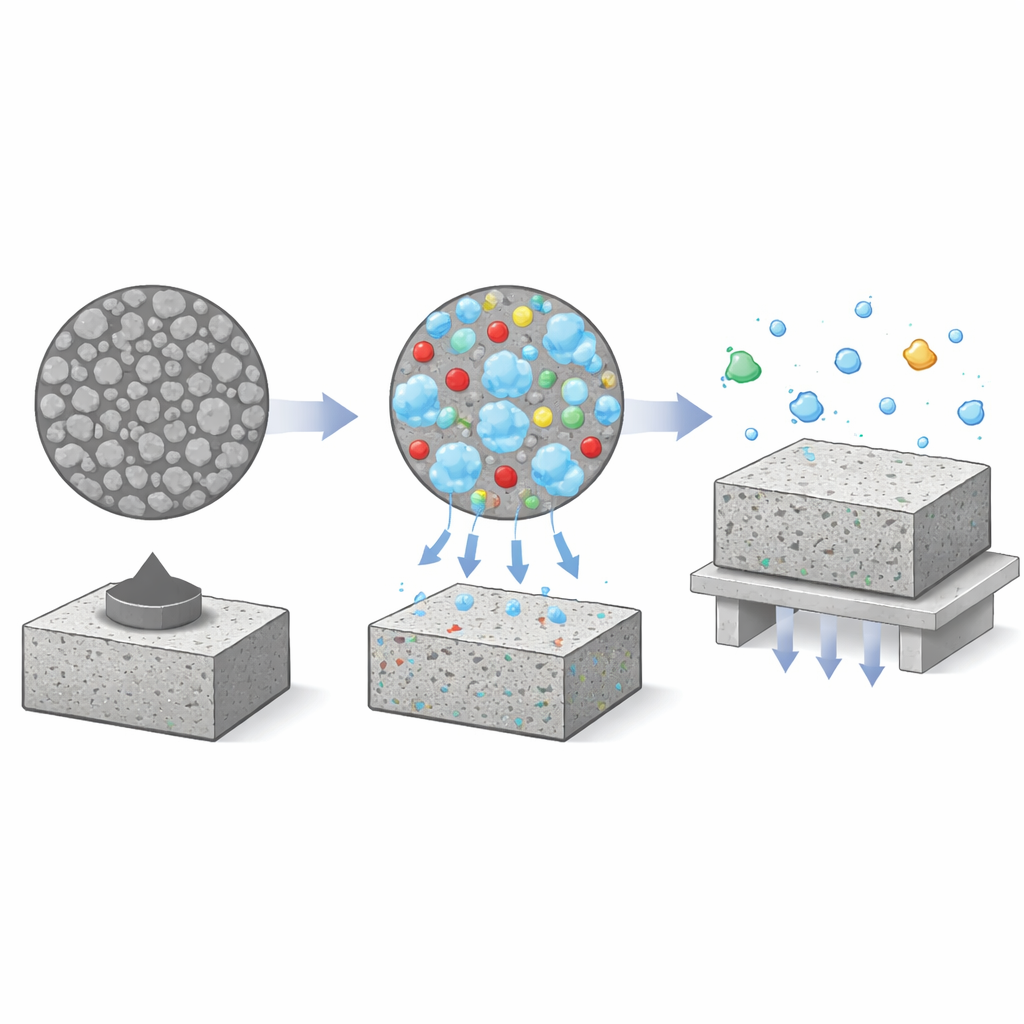
When Greener Goes Too Far
The study also showed the limits of this approach. When the amounts of aerogel or ABS were pushed higher—beyond about 10% aerogel or 15% plastic—the concrete became noticeably weaker and more porous. The ultra-light nature of aerogel and the smoother plastic surfaces created too many tiny gaps inside, which allowed more water to enter and more chloride ions to move through. These high-replacement mixes dropped into lower strength ranges and shifted toward “high” permeability, meaning they would be less suitable for protecting steel reinforcement in real structures despite being lighter.
What This Means for Future Buildings
For a layperson, the takeaway is straightforward: by carefully tuning how much waste plastic and aerogel are added, concrete can be made both greener and better-performing. The standout mix in this study is strong enough for standard structural uses, weighs less, absorbs less water, and slows down the harmful salts that lead to rusting steel—all while reusing plastic that might otherwise be burned or buried. The authors suggest that this recipe is ready to be tried on real construction sites and could be refined further for higher-strength or specialized applications, offering a promising path toward lighter, more sustainable buildings and infrastructure.
Citation: Devi, K., Singh, G. & Jindal, B.B. Sustainable lightweight polymer concrete composite through partial replacement of aggregates with ABS plastic waste and aerogel. Sci Rep 16, 11212 (2026). https://doi.org/10.1038/s41598-026-40737-7
Keywords: lightweight concrete, plastic waste reuse, silica aerogel, sustainable construction, durable materials