Clear Sky Science · en
A hybrid bio-inspired model for predicting urban air pollution using deep learning
Why cleaner city air matters to you
City air is a mix of invisible gases and tiny particles that can quietly damage lungs, heart, and brain over time. Yet many city dwellers only hear about bad air when a smog alert flashes on the news. This study introduces a smarter way to forecast air pollution in major cities around the world, aiming to give authorities and residents earlier, more reliable warnings so they can plan commutes, outdoor exercise, and public health responses with greater confidence.
The problem with guessing tomorrow’s air
Predicting city air quality is harder than it looks. Pollution comes from traffic, industry, weather patterns, and even the layout of streets and green spaces. Levels of harmful pollutants like fine dust, ozone, and nitrogen dioxide can change from one neighborhood to the next and from hour to hour. Existing computer models often struggle with noisy sensor readings, missing data, and the tangled relationships between different pollutants and weather conditions. Many perform well in one city but fail when moved to another with different traffic or climate.
A new tool that learns the rules of the air
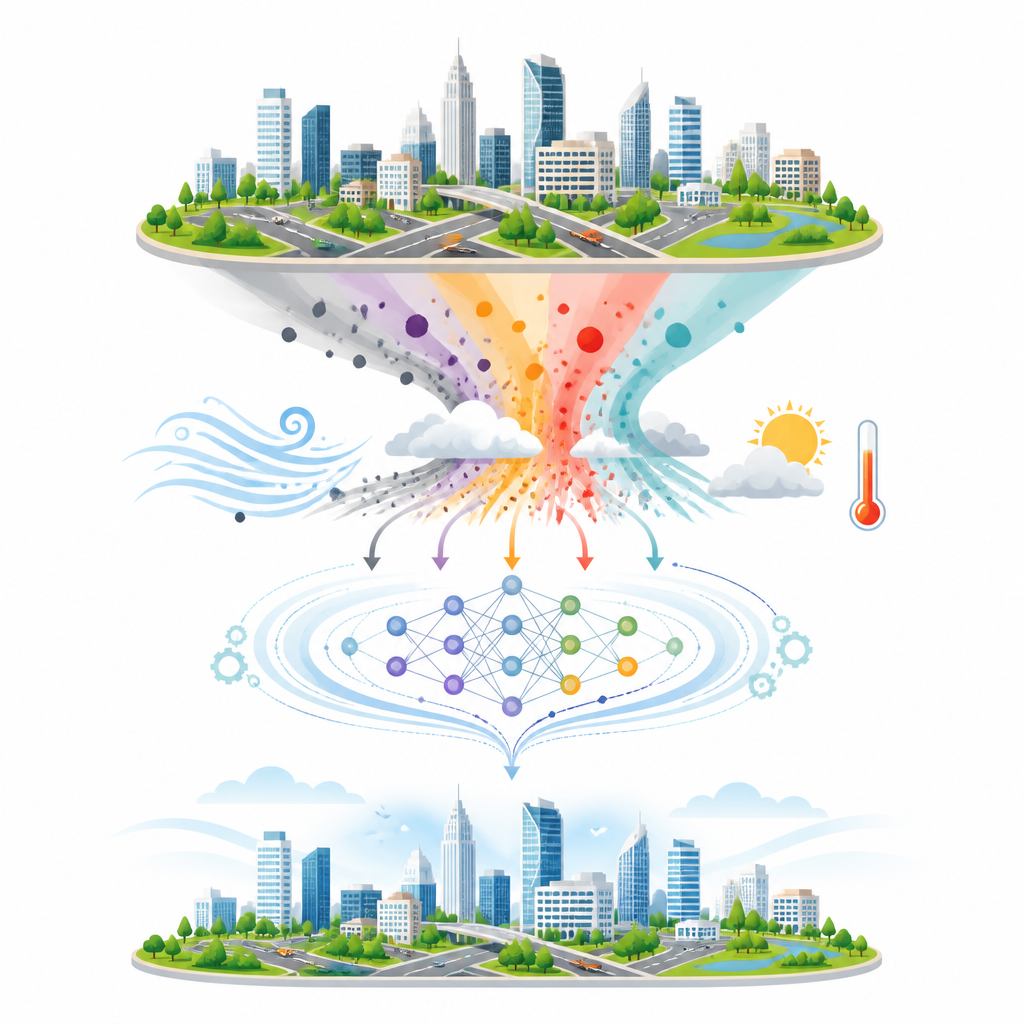
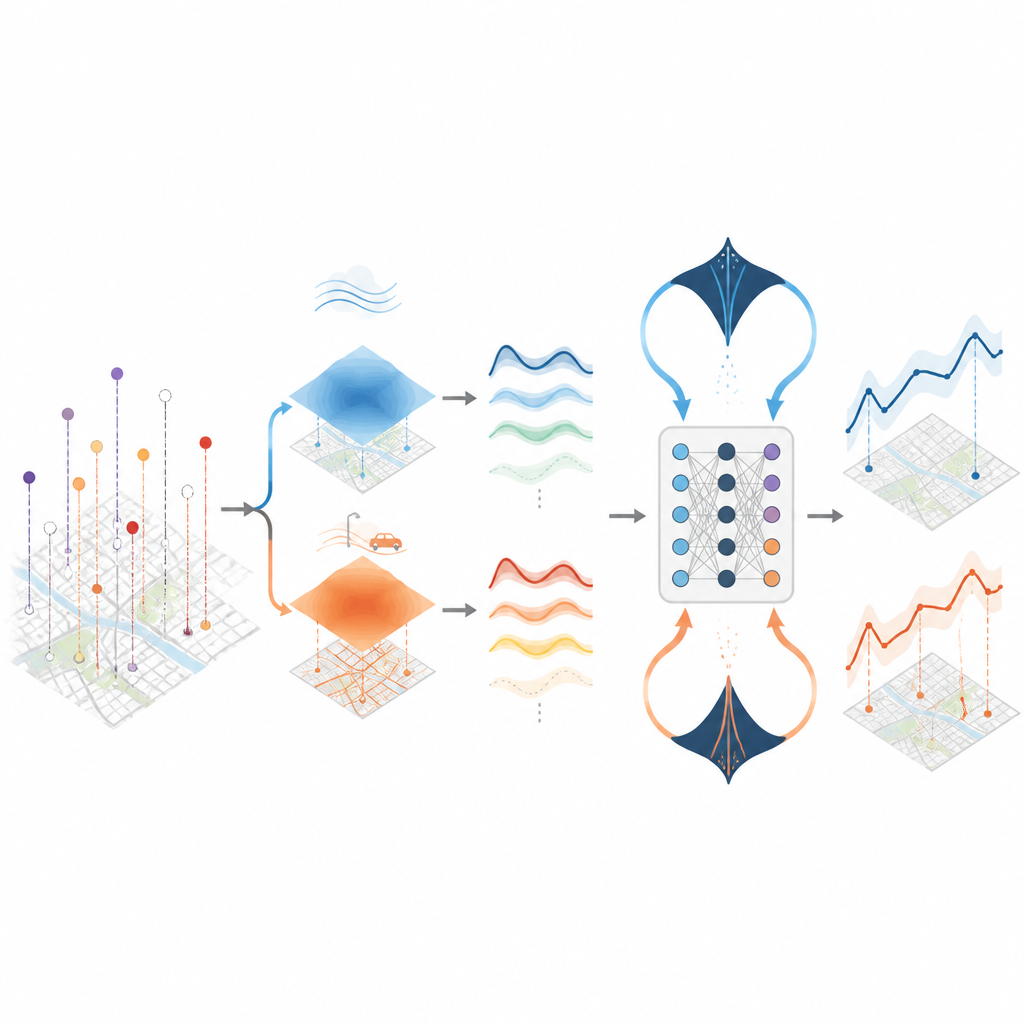
The authors present a hybrid model with a long name but a simple idea: combine data-driven learning with knowledge of how air actually behaves. First, they use a global dataset of daily air quality and weather from major cities between 2015 and 2025. A specialized cleaning step smooths the data while preserving sharp changes near busy roads or pollution sources. Next, a feature extraction stage breaks each pollution signal into pieces that represent overall levels, interactions between pollutants, and sudden spikes. These processed signals feed into a neural network that is “physics informed,” meaning it is gently steered by basic principles of how pollutants disperse and react in the atmosphere.
Letting nature inspire optimization
Even a well-designed neural network needs its internal settings tuned to perform well. Instead of relying on standard methods, the researchers borrow ideas from the way manta rays forage for food in the ocean. Their optimization algorithm imitates group searching and looping motions to explore many possible parameter combinations efficiently, then zooms in on the most promising ones. This bio-inspired search helps the model find a balance between following the data closely and respecting physical limits, such as avoiding negative pollution values or impossible jumps in concentration.
How well does it work in real cities
To test their approach, the team compared their model against several popular deep learning and machine learning systems for air quality prediction. They trained on data from a set of cities and then checked performance on different, unseen cities with varied climates and street patterns. The hybrid model reached about 99 percent accuracy and lower error measures than competing methods for key pollutants like fine particles, carbon monoxide, nitrogen dioxide, ozone, and sulfur dioxide. It also handled extreme events better. In a wildfire-like test case, a standard model produced unrealistic negative pollution values and wildly exaggerated peaks, while the physics-informed system kept its predictions within reasonable ranges and much closer to reality.
What this means for daily life and planning
In plain terms, the study shows that a model that both learns from data and respects the basic rules of physics can predict city air more reliably than models that only look for patterns. Because it generalizes well across many cities and remains stable even when data are sparse or noisy, it could support real-time air quality alerts, smarter urban planning, and health risk mapping. While the framework still simplifies some local details, such as fine-scale street canyons and microclimates, it marks a step toward air forecasts that residents and policymakers can trust when deciding where to build, how to manage traffic, and when to limit outdoor exposure.
Citation: Chaudhary, D., Vats, P., Vats, S. et al. A hybrid bio-inspired model for predicting urban air pollution using deep learning. Sci Rep 16, 15697 (2026). https://doi.org/10.1038/s41598-026-40726-w
Keywords: urban air pollution, air quality prediction, deep learning, physics-informed models, environmental monitoring