Clear Sky Science · en
Canine gait analysis using inertial sensors and deep learning for orthopedic and neurological disorders
Why your dog’s walk matters
Many dog owners notice when their pet starts to limp or move oddly, but even skilled veterinarians can struggle to tell whether a problem comes from sore joints or from the nervous system. This study explores a new way to read a dog’s walk using tiny motion sensors and modern artificial intelligence, with the goal of making earlier, more accurate diagnoses that improve treatment and quality of life.
Small sensors, big picture
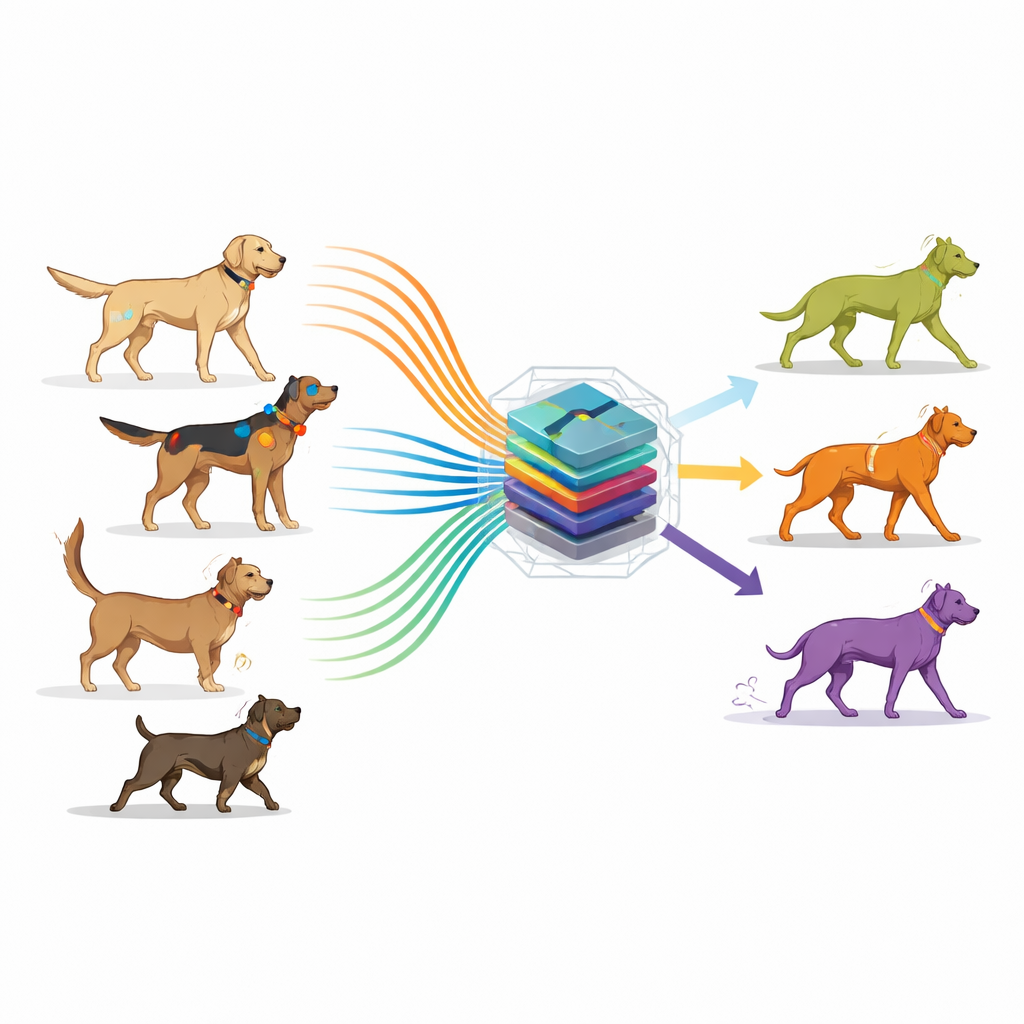
The researchers fitted dogs with coin-sized motion sensors, similar to those found in smartphones and fitness trackers. These devices contain accelerometers and gyroscopes that capture how the dog’s body moves in three dimensions as it walks or trots. Unlike bulky lab equipment such as force plates or camera systems, these sensors are inexpensive, portable, and comfortable enough for dogs to move naturally. That makes them promising tools for everyday use in veterinary clinics or even for at-home monitoring.
How the study was set up
The team worked with 29 dogs: 17 healthy animals, six with orthopedic problems such as painful limbs, and six with neurological conditions that affect coordination. Each dog walked back and forth along a short indoor runway, sometimes at a relaxed walk and sometimes at a faster trot, while wearing up to three sensors on the head, neck (via a collar), and tail region. This setup captured about three hours of detailed movement data. The scientists then broke the recordings into short snippets so that patterns in each brief segment of movement could be examined.
Teaching a computer to read a dog’s walk
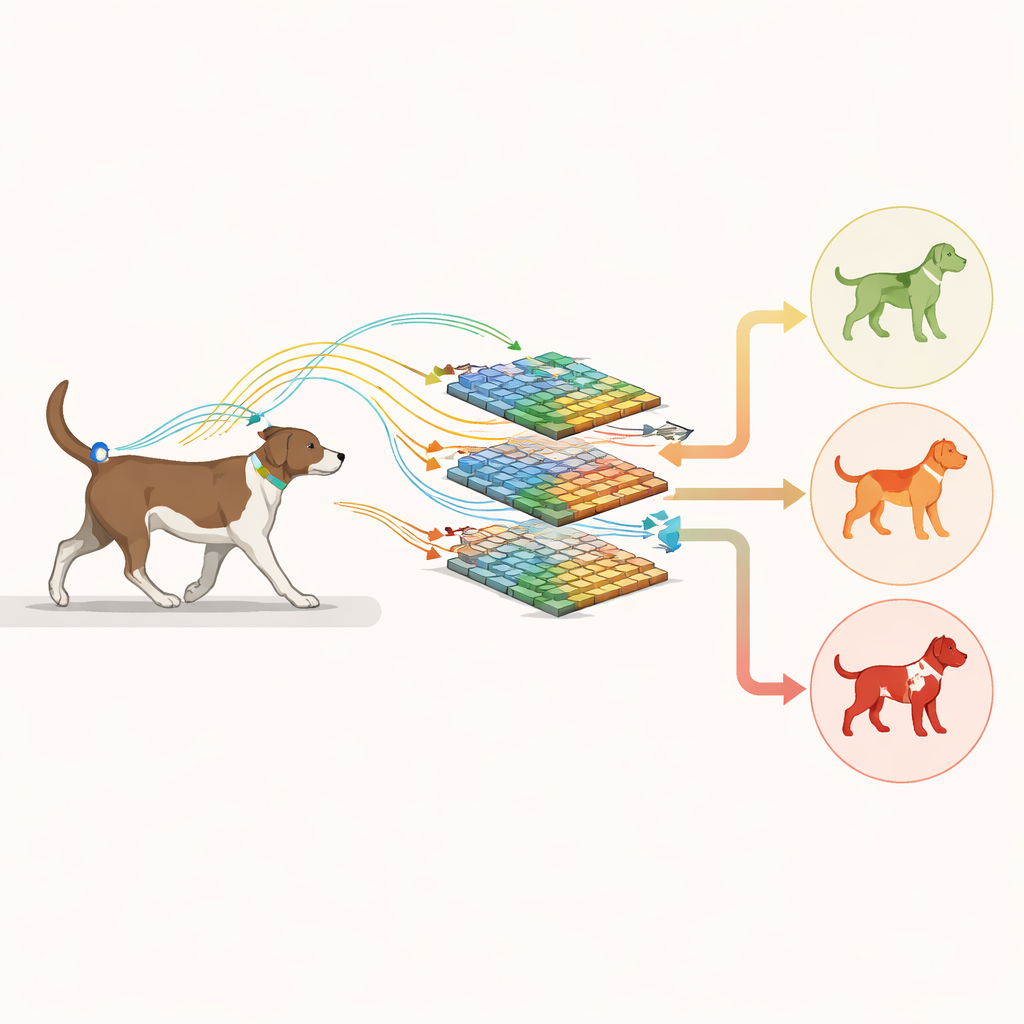
Instead of manually designing measurements—such as step length or how high the back moves—the researchers used a deep learning method that lets a computer discover patterns directly from the raw sensor signals. Their model, known as a convolutional neural network, takes in six streams of data (three directions of acceleration and three of rotation) and passes them through several layers that automatically extract informative features. In the end, the system assigns each snippet of movement to one of three categories: healthy, orthopedic, or neurological. The same network can also be used in simpler tasks, such as deciding only whether a dog is healthy or not.
Finding the best sensor setup
A key goal was practicality: how few sensors and which gait type are needed to get reliable answers. By comparing many combinations, the study found that a single sensor on the neck often performed as well as using several sensors, especially during trotting. When the computer was tested on snippets drawn from the same group of dogs it had already seen, it correctly labeled healthy, orthopedic, and neurological gait patterns about 96 percent of the time. When challenged with completely new dogs, accuracy dropped—as expected—but remained promising: about 85 percent for separating healthy from non-healthy animals and 80 percent for telling all three groups apart when using carefully chosen setups.
What this means for dogs and their vets
From a layperson’s perspective, this work shows that simply recording how a dog moves with a small collar sensor can give a computer enough information to tell whether the dog is likely healthy, has a joint or bone problem, or has a nerve-related issue. The system is not meant to replace a veterinarian, but it could serve as an objective aid that flags subtle problems earlier, supports second opinions, and reduces the need for costly or invasive tests. With larger and more varied datasets, the same approach could evolve into a routine screening tool—helping vets and owners catch gait problems sooner and tailor treatment to each dog’s specific underlying condition.
Citation: Palez, N., Straß, L., Meller, S. et al. Canine gait analysis using inertial sensors and deep learning for orthopedic and neurological disorders. Sci Rep 16, 13966 (2026). https://doi.org/10.1038/s41598-026-40717-x
Keywords: canine gait, wearable sensors, deep learning, dog lameness, veterinary diagnostics