Clear Sky Science · en
Structural, physical, and elastic properties of α-Fe2O3 nanoparticles doped on borate glasses
Why Tuning Glass with Tiny Particles Matters
From smartphone screens to medical implants and radiation shields, modern technology leans heavily on special types of glass. This study explores how sprinkling tiny particles of iron oxide—better known as the mineral hematite—into a borate-based glass can deliberately tweak its clarity, color, strength, and ability to interact with light. By carefully adjusting the amount of these nanoparticles, the researchers show how one glass recipe can be steered toward uses in optics, electronics, or even biomedical devices.
Building a New Kind of Glass
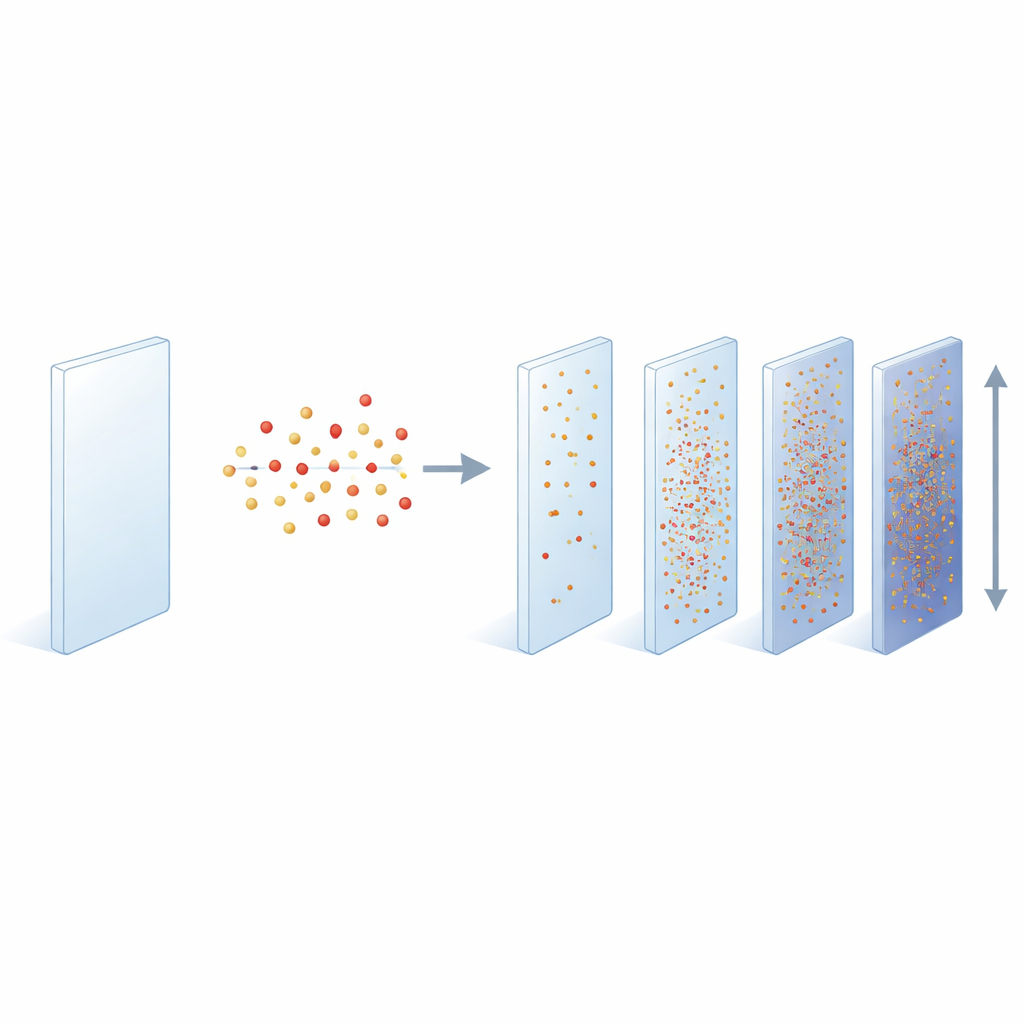
The team started with a borophosphate glass made mainly from boron oxide, calcium oxide, sodium oxide, and phosphate, then gradually replaced a small portion of the boron oxide with hematite nanoparticles (0 to 2 mol%). They melted the ingredients together at high temperature and rapidly cooled the liquid to form solid, transparent plates. X-ray measurements confirmed that all the samples remained glassy rather than crystallizing, meaning the iron oxide was successfully incorporated without forming separate crystals. Visually, the glass changed from colorless to progressively deeper brown as more iron was added, reflecting the strong light absorption of iron ions.
How the Internal Structure Shifts
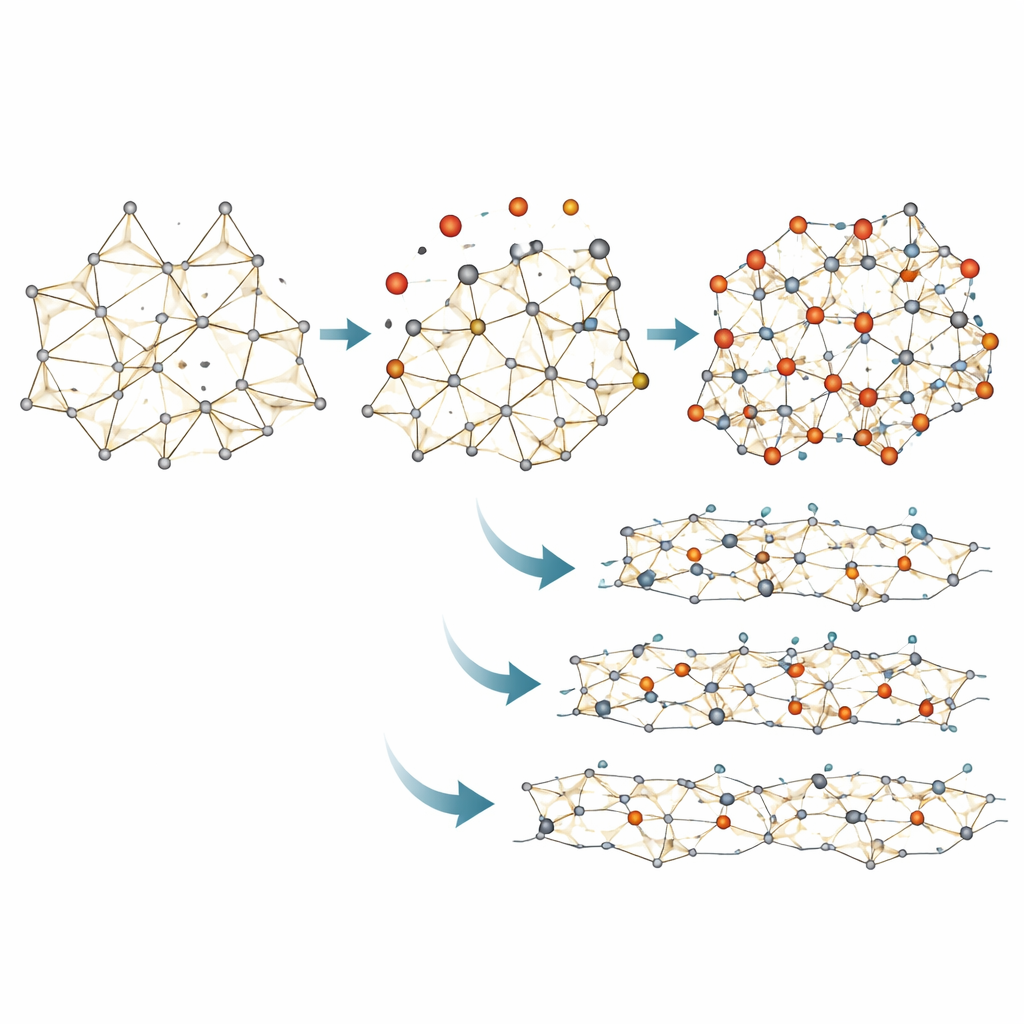
To understand what was happening inside, the researchers used infrared spectroscopy to probe the bonds between atoms in the glass network. In borate glasses, boron atoms can sit in either three-sided or four-sided oxygen cages, and the balance between these shapes strongly affects the material’s behavior. As more iron oxide was added, signals associated with four-sided boron units grew, while those from three-sided units declined. This indicates that iron acts mainly as a “network modifier”: it brings in extra oxygen and encourages a tighter, more connected glass structure. At the same time, the overall density of the glass increased and the space per molecule (molar volume) shrank, pointing to a more compact atomic packing.
Tuning Light and Color
The study also tracked how the doped glasses interact with light from the ultraviolet through the visible range. Adding hematite steadily narrowed the energy gap—the minimum energy needed for electrons in the glass to jump to a higher state—from about 3.14 to 2.36 electronvolts. This shift moves the main absorption edge toward redder light and boosts the material’s refractive index, a measure of how strongly it bends light. In simple terms, the iron-rich glasses absorb more visible light, appear darker brown, and bend light more strongly. The analysis of related quantities—such as molar refraction, electronic polarizability, and a “metallization” parameter—shows that these materials sit in a sweet spot where they behave as semiconductors and may be promising for nonlinear optical devices that control light with light.
Changing Stiffness and Flexibility
Mechanical behavior was estimated using a well-known model that links a glass’s composition and atomic packing to its stiffness. As more hematite nanoparticles were introduced, key elastic measures such as Young’s modulus, bulk modulus, and shear modulus all decreased slightly. In everyday terms, the glass became a bit less rigid and more compliant under stress. This softening is tied to the larger size of iron ions compared with boron and to subtle rearrangements of the network bonds, which loosen the structure despite its higher overall density. The trends in these elastic properties closely follow changes in packing density, confirming that small compositional tweaks can systematically tune how the glass responds to mechanical forces.
What This Means for Future Uses
Altogether, the work shows that a borate-based glass loaded with tiny hematite particles can have its density, color, light-bending power, and stiffness finely adjusted simply by varying the iron content. The glasses remain amorphous and stable while shifting from colorless insulators toward brownish, semiconducting materials with enhanced optical response. Because these properties are important for bioactive implants, radiation shielding, and advanced optical components, the study highlights a versatile glass platform where nanoscale additives act as precise knobs for engineering performance in medicine and technology.
Citation: Fouad, W., Hussein, S.A., Abd El-sadek, M.S. et al. Structural, physical, and elastic properties of α-Fe2O3 nanoparticles doped on borate glasses. Sci Rep 16, 11620 (2026). https://doi.org/10.1038/s41598-026-40715-z
Keywords: borate glass, hematite nanoparticles, optical properties, elastic modulus, radiation shielding