Clear Sky Science · en
Multi-resolution adaptive channel fusion transformer encoder LSTM for accurate streamflow prediction
Why better river forecasts matter
Rivers can rise or fall dramatically in just a few days, bringing either life‑saving water or dangerous floods. Communities that rely on rivers for drinking water, irrigation, and hydropower need forecasts that are not only accurate for tomorrow, but also reliable over weeks and seasons. This study introduces a new artificial‑intelligence approach designed specifically to read the subtle rhythms of river flow, with the aim of giving water managers earlier and more trustworthy warnings about what rivers will do next.
Looking at rivers on many time scales
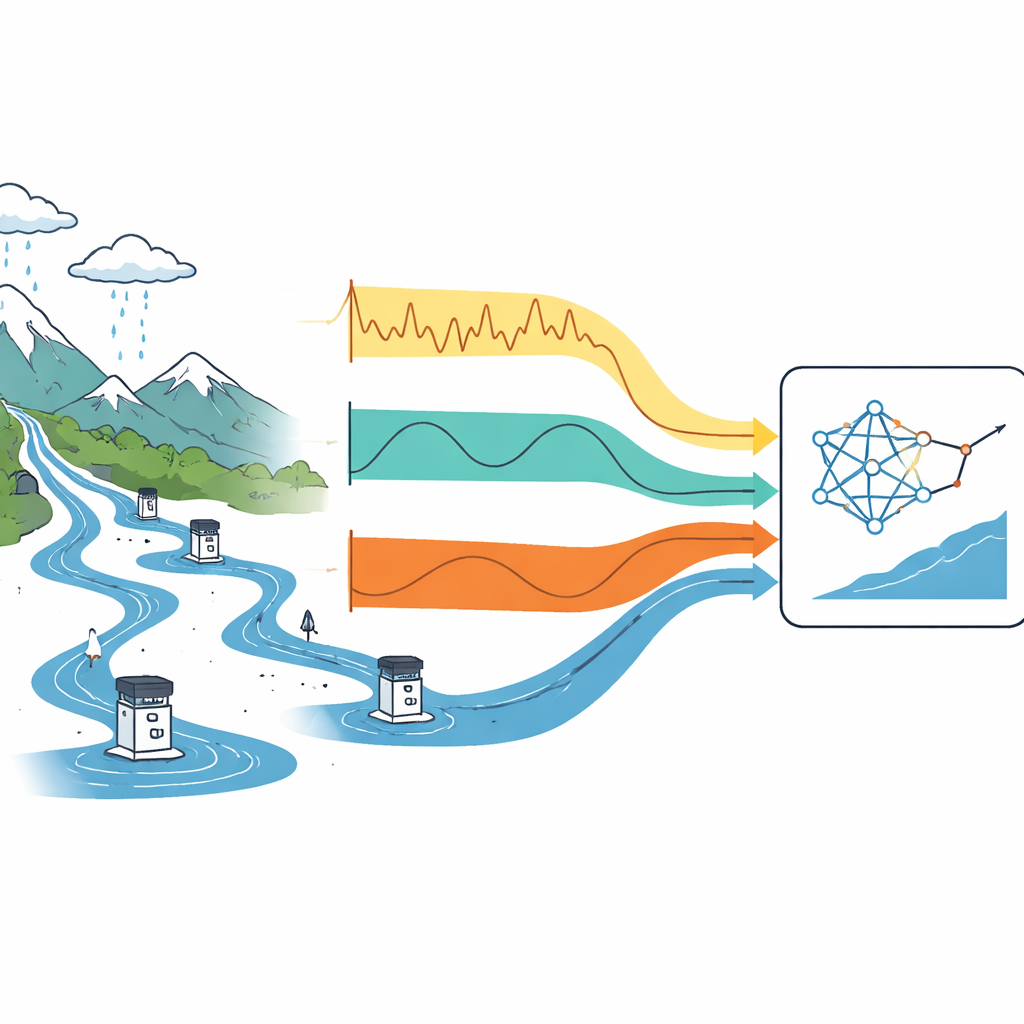
River flow is shaped by quick cloudbursts, repeating seasons, and slow‑moving climate patterns all at once. Traditional forecasting tools often focus on just one of these rhythms, which means they can miss important signals hidden in the others. The authors’ method starts by breaking a simple daily flow record from a single gauge into several “views”: recent daily values that capture sudden rises, statistical summaries that smooth out noise, and calendar‑based indicators that track regular seasonal swings. Together, these views turn a one‑dimensional flow record into a richer picture of how a river behaves over days, months, and years.
Letting the model decide what matters most
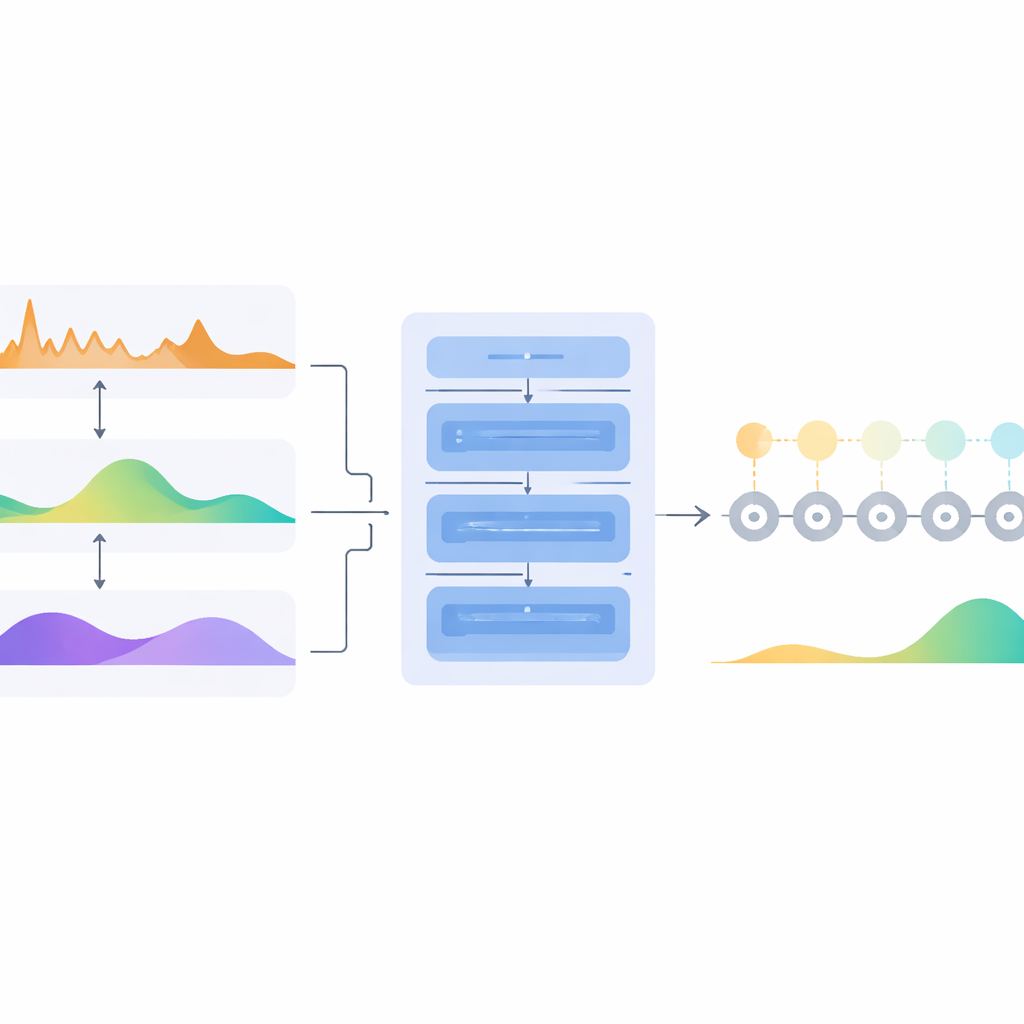
Not every river reacts to rain and dry spells in the same way, and even the same river behaves differently in wet years versus dry ones. Instead of hard‑coding a fixed recipe, the new approach uses an adaptive fusion stage that learns, from data, how much attention to give each time‑scale view at every moment. When fast storms dominate, the model can lean more on recent daily changes; during stable periods, it can rely more on longer‑term patterns. This automatic re‑weighting makes the system both flexible and more transparent, because the learned weights reveal which parts of the flow history are driving each prediction.
From long‑range memory to local detail
After fusing the different time‑scale views, the method passes this combined signal into a transformer module, a modern deep‑learning design originally developed for language translation. Here, every day in the input window can “look at” every other day, allowing the model to connect distant events such as early‑season rainfall and later snowmelt. A second attention step then highlights the particular days that are most influential for the forecast. Finally, the information flows through a chain of memory cells known as an LSTM, which specializes in preserving smooth day‑to‑day continuity. This combination lets the system remember far‑back influences while still honoring the natural inertia of river flow.
Testing on real rivers with very different moods
The researchers trained and tested their model on ten years of daily flow records from three stations in Turkey’s Western Black Sea Basin. These sites span highly flashy rivers with sudden peaks, more moderate streams, and relatively stable flows. Using standard accuracy scores, the new approach consistently beat several strong contenders, including pure transformer models, a transformer‑plus‑LSTM hybrid, a combined LSTM–GRU system, and a modern convolutional network that estimates uncertainty. In some cases, prediction errors dropped by nearly half relative to existing methods, and the model proved particularly good at capturing the timing and size of sharp flood‑like peaks.
Robustness and insight, not just raw accuracy
Beyond its numerical gains, the model showed an ability to generalize when trained on one river and tested on another, a demanding test of robustness. The patterns of attention it learned also lined up with hydrological intuition: during high‑flow events, it focused on the most recent days, while during low‑flow periods it spread its focus over a longer history, echoing the role of groundwater storage. These behaviors suggest that the system is not simply memorizing data, but is instead capturing real physical relationships in how water moves through the landscape.
What this means for future river forecasting
For non‑specialists, the key message is that this hybrid deep‑learning model can read a river’s “heartbeat” across many time scales at once, adjust its focus as conditions change, and explain which parts of the past shaped its prediction. In practical terms, that can translate into earlier, more reliable warnings of floods and low‑water shortages, supporting safer communities and smarter water use. While the approach is more complex than traditional tools and will need further testing in other climates, it offers a promising blueprint for next‑generation river forecasting systems that are both powerful and understandable.
Citation: Apak, S., Kilinc, H.C., Yurtsever, A. et al. Multi-resolution adaptive channel fusion transformer encoder LSTM for accurate streamflow prediction. Sci Rep 16, 10149 (2026). https://doi.org/10.1038/s41598-026-40713-1
Keywords: streamflow forecasting, deep learning, river floods, water management, time series