Clear Sky Science · en
Bacteria-soil–plant linkages underlie the mosaic structure of the soil bacterial communities in near-natural stands of Białowieża Primeval Forest
Hidden Life Beneath an Ancient Forest
The Białowieża Primeval Forest on the Polish–Belarusian border is one of the last large temperate forests in Europe that has remained largely untouched by people. While its towering trees and rich wildlife are well known, this study looks at a less visible world: the trillions of bacteria living in the soil. These tiny organisms quietly recycle nutrients, store and release carbon, and help plants grow. Understanding how they are organized in such a natural forest gives us a rare glimpse of what a healthy, self-regulating woodland looks like belowground.
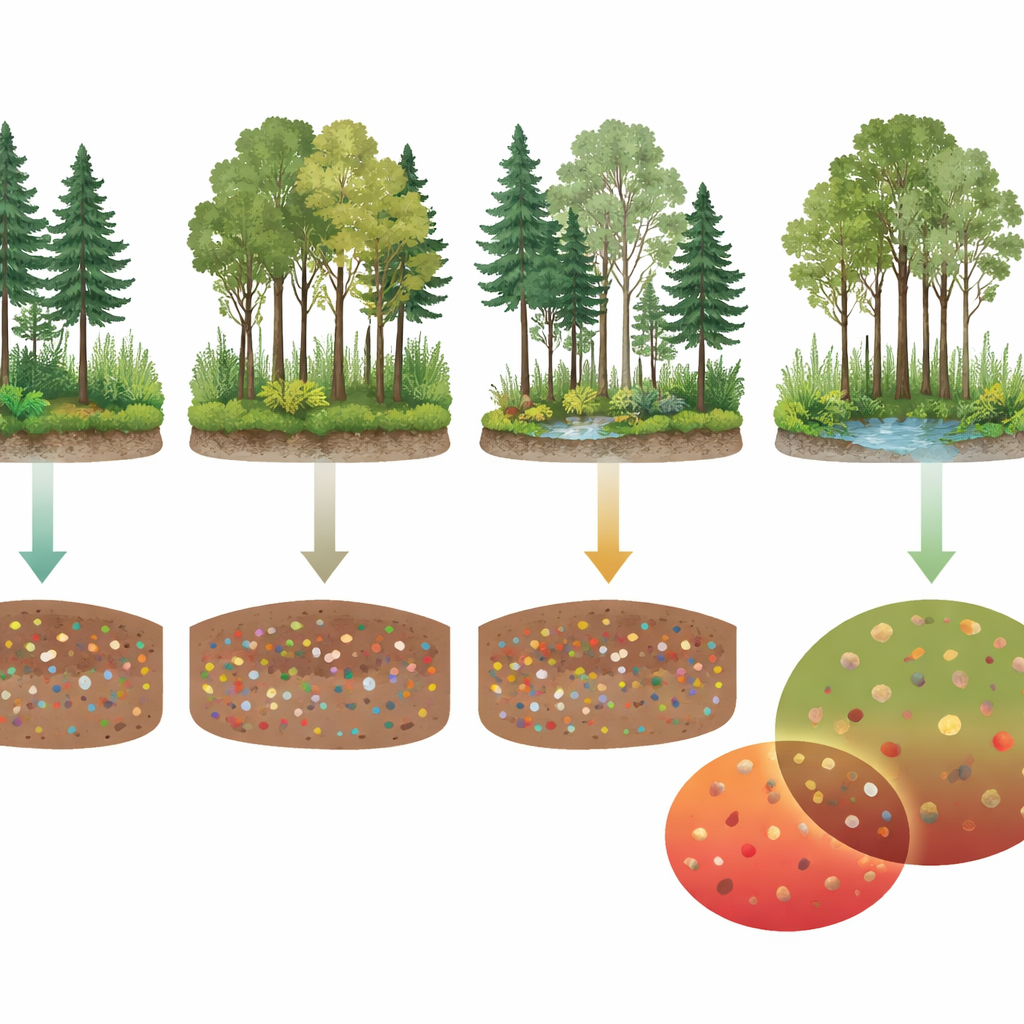
A Natural Patchwork of Forest Rooms
Białowieża National Park is not one uniform forest, but a mosaic of “rooms” with different tree species and ground vegetation. The researchers focused on five main types: dry conifer stands dominated by pines and spruces; mixed conifer forests; mixed broadleaf forests; classic broadleaf stands rich in deciduous trees; and moist alder forests along wetter spots. Because these areas have been protected from direct human disturbance for centuries, they form an outdoor laboratory where differences in plants and soil arise naturally rather than from logging or planting. By comparing these forest types side by side, the team could see how vegetation and soil conditions combine to shape the underground community of bacteria.
Reading the Forest’s Underground Census
To map this hidden world, the scientists collected topsoil from 40 plots and used long-read DNA sequencing to identify bacterial groups, alongside flow cytometry to count cells. They also tested how well the microbes could feed on 31 different carbon sources using special “EcoPlates” that change color as bacteria grow. In parallel, they measured soil features such as acidity, moisture, organic matter, and nutrients, and carefully recorded the plant species carpeting the forest floor. Together, these data reveal not just which bacteria are present, but how active and versatile they are, and how they relate to both soil chemistry and the mix of plants above.
Three Distinct Underground Neighborhoods
The forest’s soil turned out to host more than 1,600 bacterial genera, dominated everywhere by two big groups, but arranged very differently from place to place. Statistical analyses showed that soil acidity was the single strongest factor separating communities. Highly acidic conifer soils fostered dense but relatively low-diversity bacterial assemblages dominated by acid-loving, slow-growing species. At the other extreme, alder forests with milder acidity supported the richest and most metabolically active microbiomes, able to use a wide range of carbon sources such as amino acids and nitrogen-rich compounds. Broadleaf forests fell in between, with moderate acidity and bacterial communities adapted to relatively dry, nutrient-poor conditions. Mixed forests were the most variable, sometimes resembling one extreme, sometimes the other, reflecting their shifting combinations of trees, ground plants, and soil.
Plants and Soil Talk Through Microbes
The forest floor vegetation—herbs, grasses, and low shrubs—proved to be just as important as soil chemistry in explaining bacterial patterns. Conifer stands tended to have low, species-poor understoreys dominated by heather-like plants and tough grasses, and these were repeatedly linked to acid-loving bacterial groups suited to harsh, nutrient-limited environments. In contrast, alder patches hosted tall, lush herbs such as nettles and other moisture-loving plants. These areas were strongly associated with bacterial genera involved in breaking down nitrogen-rich organic matter and in key steps of the nitrogen cycle. Shade-tolerant herbs in broadleaf stands formed their own distinctive plant–microbe associations. Advanced statistical tools that integrate plants, soil, and bacteria all pointed to the same picture: the forest is organized into three robust ecological clusters—alder, broadleaf, and conifer—each with its own characteristic combination of understorey vegetation, soil conditions, and bacterial communities, while mixed forests form transitional zones.
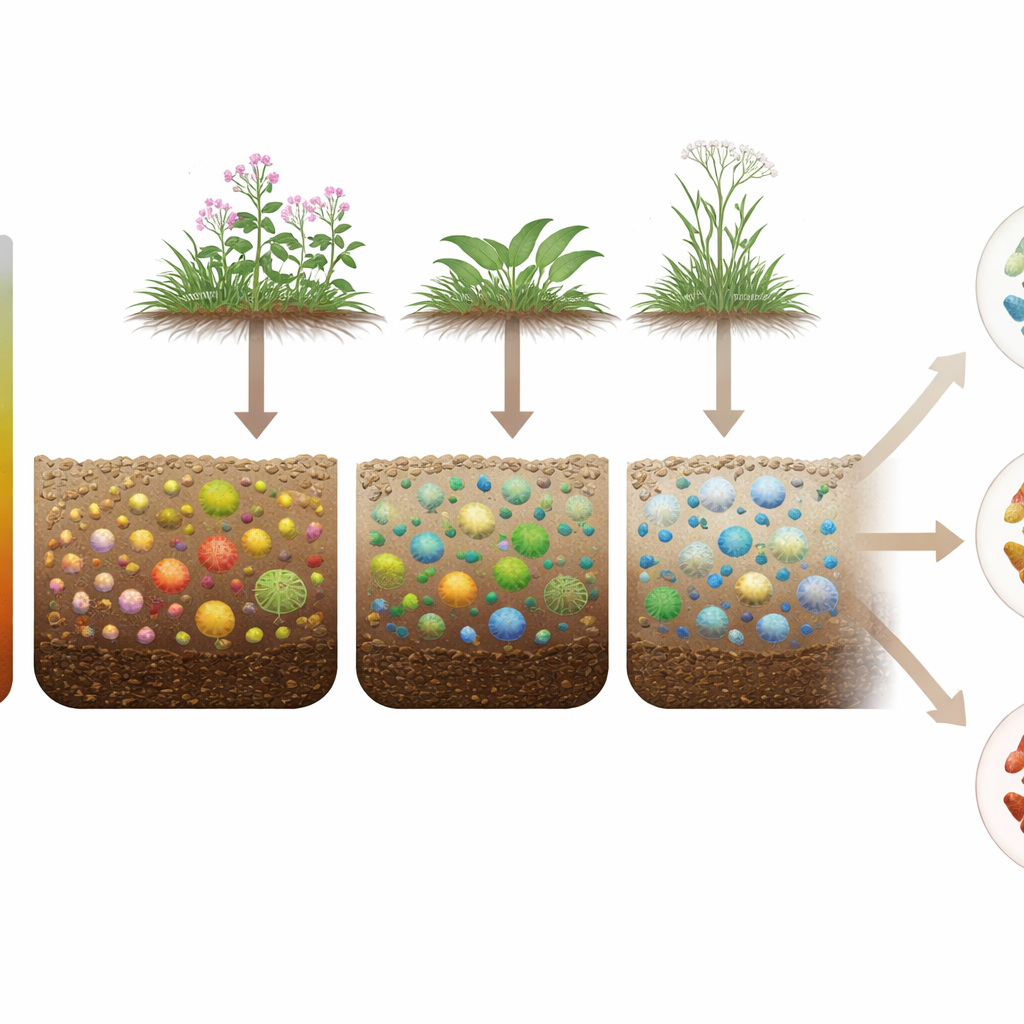
Why This Matters for Forest Futures
The study shows that in a near-natural temperate forest, soil bacteria are not randomly scattered; they are filtered by a blend of soil acidity and the identity of plants growing above them. Alder forests emerge as hotspots of bacterial diversity and activity, conifer stands as strongholds of acid-tolerant specialists, and broadleaf forests as an intermediate but distinct state. Because these microbial communities influence how carbon and nutrients move through the ecosystem, their mosaic structure likely helps stabilize the forest’s overall functioning. By providing a detailed baseline of how vegetation, soil, and microbes are linked in an old-growth setting, this work offers a reference point for judging how modern, managed forests differ—and how climate change or land-use decisions might ripple through the living fabric beneath our feet.
Citation: Drewnowska, J.M., Lewandowska, W., Zieliński, P. et al. Bacteria-soil–plant linkages underlie the mosaic structure of the soil bacterial communities in near-natural stands of Białowieża Primeval Forest. Sci Rep 16, 13444 (2026). https://doi.org/10.1038/s41598-026-40694-1
Keywords: forest soil microbiome, Białowieża Primeval Forest, understory vegetation, soil pH, bacterial diversity