Clear Sky Science · en
Reliability of contactless vital sign measurement algorithms for use in drone-based mass casualty triage
Why Flying Robots Could Help Save Lives
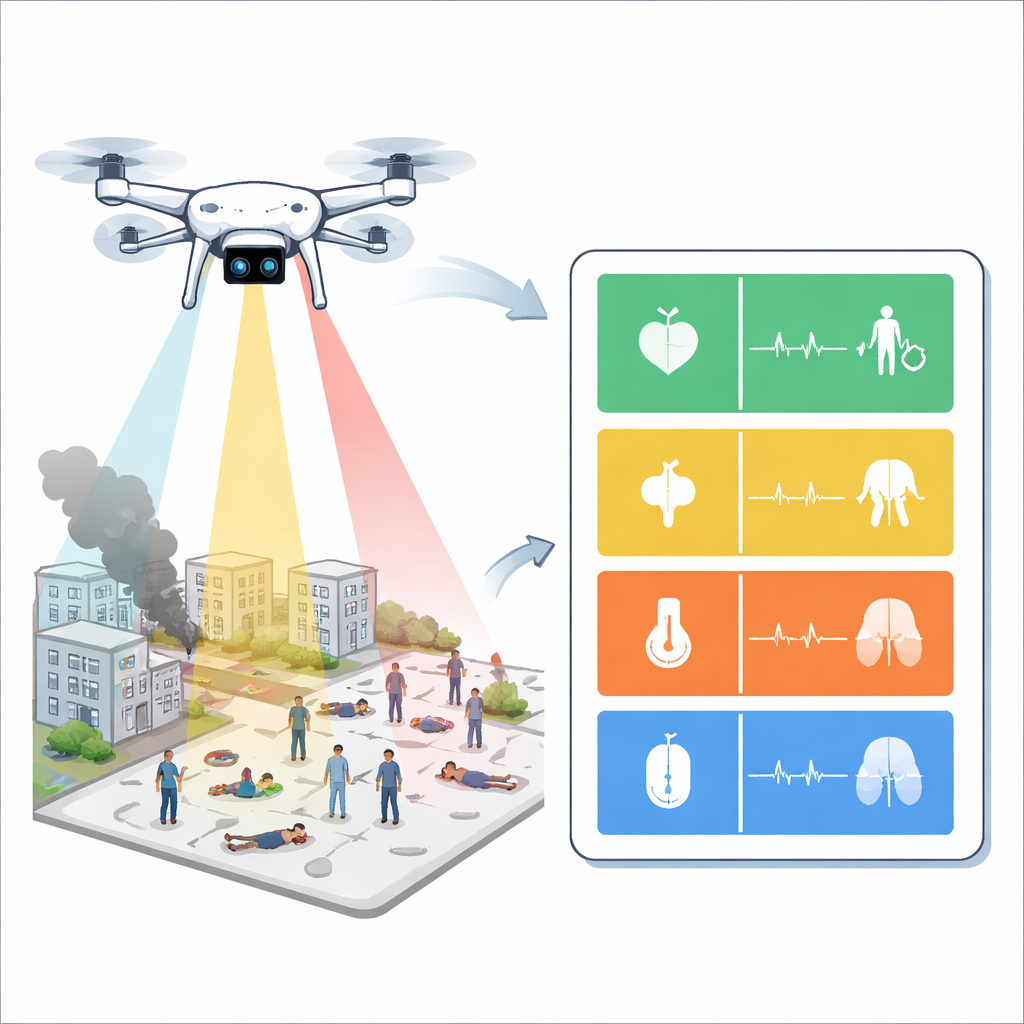
When disaster strikes and there are more injured people than rescuers, every second counts. Paramedics must quickly decide who needs help first, often while working in dangerous, chaotic scenes. This study explores a futuristic but increasingly realistic idea: using camera‑equipped drones to fly over a mass‑casualty incident and measure people’s vital signs—heart rate, breathing, temperature, and oxygen levels—without touching them. If reliable, this approach could help doctors make faster, safer triage decisions from a distance.
How Drones Can “See” Vital Signs
The researchers built a system that lets a drone act like a flying monitor. A special camera on the drone captures both standard color video and thermal (heat‑sensitive) images of people’s faces from several meters away. Instead of attaching clips, cuffs, or sensors to the skin, the system looks for tiny, otherwise invisible changes in skin color and temperature. Those patterns are linked to how fast the heart is beating, how quickly a person is breathing, how warm their body is, and how much oxygen is in their blood. In a mass‑casualty event, this could allow rescuers to start assessing many victims at once without physically reaching each one.
Turning Face Videos into Health Data
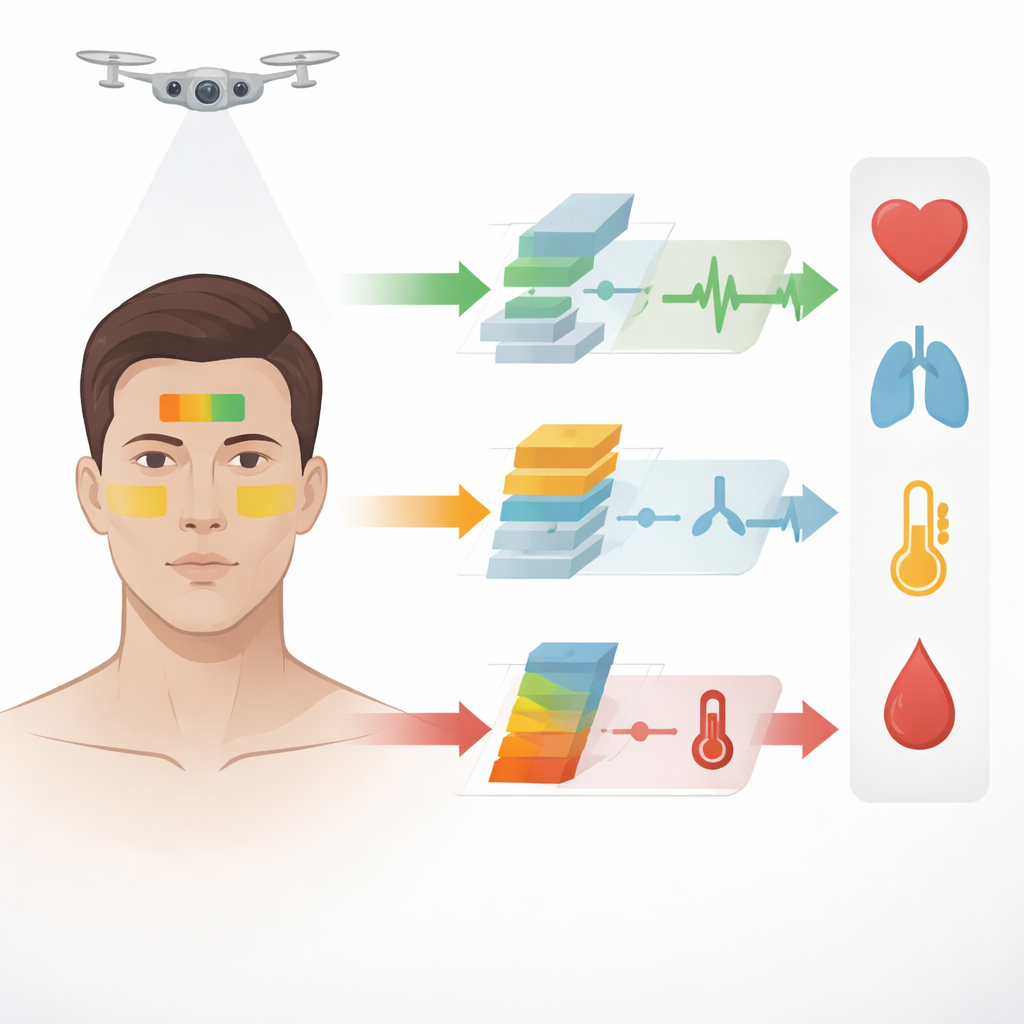
To test their idea, the team recorded 37 healthy volunteers both indoors and outdoors while a standard bedside monitor measured their vital signs in the usual way. At the same time, a drone hovered nearby and filmed them for about a minute. The videos were then sliced into short segments—around 13 to 15 seconds long—and fed into custom algorithms. For heart rate, the software zoomed in on the forehead and tracked very subtle shifts in skin color that occur with each heartbeat. For breathing, it used thermal images of the nose to detect gentle warm‑cool cycles as air moved in and out. Body temperature came from the hottest part of the forehead in the thermal images, and oxygen levels were estimated using a learning algorithm trained on patterns from the face’s thermal signal.
How Well Did the System Perform?
When the drone‑based readings were compared with the bedside monitor, the match was strikingly close for most measurements. Indoors, oxygen saturation and body temperature estimates were accurate more than 98% of the time, and heart rate nearly 98% of the time, with average differences so small they would be hard to notice in regular clinical use. Outside, under sunlight and natural conditions, performance remained similarly strong, with only a slight drop. Breathing rate was the hardest to capture; its accuracy was still good but clearly lower than for the other vital signs. Short analysis windows—chosen to keep triage fast—likely made breathing measurements more vulnerable to noise and small body movements.
What This Could Mean in a Real Emergency
The findings suggest that contactless vital‑sign monitoring from drones is not just science fiction. With only a few seconds of stable video, the algorithms produced heart rate, oxygen level, and temperature readings that closely tracked standard equipment, both indoors and outside. Breathing measurements were less precise but still clinically useful. The system did show some systematic quirks—for example, small over‑ or under‑estimates in oxygen levels at the extremes—and it was tested only on healthy, mostly still volunteers in relatively controlled settings. Real disaster scenes will involve smoke, crowds, movement, and injured people with unstable vital signs, so more testing in rougher conditions and diverse populations is essential.
Where the Technology Goes Next
Despite these caveats, this work offers a compelling glimpse of how drones, smart cameras, and advanced image analysis could transform emergency care. In future mass‑casualty incidents, a drone swarm might scan an entire scene, flag people with dangerously low oxygen, high fever, or abnormal heart rate, and feed that information into a decision‑support system that guides rescuers on the ground. The authors conclude that their algorithms are accurate enough to be integrated into such drone‑based triage and remote monitoring systems, provided they are further refined to handle motion, poor lighting, and the full range of real‑world medical conditions.
Citation: Tayfur, İ., Şimşek, P., Akgül, E.C. et al. Reliability of contactless vital sign measurement algorithms for use in drone-based mass casualty triage. Sci Rep 16, 12847 (2026). https://doi.org/10.1038/s41598-026-40691-4
Keywords: drone triage, contactless vital signs, remote medical monitoring, disaster response, medical imaging algorithms