Clear Sky Science · en
A mathematical approach to Chikungunya transmission dynamics incorporating media awareness and optimal control
Why this matters for everyday life
Chikungunya is a mosquito-borne illness that can cause intense joint pain, fevers, and long-lasting fatigue. In India and many tropical regions, it resurfaces in waves, straining families, clinics, and local economies. This study asks a practical question with mathematical tools: if we account for hidden infections and public awareness campaigns, what mix of prevention and treatment can most effectively keep chikungunya in check in different parts of India?
How the infection moves through people and mosquitoes
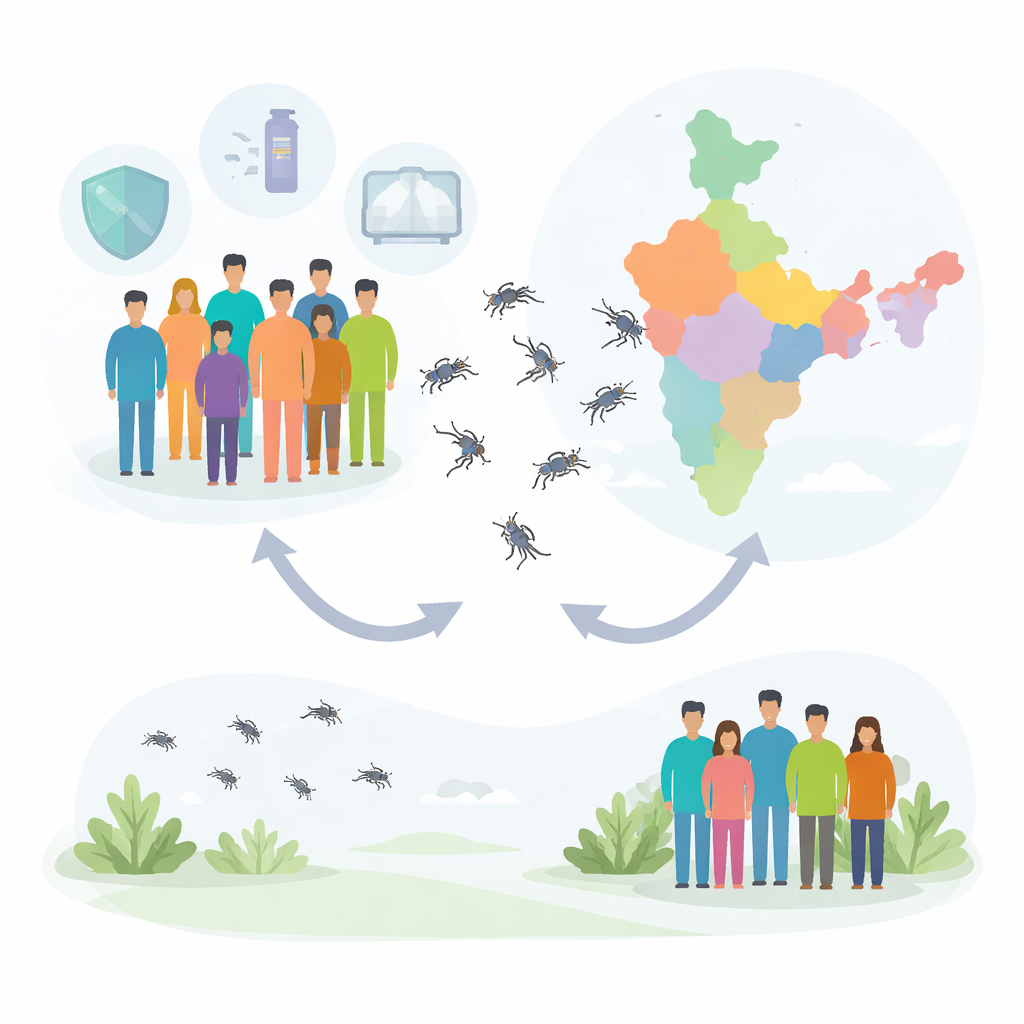
The authors build a detailed story of chikungunya’s spread using a compartment model that tracks people and mosquitoes through key stages. People can be unaware and at full risk, become aware and more cautious, be exposed, fall ill without symptoms, fall ill with clear symptoms, recover, or be influenced by media campaigns. Mosquitoes move from being susceptible to exposed to infectious and, once infectious, remain able to spread the virus for the rest of their short lives. The model links these stages through mosquito bites: infected mosquitoes can pass the virus to people, and infected people can pass it back to biting mosquitoes.
How information and behavior change the risk
A central feature of the model is a “media awareness” component: news, campaigns, and education efforts that encourage people to use repellents, wear long sleeves, or sleep under nets. In the equations, this shows up as a factor that reduces the chance an aware person becomes infected when bitten. Awareness does not last forever—people gradually slip back into old habits—so the model also includes the fading of media influence over time. By distinguishing between aware and unaware individuals, the researchers can estimate how strongly public information drives safer behavior and how quickly that effect must be renewed.
Pinpointing what drives outbreaks in India’s hardest-hit states
To move beyond theory, the team calibrates their model using nearly a decade of chikungunya case data from across India and from three high-burden states: Gujarat, Karnataka, and Maharashtra. They adjust key parameters—such as mosquito biting rate, transmission probability, recovery speed, and strength of media impact—until model outputs align with the cumulative case counts in each region. The resulting fits are strong, suggesting the model captures the broad epidemic patterns well. With these tuned parameters, they compute the basic reproduction number, a measure of how many new infections one case generates in a mostly susceptible population. Nationally, this value is around 1.4, signaling ongoing transmission; in Gujarat, Karnataka, and Maharashtra it is notably higher, reflecting more favorable conditions for spread.
Which levers matter most for control
Once the model is grounded in real data, the authors test how sensitive this reproduction number is to each parameter. Across India and all three states, the mosquito biting rate stands out as the single most influential factor, followed by how efficiently mosquitoes and humans infect one another. By contrast, faster recovery helps but has a smaller effect on whether the disease takes hold in the first place. Visual maps of parameter combinations show a sharp boundary between “safe” regions where outbreaks die out and “epidemic” regions where they grow, meaning small shifts in mosquito biting or recovery rates can tip a community from control to crisis. The analysis also shows that stronger awareness and behavior change can noticeably lower the peak and length of symptomatic illness.

Finding the best mix of prevention and care
The study goes a step further by framing control of chikungunya as an optimization problem: given limited resources, how much effort should go into preventing bites versus speeding recovery? Two time-varying control knobs represent personal protection (reducing mosquito–human contact) and better treatment (shortening how long sick people remain infectious). Using a mathematical tool known as Pontryagin’s Maximum Principle, the authors find the time paths for these interventions that minimize a combined “cost” made up of infections and control effort over a decade. Simulations show that either prevention or improved care alone cuts cases meaningfully, but applying both together produces the largest and fastest reduction in symptomatic infections across all regions.
What this means for public health action
In plain terms, the paper concludes that chikungunya in India is being sustained by intense mosquito–human contact, and that states like Gujarat, Karnataka, and Maharashtra face especially high risk. The work suggests that the most effective strategy is a coordinated blend of strong mosquito-bite prevention and better clinical management, reinforced by ongoing media campaigns that keep people alert and engaged. While the model simplifies reality—treating populations as evenly mixed and not explicitly modeling climate or movement between regions—it offers clear guidance: cutting mosquito bites, maintaining public awareness, and improving care together can shift communities from persistent outbreaks toward long-term control.
Citation: Karthik, A., Ghosh, M. A mathematical approach to Chikungunya transmission dynamics incorporating media awareness and optimal control. Sci Rep 16, 13543 (2026). https://doi.org/10.1038/s41598-026-40681-6
Keywords: chikungunya, mosquito-borne disease, mathematical modeling, public health awareness, optimal control