Clear Sky Science · en
Exploring adaptive capacity to arid heat in remote First Nations communities in Central Australia
Why staying cool in the desert matters
In Central Australia, many remote First Nations communities already live with the kind of extreme heat that climate forecasts predict for the end of the century. This study asks a simple but crucial question: how do people in these communities cope with such intense heat, and what makes them more or less able to stay healthy and safe? By listening closely to residents’ own stories, the research reveals both the pressures they face and the strengths they draw on to adapt.
Life in a place that keeps getting hotter
Central Australia is one of the hottest parts of the country, with dozens of days each year over 40 °C. For people in small, isolated communities, this is not just uncomfortable—it shapes daily life. Participants in the study described how hot weather worsens headaches, breathing problems, tiredness and sleep, and limits travel, hunting and other cultural activities. Children, older people, pregnant women, people with disabilities and those with chronic illnesses were seen as most at risk. Many residents also notice changes in the land itself: waterholes that used to hold water now run dry more often, and traditional bush foods are harder to find as invasive grasses spread.
Homes, power and shade: everyday weak spots
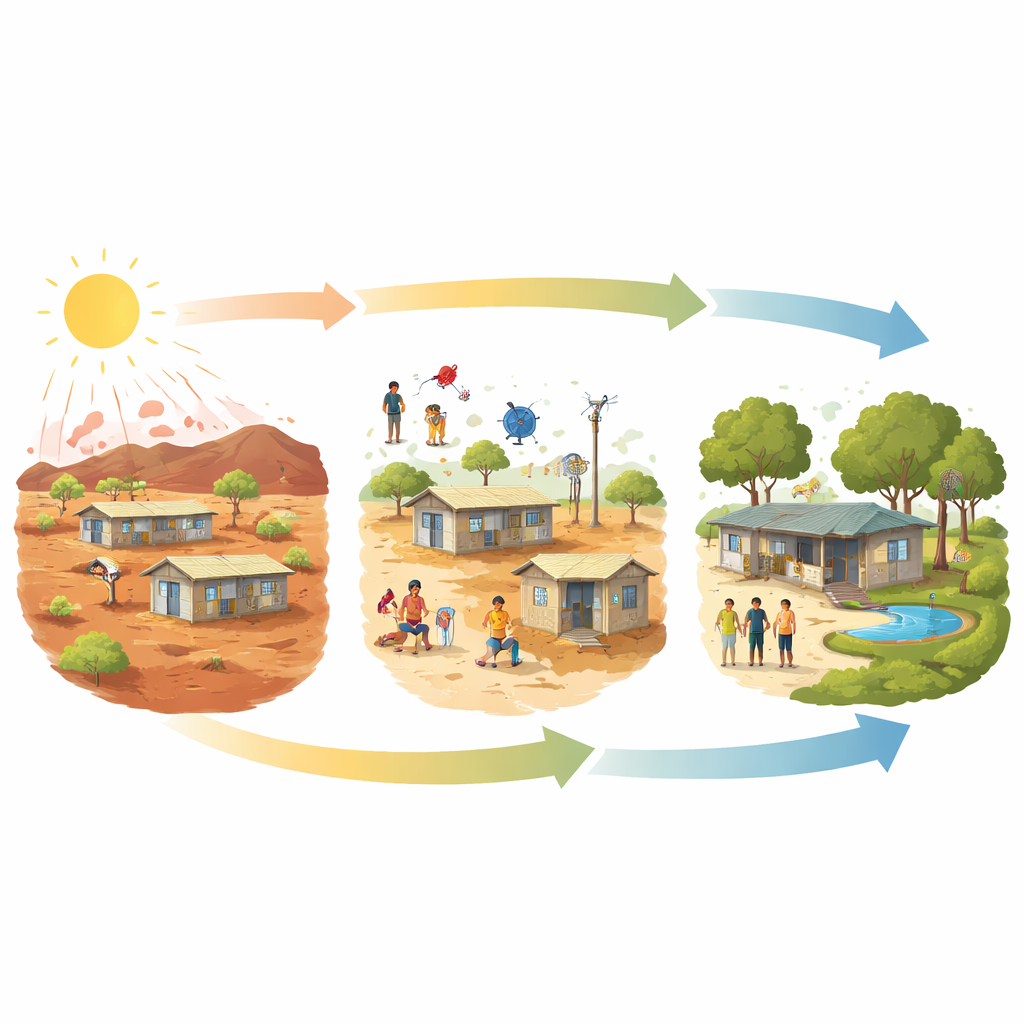
The study found that the biggest weak spots in coping with heat come from housing, energy and local infrastructure. Many homes are overcrowded, poorly insulated and lack reliable air conditioning. Residents often rely on pre-paid power cards; when money runs out, fridges stop, food spoils and families may sleep outside. Shade is limited around newer “transitional” houses and public spaces, and playgrounds, walkways and community areas often sit in full sun without nearby taps or fountains. Health clinics can be far, open only a few days a week, and hard to reach on foot in extreme heat, especially for older people or those who are unwell.
Local know-how and community support
Despite these challenges, the research also highlights strong local know-how and social networks that help people get through hot days. Residents use a mix of strategies: running fans or air conditioners when power allows, opening windows, hanging cloth to block direct sun, regularly showering and mopping floors to cool rooms. Outdoors, people sit under trees, sleep outside at night, hose down yards, swim in creeks or community pools, and dig shallow soakage holes when water levels are low. Many shift heavy tasks, clinic visits and hunting trips to early morning or evening. Community buildings—schools, clinics, aged-care centres, art centres and stores—act as informal cooling hubs where children and elders can rest in cooler air. Sharing is common: neighbours store each other’s food during power cuts or help with power cards, and people draw on both modern weather forecasts and traditional signs in the sky to anticipate long, hot summers.
What communities say they need
Participants were clear that personal coping strategies are not enough as heatwaves lengthen and intensify. They called for more shaded areas and water points at sports fields, parks, meeting places and cemeteries; better-designed, climate-friendly housing developed with community input; and regular servicing of cooling systems before summer. They also stressed the need for stronger heat-health education, delivered by local services in local languages, using visual tools such as videos and posters so that people who are less comfortable with reading can still understand how to recognise and respond to heat stress. Improved transport and clinic pickup services during very hot periods were seen as vital for safe access to care.
Building long-term safety in a hotter world
Overall, the study shows that people in remote First Nations communities are far from passive victims of heat. They already use a rich mix of cultural knowledge, everyday habits and mutual support to stay as cool as possible. But many of these responses are short-term fixes that depend on things like reliable water and at least some access to power and shade. As the climate warms, the authors argue that real heat resilience will require more than asking individuals to adapt. It will demand investment in better housing, affordable and stable energy, community cooling spaces, and respectful, co-designed health communication that centres First Nations knowledge and priorities.
Citation: Bhatta, M., Baliva, G., Pascoe, S. et al. Exploring adaptive capacity to arid heat in remote First Nations communities in Central Australia. Sci Rep 16, 10111 (2026). https://doi.org/10.1038/s41598-026-40677-2
Keywords: extreme heat, First Nations communities, remote Australia, climate resilience, housing and energy