Clear Sky Science · en
Enhanced urine glucose sensing using two-dimensional TMDCs-based SPR biosensor
Why a Simple Urine Test Matters for Millions
Diabetes affects hundreds of millions of people worldwide, and keeping blood sugar in check usually means pricking fingers day after day. This study explores a different path: turning a simple urine sample into a precise window on glucose levels, without needles, test strips, or chemical reagents. By rethinking how light interacts with ultra-thin materials on a tiny chip, the authors design a sensor that could one day make routine glucose checks faster, gentler, and cheaper.
A New Way to Read Glucose with Light
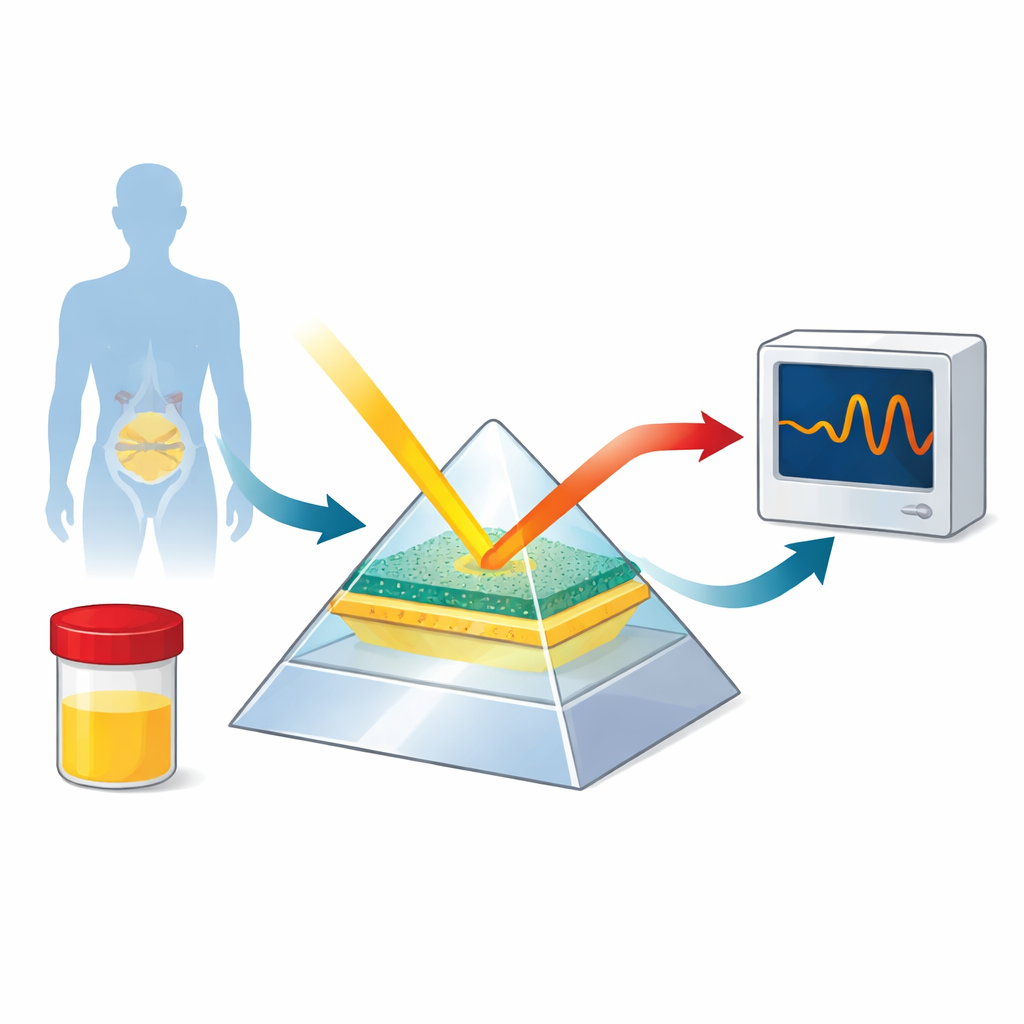
At the heart of the work is a technology called surface plasmon resonance, or SPR. In an SPR sensor, a beam of light enters a transparent block (a prism), hits a thin metal film, and reflects back out. Under just the right conditions, some of the light’s energy couples to ripples of electrons at the metal’s surface. This makes the reflected beam suddenly dim at a specific angle. That special angle is extremely sensitive to how the nearby liquid—here, urine—bends light. Because the liquid’s optical properties shift with glucose content, tracking the angle lets the sensor infer how much sugar is present, without adding dyes or enzymes. The challenge is squeezing out enough sensitivity to detect both normal and high glucose levels reliably.
Stacking Exotic Layers for Sharper Sensing
The researchers redesign the traditional SPR stack to boost its performance. They choose a calcium fluoride prism, known for low optical loss and stable behavior with temperature, and coat it with two metals: silver and aluminum. Silver offers a narrow, sharp SPR response, while aluminum helps tune the resonance. On top of these metals they add a sheet from a family of ultra-thin crystals called transition metal dichalcogenides. Only a single atomic layer thick, these materials soak up light strongly and provide a very large surface area for molecules to interact with. The team tests several candidates—WS₂, WSe₂, MoSe₂, MoTe₂—and finds that MoS₂, with its particularly high refractive index, gives the largest shift in the resonance angle when glucose changes, even in tiny amounts.
Finding the Sweet Spot in the Sensor Design
To turn this concept into a working design, the authors run detailed computer simulations using a numerical technique that tracks how electromagnetic waves move through the layered structure. They vary the thickness of the silver and aluminum films and the number of MoS₂ layers, then calculate how the resonance angle, sharpness of the dip, and overall signal quality respond. A key insight is that “more” material is not always better: adding extra MoS₂ layers moves the liquid farther from the metal, weakens the interaction region where the electric field is strongest, and actually reduces sensitivity. The optimal design uses a single MoS₂ layer atop carefully chosen thicknesses of silver and aluminum, creating a tightly confined light field that extends about 190 nanometers into the urine. This depth is enough for glucose molecules to be “seen” while keeping the signal clean and strong.

From Healthy to Diabetic in One Continuous Scale
With the optimized stack in place, the team mimics real urine samples spanning normal and diabetic glucose ranges by changing the liquid’s refractive index in their simulations. For healthy individuals, glucose is essentially absent, and the refractive index sits near 1.335. In diabetic conditions it can climb significantly higher. The sensor’s resonance angle shifts smoothly from about 82 to 88 degrees as the modeled glucose concentration rises from non-diabetic levels up to 10 grams per deciliter—a very broad and clinically relevant span. The relationship between angle and refractive index is nearly perfectly linear, which means that once calibrated, the sensor can convert an observed angle directly into a glucose value with high confidence.
What This Could Mean for Everyday Care
In plain terms, the study shows that by combining a double metal layer with an ultra-thin MoS₂ sheet, an SPR chip can detect changes in urine glucose with remarkable sensitivity and reliability, all without enzymes, dyes, or invasive sampling. The device concept reaches a sensitivity that outperforms many earlier designs, while keeping the structure relatively simple and compatible with standard fabrication methods. Although the work is based on simulations and still needs experimental validation, it points toward future non-invasive glucose monitors where a small optical reader and a disposable chip could replace repeated finger sticks—making life with diabetes a little less painful and a lot more convenient.
Citation: Dey, B., Rahman, M.T. & Saha, A. Enhanced urine glucose sensing using two-dimensional TMDCs-based SPR biosensor. Sci Rep 16, 11250 (2026). https://doi.org/10.1038/s41598-026-40664-7
Keywords: urine glucose sensor, noninvasive diabetes monitoring, surface plasmon resonance, 2D MoS2 materials, optical biosensors