Clear Sky Science · en
Fuzzy decision support systems for hospital infection management: a circular q-ROF CRADIS method to prevention and control
Why Hospital Germs Are So Hard to Manage
Every time we enter a hospital, we expect it to be a place of healing, not a source of new infections. Yet hospital-acquired infections still affect millions of patients worldwide, lengthening hospital stays, driving up costs, and sometimes costing lives. Choosing which prevention steps to fund and enforce—better hand hygiene, new cleaning machines, antibiotic rules, extra staff training—is anything but simple. This paper introduces a new kind of decision-support tool that helps hospitals sort through messy, uncertain expert opinions to decide which infection-control strategies will do the most good in the real world.
When Clear Numbers Are Not Enough
Hospital leaders often rely on checklists, score cards, or statistical reports to judge infection risks. These tools assume that data are complete and precise and that different factors—like cost, safety, and staff workload—combine in a straightforward way. In reality, experts disagree, evidence is incomplete, and priorities shift as outbreaks and resistance patterns change. Classic decision methods struggle with this kind of ambiguity. They may force a simple yes-or-no answer where experts actually feel “somewhat confident but still hesitant,” or they may ignore the cyclical nature of opinions that change with new waves of disease.

A New Way to Capture Doubt and Disagreement
To address this, the authors build on a branch of mathematics called fuzzy logic, which is designed to model shades of gray instead of black-and-white choices. Standard fuzzy tools let experts say an option is partly acceptable and partly unacceptable. The new framework goes further by representing acceptance, rejection, and hesitation together, arranged in a circular structure that naturally reflects back-and-forth, cyclical judgments. This structure—called a circular q‑rung orthopair fuzzy model—can handle extreme uncertainty and strong disagreements better than earlier fuzzy approaches, without turning the analysis into an opaque “black box.”
Turning Messy Opinions into Actionable Rankings
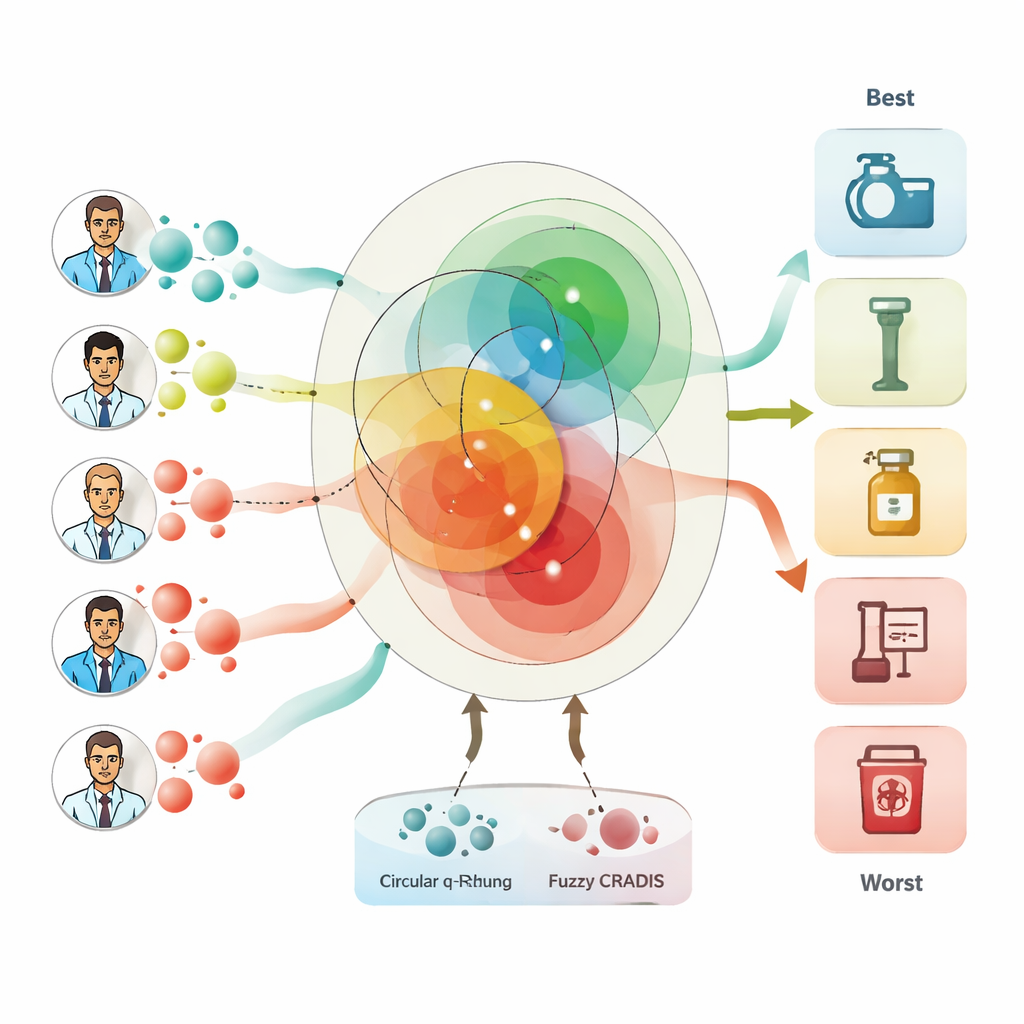
The second ingredient of the framework is a ranking method known as CRADIS, which compares each infection-control strategy to an imagined “ideal” strategy and a worst‑case “anti‑ideal” one. In this study, the authors redesign CRADIS so it can operate inside the new circular fuzzy environment. Experts rate several common hospital measures—such as strict hand hygiene protocols, improved environmental cleaning, antibiotic stewardship programs, advanced disinfection technologies, and staff training—against six goals: cutting infections, protecting patients, implementing measures accurately, ensuring long‑term sustainability, adapting to changing conditions, and handling task complexity. The system combines all expert views, measures how close each option is to the ideal and how far from the anti‑ideal, and then produces an overall ranking.
What the Model Favors in Practice
In a case study with three infection-control specialists and five competing strategies, the tool highlighted strict hand hygiene and antimicrobial stewardship as top priorities. Waste segregation and sterilization systems also performed well, while high‑tech disinfection devices and routine training alone ranked lower under the chosen criteria and constraints. Importantly, the framework did more than just produce a single list: it allowed the authors to test how the rankings would change if expert weights or assumptions shifted. The rankings proved stable, especially for widely agreed‑upon measures like hand hygiene, and only modestly sensitive for more complex, resource‑intensive options, suggesting that the results are robust rather than fragile.
Why This Matters for Patients and Hospitals
For non-specialists, the take‑home message is that the “best” infection-control strategy is rarely obvious, even to experts, because it must balance effectiveness, safety, cost, staff effort, and future risks under deep uncertainty. This study offers hospitals a structured way to capture expert doubt instead of hiding it, compare options fairly, and see how sensitive their choices are to differing opinions. By doing so, the framework helps leaders prioritize proven, preventive measures—such as hand hygiene and careful antibiotic use—while still accounting for local realities. Although mathematically sophisticated, its purpose is simple: to turn messy human judgment about hospital germs into clearer, more defensible decisions that protect patients.
Citation: Li, M., Wang, R., Wang, M. et al. Fuzzy decision support systems for hospital infection management: a circular q-ROF CRADIS method to prevention and control. Sci Rep 16, 12154 (2026). https://doi.org/10.1038/s41598-026-40658-5
Keywords: hospital infection control, decision support, fuzzy logic, multi-criteria ranking, antimicrobial stewardship