Clear Sky Science · en
Fusarium wilt disease induced changes in the composition and function of the rhizosphere metabolome and microbiome in tobacco plants
Why soil around roots matters
Tobacco plants, like all crops, live in close partnership with the thin layer of soil wrapped around their roots. This zone, called the rhizosphere, is packed with tiny organisms and chemicals that can either protect plants or leave them vulnerable to disease. This study explores why some tobacco fields shrug off a devastating fungus that causes Fusarium wilt, while others collapse, and shows how subtle shifts in underground life can tip the balance between healthy harvests and serious crop loss. 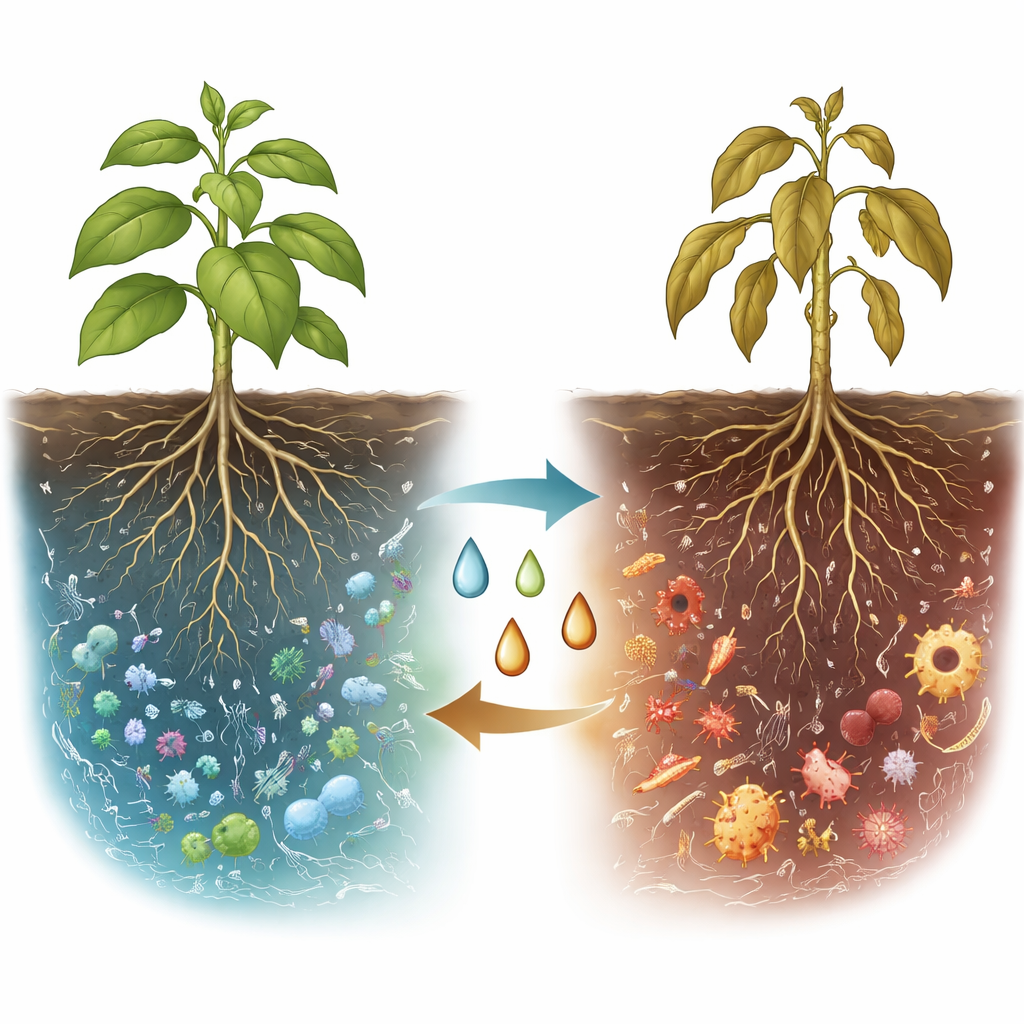
Hidden helpers and hidden threats in the soil
Fusarium wilt is a fungal disease that clogs plant vessels, leading to yellowing leaves, root rot, and sometimes complete field failure. The authors compared soil clinging to the roots of healthy tobacco plants with soil from nearby diseased plants in long-term tobacco fields in China. Instead of focusing only on the pathogen, they measured hundreds of small molecules and sequenced DNA from bacteria and fungi, building a combined picture of what was happening chemically and biologically around the roots in both conditions.
Chemical fingerprints of sick soil
The team detected more than 500 different metabolites in the rhizosphere and found that healthy soils contained a wider variety than diseased soils. Sixty‑five compounds differed clearly between the two groups. Three molecules in particular—Aesculin, 8‑Deoxy‑11‑hydroxy‑13‑chlorogrosheimin, and N‑Gluconyl ethanolamine phosphate—stood out as strongly linked with diseased soils and with microbes that thrive under disease conditions. These compounds are connected to basic cell functions such as energy use and building genetic material, suggesting that shifts in core metabolism accompany, and may even drive, the move from healthy to sick soil.
Microbial crowds and underground networks
Healthy rhizosphere soils hosted richer and more even communities of both bacteria and fungi than diseased soils. Beneficial or potentially protective groups, including Chloroflexi, Bryobacter, Bacillus, Preussia, and Tausonia, were more common in healthy samples, while disease‑associated genera such as Lysobacter, Arthrobacter, Fusarium, Lectera, and several other fungi dominated diseased soils. When the researchers mapped how these organisms co‑occur, healthy soils showed larger, denser microbial networks with many more connections among species. In diseased soils, those networks were smaller and more fragile, implying that the underground community had lost some of its ability to buffer shocks and resist invasion. 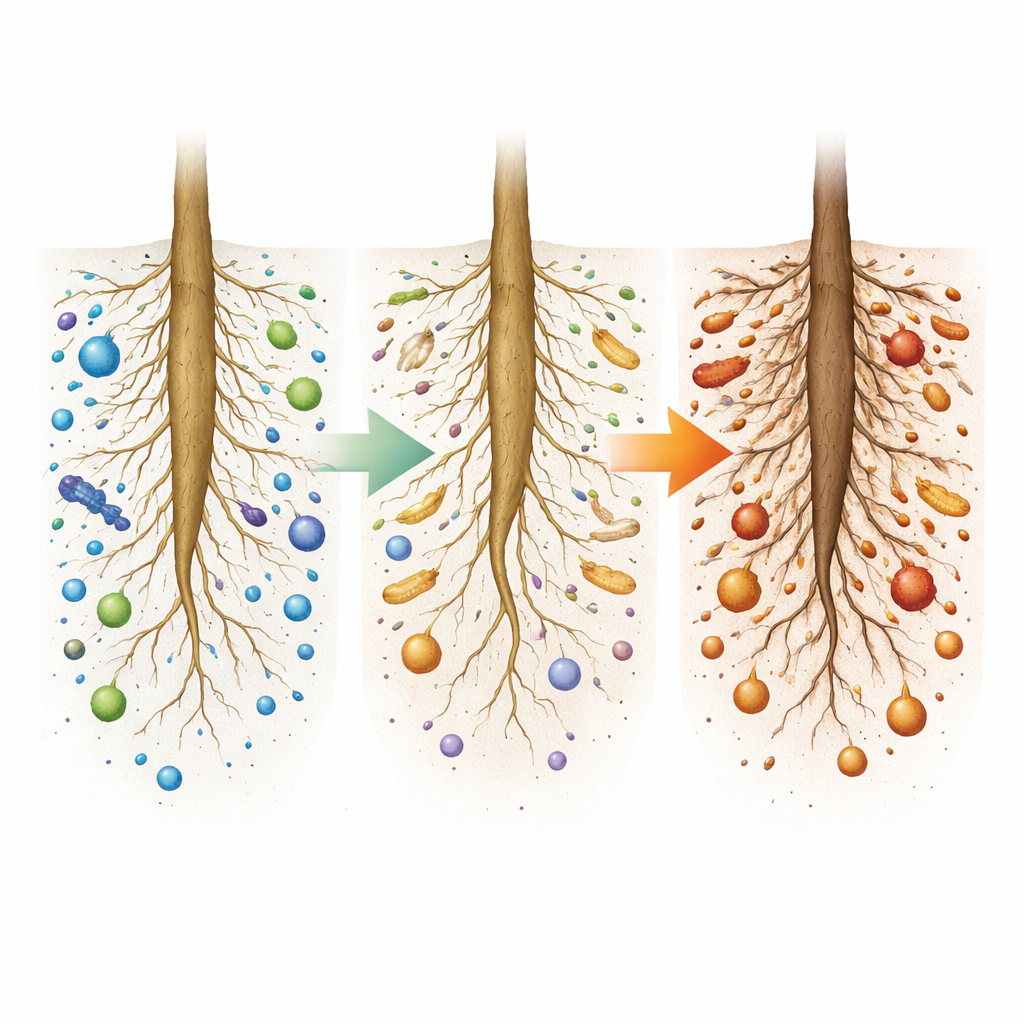
How communities form and change over time
By tracking soils at three stages of plant growth, the study also examined how microbial communities are assembled. In both bacteria and fungi, healthy soils initially followed a more predictable, environmentally driven pattern, but later shifted to a more random, flexible assembly. Diseased soils, in contrast, stayed under strong, fixed selection throughout the season, as if locked into a stressed state. The three key metabolites identified were tightly linked with microbes enriched in diseased soils and negatively linked with those associated with health, hinting at feedback loops where certain chemicals favor disease‑prone communities that, in turn, reinforce those same chemical conditions.
What this means for future crop protection
Overall, the study shows that Fusarium wilt is not just a story of a single bad fungus attacking plant roots. Instead, disease emerges from a reshaping of the entire rhizosphere “ecosystem,” including which microbes are present, how strongly they interact, and which metabolites flow around the roots. Healthy soils feature diverse, well‑connected microbial webs and more balanced chemistry, while diseased soils are chemically skewed and biologically simplified. By pinpointing specific metabolites and microbial groups tied to health or disease, this work lays a foundation for new control strategies that steer the soil community—through tailored microbes, targeted amendments, or plant breeding—toward a self‑maintaining, disease‑suppressive state, reducing reliance on chemical fungicides.
Citation: Yang, L., Yang, W., Zhang, H. et al. Fusarium wilt disease induced changes in the composition and function of the rhizosphere metabolome and microbiome in tobacco plants. Sci Rep 16, 10312 (2026). https://doi.org/10.1038/s41598-026-40653-w
Keywords: soil health, plant microbiome, Fusarium wilt, rhizosphere, tobacco crops