Clear Sky Science · en
Sintered poultry-base waste as low-cost adsorbent for the uptake of Congo red: insight into kinetics, isotherms and thermodynamics
Turning a Farm Problem into a Water Fix
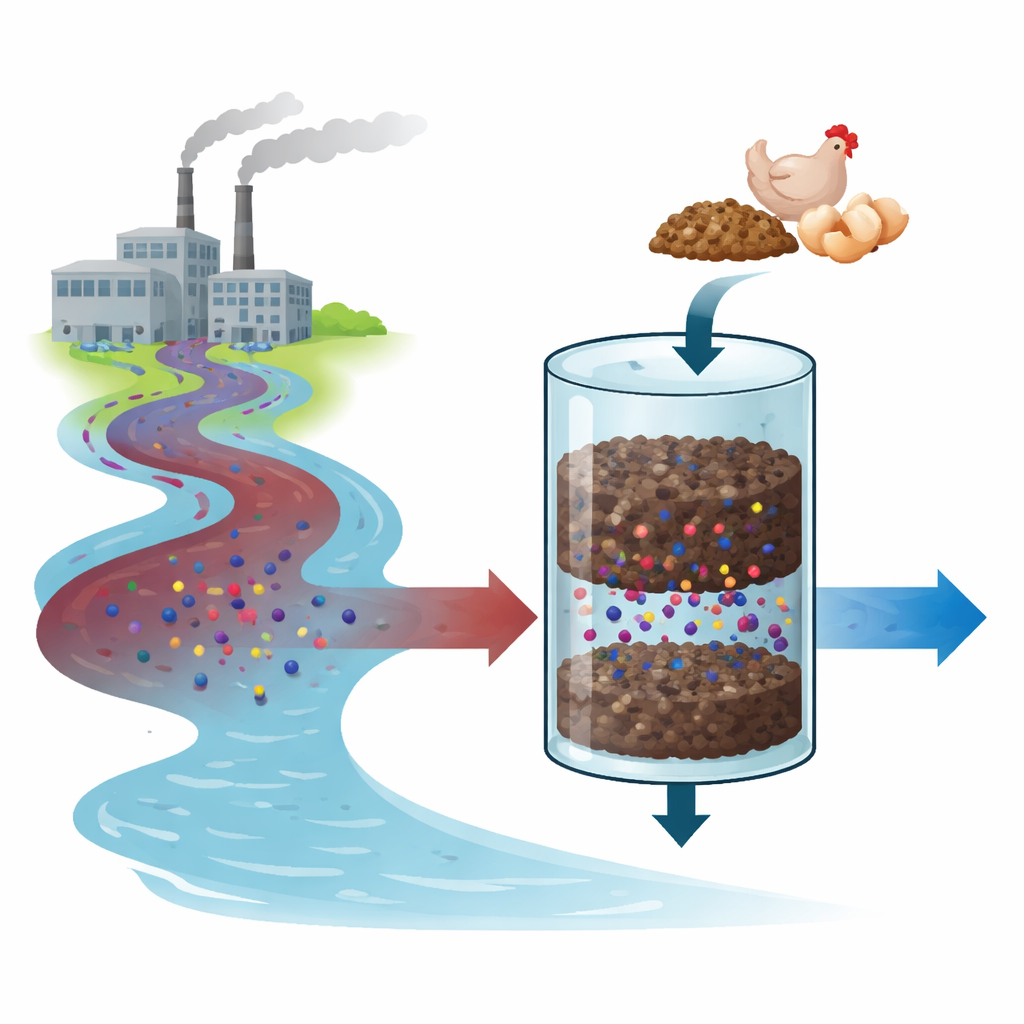
Across the world, factories that dye fabrics, make paper, plastics, and cosmetics release brightly colored wastewater that can linger in rivers and lakes for years. One particularly stubborn red dye, Congo red, is hard to remove and can harm both wildlife and people. This study explores an unexpected solution: transforming poultry-processing waste into a simple, low-cost material that can pull this dye out of water, offering a way to clean polluted streams while also reducing agricultural waste.
Why Color in Water Matters
Colored wastewater is not just an eyesore. It blocks sunlight from penetrating the water’s surface, disturbing photosynthesis and disrupting aquatic food chains. Congo red, a widely used red dye, dissolves easily, resists natural breakdown, and can irritate skin and organs and may contribute to long-term health risks. Traditional treatment methods—such as chemical oxidation, membrane filters, and advanced reactors—can remove some dyes, but they are often expensive, power-hungry, and create additional sludge that must be handled safely. As industries grow, communities, especially in developing regions, need simpler, cheaper, and more sustainable ways to clean up these polluted waters.
From Poultry Leftovers to Cleaning Granules
Poultry-based waste from slaughterhouses and processing plants is generated in huge quantities and is difficult to dispose of safely. The researchers in this study collected such waste, washed and dried it, and then processed part of it in a high-temperature furnace at 650 °C, in limited oxygen. This heat-treatment step, called sintering, burned away volatile components, opened up pores, and stabilized the material. The untreated portion was kept as-is for comparison. The two versions—raw poultry-based waste (PBW) and sintered poultry-based waste (SPBW)—were then carefully examined using microscopes and surface-analysis tools to see how their structure and composition differed.
How Well the New Material Grabs Dye
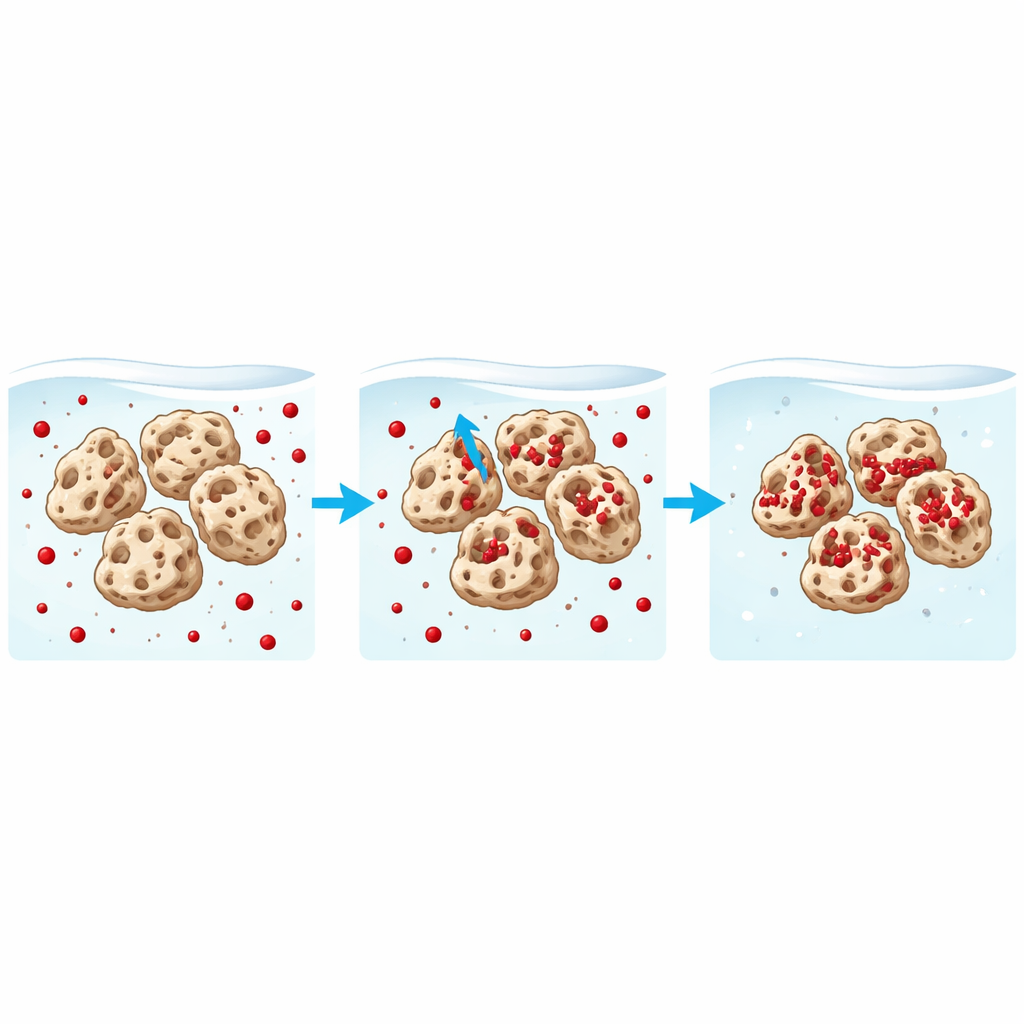
In lab tests, both PBW and SPBW were mixed with water containing Congo red under various conditions, such as different dye levels, contact times, pH values, and temperatures. The sintered material consistently absorbed more dye and did so more steadily over time. SPBW reached its equilibrium capacity in about two hours and could hold roughly 60 milligrams of dye per gram of material, compared with about 40 milligrams per gram for the untreated waste. The sintered granules had a much larger internal surface area and more connected pores, giving dye molecules many more places to stick. The process worked best in acidic water—conditions common in many dye-house effluents—and became more effective as the temperature rose, indicating that warmth helps dye molecules move into and through the pores.
Peeking Inside the Process
To understand what was happening at a deeper level, the team analyzed how quickly the dye disappeared from the water and how much ended up on the material’s surface under different scenarios. Their data showed that the rate of removal matched models where the dye first attaches to available surface sites and then slowly moves into interior pores. Other measurements suggested that several gentle forces work together: attraction between positively charged sites on the waste and the negatively charged dye, stacking of dye’s ring-shaped molecules against carbon-rich surfaces, and hydrogen bonding. Heat-treatment strengthened these effects by stabilizing useful surface groups and creating a more open, durable pore network. Importantly, when the dye-laden material was washed with a mild acidic solution, much of the dye could be released, and the same granules reused several times with only a gradual drop in performance.
What This Means for Real-World Water
For communities facing bright-red industrial discharges and growing piles of poultry waste, this work points to a promising two-in-one solution. By simply heating poultry-processing leftovers—without costly chemicals—the waste can be turned into sturdy granules that capture a troublesome dye efficiently, under conditions similar to real textile wastewater. The process is spontaneous, benefits from moderate warmth, and allows the material to be regenerated several times, which keeps ongoing costs low. While more work is needed to scale up and test with mixed, real-world effluents, sintered poultry-based waste emerges as a practical, eco-friendly candidate for dye cleanup in regions where resources are limited but the need for cleaner water is urgent.
Citation: Din, S.U., Ibrahim, A., Shawabkeh, A. et al. Sintered poultry-base waste as low-cost adsorbent for the uptake of Congo red: insight into kinetics, isotherms and thermodynamics. Sci Rep 16, 10270 (2026). https://doi.org/10.1038/s41598-026-40647-8
Keywords: wastewater treatment, dye removal, Congo red, poultry waste adsorbent, low-cost adsorbent