Clear Sky Science · en
Sea-level changes modulate beach face slope in coastal upwelling zones
Why changing sea level matters for everyday beaches
Beaches are usually pictured as passive strips of sand endlessly reshaped by waves. This study shows that another player, short‑term changes in sea level, can quietly but powerfully reshape the slope of the shore itself, especially in tropical regions affected by coastal upwelling. Understanding this hidden influence helps explain why some beaches steepen or flatten in ways that do not match the wave conditions we see at the surface, with implications for erosion risk, coastal planning, and ecosystems that depend on sandy shores.
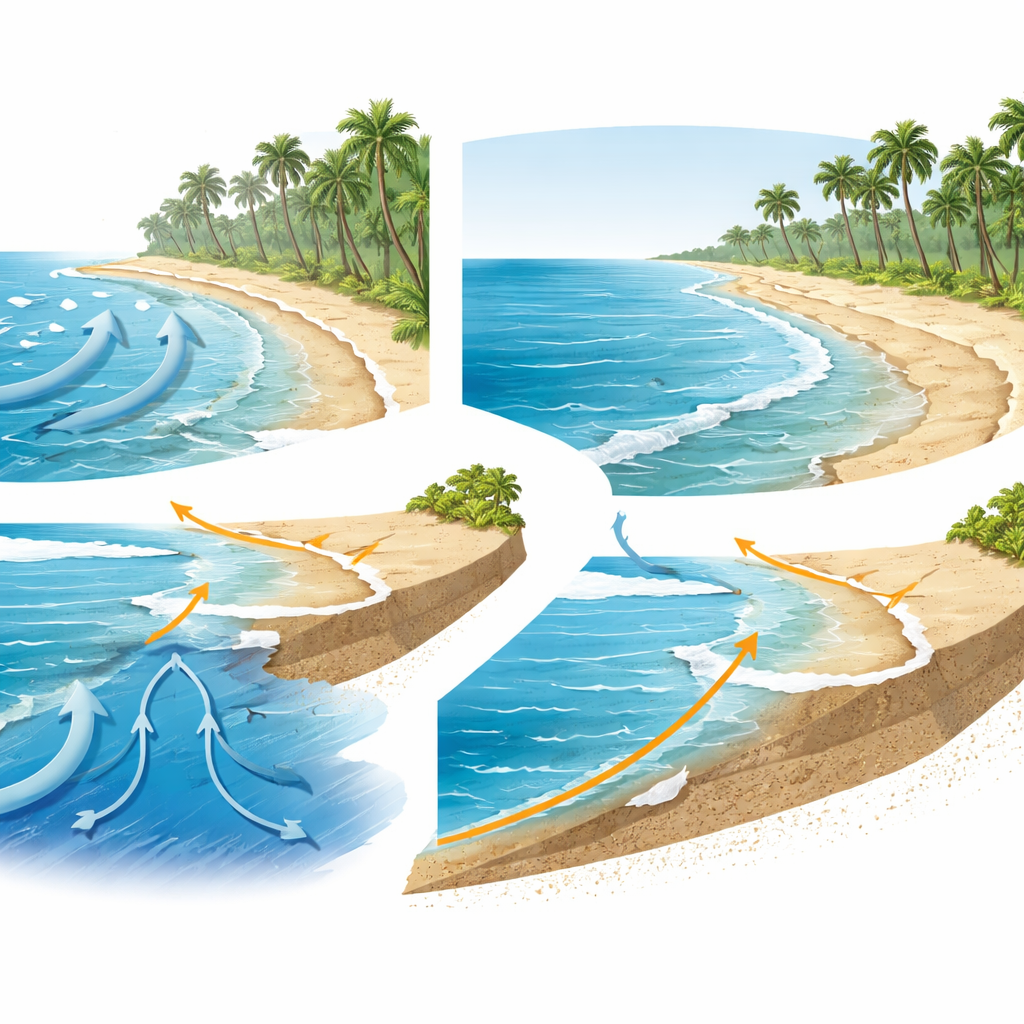
Two tropical beaches, similar sand, very different behavior
The researchers analyzed 3.5 years of daily video‑derived beach profiles at two low‑tide terrace beaches: Grand Popo in Benin, West Africa, and Nha Trang in southern Vietnam. Both sites are microtidal (with relatively small tides), have similar sand grain size, and share a characteristic shape: a steep upper beach that meets a gently sloping sandy terrace submerged at low tide. According to classic theory, the overall beach form at such sites should be largely controlled by wave energy, summarized in a dimensionless measure known as the Dean number. As waves grow stronger, the beach face should flatten; as waves weaken, it should steepen. Grand Popo follows this rule fairly well. Nha Trang, however, shows puzzling seasonal episodes in which the beach face gets steeper while the shoreline erodes, or flattens while the beach builds out—behaviors that run counter to what waves alone should produce.
Tracking how the shoreline and slope move together
To untangle these patterns, the authors introduced a simple diagnostic tool called the Swash Dynamic Diagram. It tracks, month by month, how two quantities change together: the steepness of the upper beach and the cross‑shore position of the shoreline. When waves dominate, accretion tends to go with steepening and erosion with flattening, defining what the authors call “Mode 1” evolution. Grand Popo’s data cluster neatly along this mode. At Nha Trang, though, a second co‑evolution pattern, “Mode 2,” emerges. In this mode, erosion comes with a steeper beach, and accretion with a flatter one—almost a mirror image of the wave‑driven behavior. Intriguingly, Mode 2 appears both when waves dissipate mainly in the swash zone and when they are strongly transformed over the offshore terrace, hinting that another control, beyond offshore wave energy, is at work.
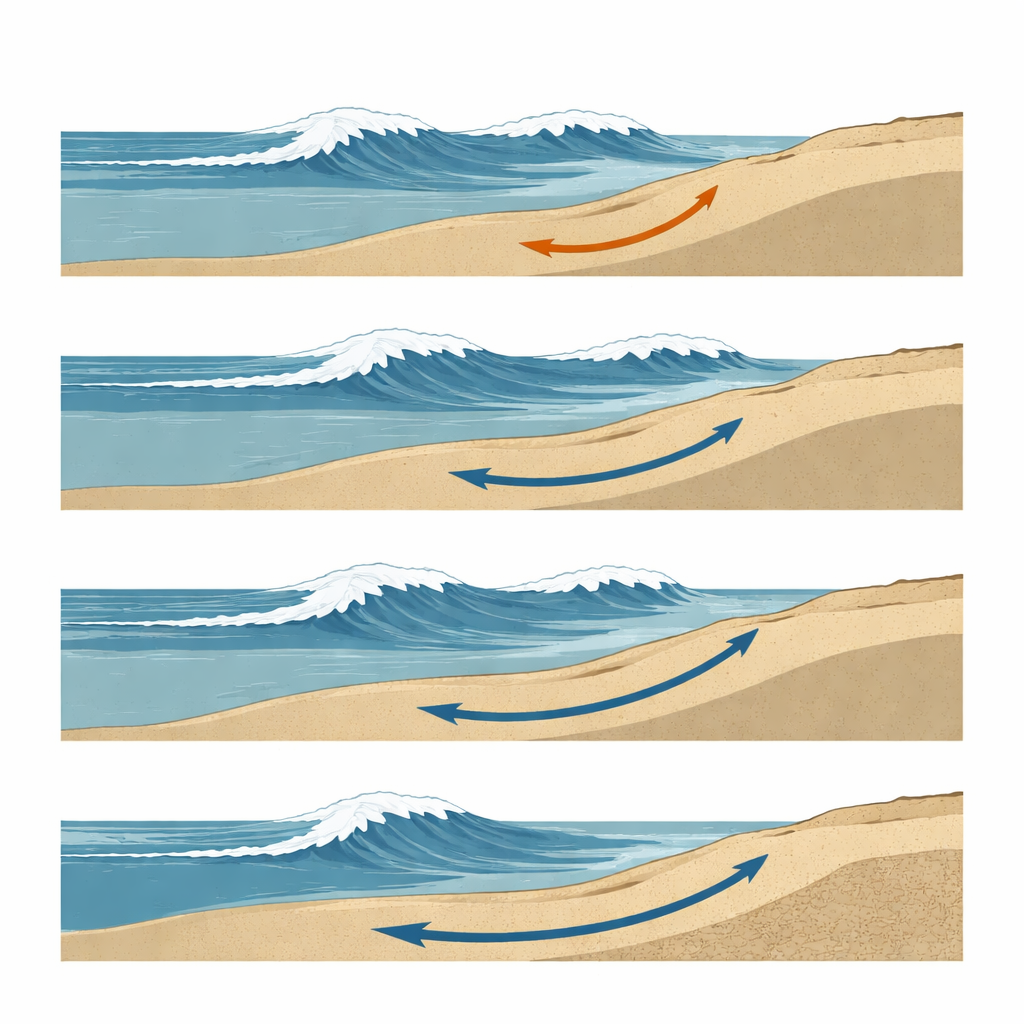
The hidden role of coastal upwelling and water level swings
The team then examined broader ocean conditions along the Vietnamese coast. Each year, as winds reverse direction and drive surface water offshore, an upwelling system develops: cooler, deeper water rises near the coast, sea surface temperature drops, and satellite measurements show a negative sea level anomaly—a temporary local lowering of sea level. At the same time, the contribution of waves to nearshore water level also decreases. When combined, these effects produce the lowest total coastal water levels of the year precisely during the period when Nha Trang displays its puzzling Mode‑2 behavior under otherwise modest wave energy. This suggests that vertical shifts in water level change where waves break and where swash runs up the beach, reorganizing where sand is picked up and dropped, and thereby altering the beach face slope independently of changes in wave strength.
Wave tank experiments that replay nature in miniature
To test this idea, the authors built a scaled physical model in a narrow flume: a simple sandy beach with a steep upper slope and a short sandy terrace, forced by controlled monochromatic waves. By systematically changing both wave conditions and the water depth over the terrace, they recreated transitions between different nearshore states. Under higher water levels, the model beach behaved like Grand Popo: changes in wave energy alone produced Mode‑1 behavior, with predictable links between accretion, erosion, and slope change. When they lowered the water level so that waves began to break earlier over the terrace, the same range of wave conditions produced Mode‑2 trajectories, with the slope and shoreline moving in opposite directions. A key nondimensional ratio comparing wave height to water depth over the terrace emerged as a rough threshold: when this ratio approached or exceeded unity, water‑level control over sand redistribution became dominant.
What this means for coasts in a changing ocean
The study concludes that short‑term sea‑level modulations—driven here by coastal upwelling, but potentially also by mesoscale eddies, atmospheric pressure systems, or large‑scale climate patterns—can steer how beaches migrate between their preferred shapes. In low‑tide terrace settings, these vertical shifts in water level can be just as important as the waves themselves in deciding whether a beach steepens, flattens, erodes, or recovers. For non‑specialists, the key message is that “sea‑level change” is not only about long‑term global rise: seasonal and regional bumps and dips of a few tens of centimeters can quietly tip the balance of sand along the shore, challenging traditional wave‑only frameworks and calling for coastal models and management plans that explicitly account for these hidden water‑level swings.
Citation: Aparicio, M., Lacaze, L., Almar, R. et al. Sea-level changes modulate beach face slope in coastal upwelling zones. Sci Rep 16, 10032 (2026). https://doi.org/10.1038/s41598-026-40630-3
Keywords: coastal upwelling, beach erosion, sea level variability, nearshore morphodynamics, tropical sandy beaches