Clear Sky Science · en
Vibrational contribution to the sub-terahertz dielectric response of kinesin and its hydration shell
Why tiny protein vibrations matter
Inside every living cell, molecular machines called proteins constantly flex, twist, and vibrate as they perform vital tasks. One such machine, the motor protein kinesin, literally walks along cellular tracks to haul cargo. This study asks a subtle but important question: how do the tiniest, ultrafast vibrations of kinesin—and the thin layer of water clinging to it—shape the way it responds to very high‑frequency electromagnetic fields in the sub‑terahertz range? The answer could influence how we sense protein motions, design new bio‑inspired devices, and possibly steer protein function using tailored electromagnetic signals.
Motors that walk and quietly hum
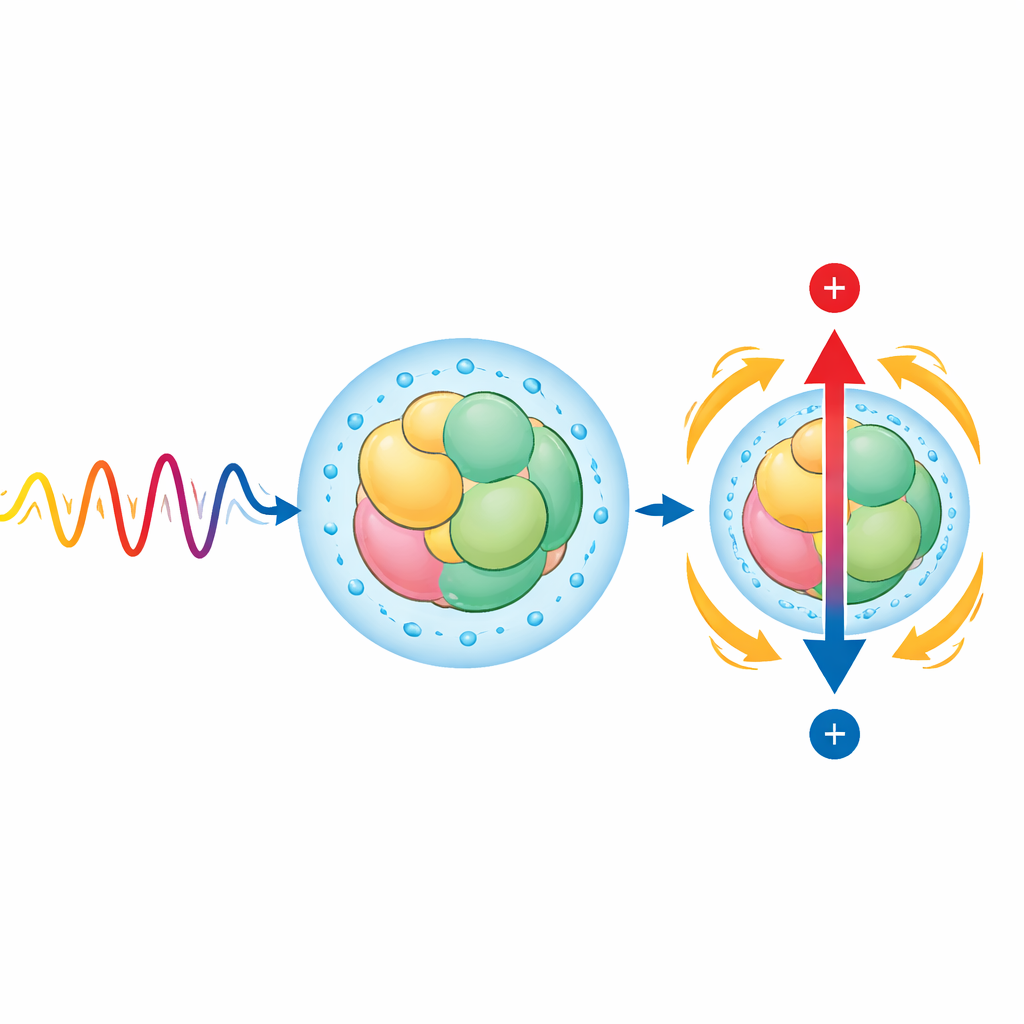
Kinesin is best known for its visible, stepwise motion along microtubules during cell division and cargo transport in neurons. Beneath these larger movements, however, lies a rich spectrum of internal vibrations that occur billions of times per second. The authors used detailed computer simulations to analyze these collective vibrational modes in the “motor domain” of kinesin—the part that binds fuel molecules and interacts with its track. By combining molecular dynamics, which samples realistic protein shapes, with normal mode analysis, which extracts characteristic vibrational patterns, they calculated how these motions change the protein’s electrical dipole and thus how strongly kinesin interacts with sub‑terahertz electromagnetic waves.
The special water skin around proteins
Proteins do not operate in isolation; they are wrapped in a shell of water whose behavior differs from ordinary bulk liquid. The team first examined how water molecules move in successive layers around kinesin during a 30‑nanosecond simulation. They found that water within about 3 ångströms of the protein surface tends to linger longer and move more slowly than water farther away. This “bound water” forms a graded hydration layer rather than a sharp boundary, but the innermost shell is clearly distinct. Based on this, the authors constructed two systems for vibrational analysis: dry kinesin and kinesin surrounded by just this thin bound‑water layer, allowing them to isolate how the immediate hydration shell reshapes the vibrational and dielectric response.
How water stiffens the molecular dance
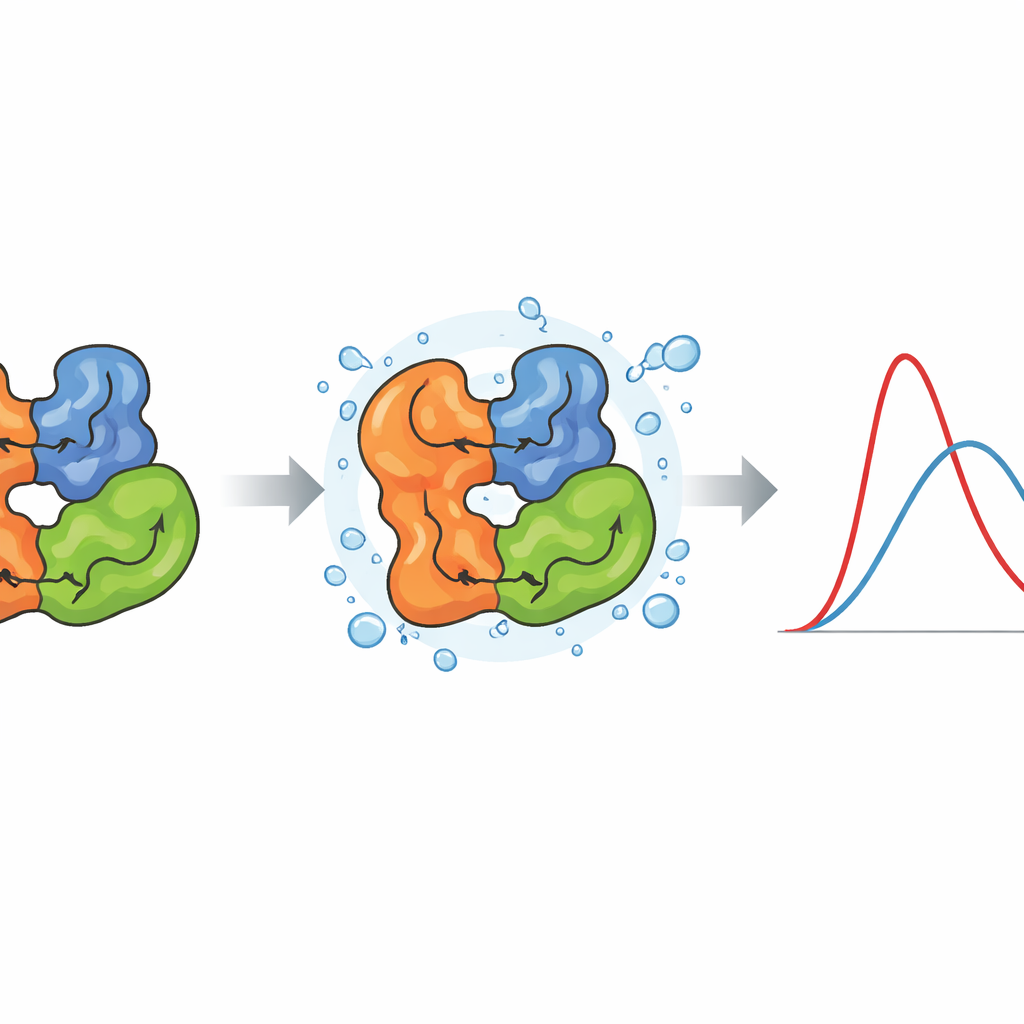
Using the computed vibrational modes, the researchers predicted how kinesin would store and dissipate energy from an applied electric field, quantified through dielectric susceptibility and absorption spectra. Compared with the dry protein, the hydrated kinesin showed a “blue‑shift” of its absorption: low‑frequency peaks weakened while higher‑frequency contributions became relatively stronger, as if the water shell made the system mechanically stiffer. In the crucial 0–400 GHz range, both the ability to store energy and the energy loss (absorption) were reduced when bound water was included. By decomposing the total response into separate contributions from the protein and the water, they discovered that the overall absorption is not a simple sum of the two. Instead, the fluctuating dipoles of protein and water tend to orient partly opposite to one another, leading to partial cancellation and therefore a lower net signal.
Comparing molecular machines and tuning conditions
To place kinesin in context, the authors reused earlier vibrational data for another cellular workhorse, the tubulin dimer, which forms the tracks kinesin walks on. After converting those data into absolute absorption units using the same framework, they found that tubulin absorbs more strongly in the sub‑terahertz range than kinesin when both include a similar hydration shell. This is largely because tubulin is bigger and has more low‑frequency vibrational modes packed into a given frequency window. The study also explored how damping (which broadens and weakens vibrational resonances) and protein concentration affect the spectra. As expected, higher concentrations scale the absorption nearly linearly, reflecting more vibrating molecules per unit volume, while stronger damping smooths out sharp features into broader, flatter curves.
What this means for sensing and controlling proteins
In plain terms, the work shows that a thin, tightly bound layer of water can significantly reshape how a protein vibrates and how it interacts with high‑frequency electromagnetic fields. The hydration shell not only shifts key vibrational features to higher frequencies but also reduces the overall absorption by partially cancelling the protein’s own electrical response. Because these effects are quantified in absolute physical units, the results offer a bridge between theory and experiments that probe proteins with terahertz and sub‑terahertz radiation. Beyond deepening our understanding of how water and proteins move together, this knowledge may help refine techniques for monitoring protein conformational changes, improve models of biological tissues exposed to electromagnetic fields, and guide the design of nanoscale devices that harness protein vibrations as functional elements.
Citation: Pandey, S.K., Cifra, M. Vibrational contribution to the sub-terahertz dielectric response of kinesin and its hydration shell. Sci Rep 16, 11508 (2026). https://doi.org/10.1038/s41598-026-40625-0
Keywords: kinesin, protein vibrations, terahertz spectroscopy, hydration shell, dielectric response