Clear Sky Science · en
Sodium and potassium analysis of individual coccoliths by secondary ion mass spectrometry
Tiny Ocean Builders with a Big Climate Story
Coccolithophores are microscopic algae that coat themselves in intricate armor made of calcium carbonate plates called coccoliths. When these organisms die, their plates rain down to the seafloor and accumulate as sediment, quietly recording information about the oceans in which they grew. If scientists can read the chemical signatures locked inside individual coccoliths, they gain a powerful way to reconstruct past ocean conditions such as temperature, chemistry, and possibly even salinity. This study asks whether the amounts of two everyday elements—sodium and potassium—inside coccoliths can serve as such “time‑capsule” tracers of ancient seas.
Why These Shells Matter for Earth’s Past
Coccolithophores have been part of the oceans for more than 200 million years and play a key role in the global carbon cycle. Their calcium carbonate plates help move carbon from the surface ocean to the deep sea, influencing long‑term climate. Because their remains are widespread and well preserved in marine sediments, they are ideal candidates for reading Earth’s environmental history. Traditionally, scientists have relied on the relative abundance of species, plate sizes, or organic molecules produced by these algae to infer past temperatures and carbon dioxide levels. Inorganic “fingerprints” in the coccolith calcite itself—ratios of elements like magnesium or strontium to calcium—offer another, often more direct, window into past seawater conditions.
Looking for New Chemical Clues
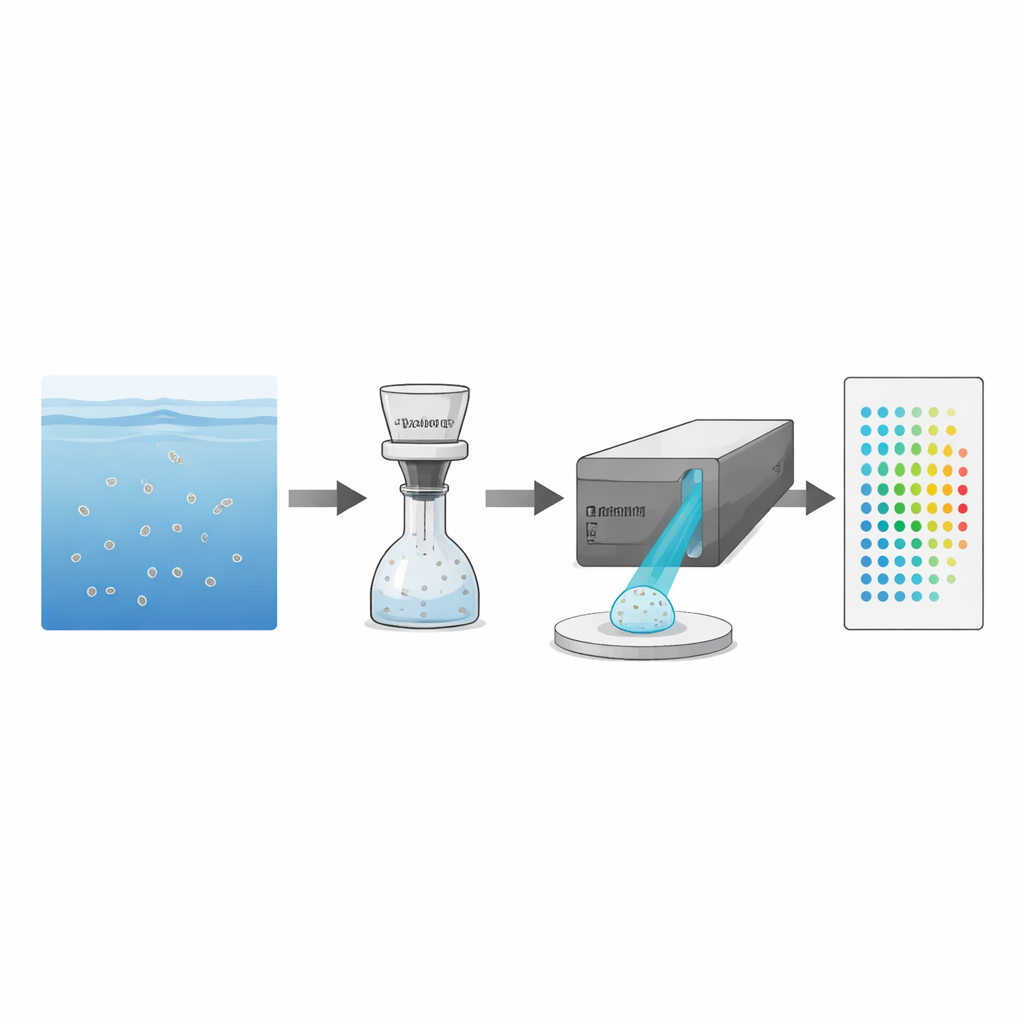
The authors focused on coccoliths of the species Emiliania huxleyi (recently renamed Gephyrocapsa huxleyi), one of the most common modern coccolithophores. They asked whether sodium and potassium, alongside better‑studied elements like magnesium and strontium, might track environmental properties such as salinity and alkalinity (a measure related to seawater’s buffering capacity). To probe extremely small structures without destroying them, the team used nano‑scale secondary ion mass spectrometry (NanoSIMS). In this method, a focused ion beam rasters across a single coccolith and sputters off tiny fragments; detectors then count the ions of different elements, allowing the researchers to map how elements are distributed within each plate and to calculate their ratios to calcium.

Separating True Signals from Contamination
Because coccoliths are so small and have a large surface area relative to their volume, they are especially vulnerable to contamination from sea salt crystals and organic matter that can cling to their surfaces. This poses a serious problem when trying to measure sodium and potassium, which are also abundant in seawater. The team designed a careful workflow: coccoliths from both natural samples (from the Mediterranean and Black Seas) and laboratory cultures were filtered, rinsed with buffer, dried, and then imaged. Using NanoSIMS image stacks, the researchers identified and digitally excluded pixels and depth intervals showing obvious contamination, and they corrected for random counting noise. After this rigorous filtering, they found that sodium, potassium, magnesium, and strontium appeared evenly distributed within each coccolith at the spatial resolution of their measurements, suggesting that any remaining signal reflected the coccolith’s internal composition rather than surface dirt.
What the Element Ratios Reveal—and What They Don’t
Even after accounting for contamination, the elemental ratios varied strongly from one coccolith to another within the same sample. Strontium to calcium ratios were relatively consistent, hinting at tight biological control and incorporation into the regular calcite lattice. By contrast, sodium, potassium, and magnesium showed much larger variability, implying that they may enter the coccolith through less strictly controlled pathways, possibly involving organic components or post‑formation processes at the cell surface. When the authors compared coccolith chemistry to environmental data, they found only limited patterns. In the Mediterranean samples alone, sodium and magnesium ratios tended to decrease as salinity and alkalinity increased, while strontium showed the opposite behavior. However, these trends weakened or changed when Black Sea samples were included, and they did not reappear in controlled laboratory cultures where salinity and alkalinity were varied independently. This suggests that other, unmeasured environmental or biological factors have a strong influence.
Implications for Reading the Ocean’s Archive
The study provides the first detailed measurements of sodium and potassium in individual coccoliths and shows that these elements can be measured reliably with NanoSIMS after careful correction for contamination. However, the results also indicate that their incorporation into coccolith calcite is largely governed by biological controls within the algae rather than directly mirroring seawater salinity or alkalinity. In simple terms, the tiny ocean builders appear to “decide” how much sodium and potassium to lock into their shells, obscuring any straightforward link to the surrounding water. As a result, sodium and potassium in coccoliths are not yet ready to serve as robust gauges of past ocean salinity. Before these chemical clues can be confidently used to read Earth’s climate history, scientists will need a deeper understanding of how coccolithophores regulate trace elements during shell formation.
Citation: Roepert, A., Middelburg, J.J., Weiss, G.M. et al. Sodium and potassium analysis of individual coccoliths by secondary ion mass spectrometry. Sci Rep 16, 11348 (2026). https://doi.org/10.1038/s41598-026-40623-2
Keywords: coccolithophores, paleoceanography, trace elements, NanoSIMS, ocean salinity