Clear Sky Science · en
Artificial intelligence tools for AgNP-SSB-SN and AgNP-CSS-SN biosynthesis from Synechococcus PCC 11901 and Chlorella sorokiniana MSP1 for hazardous dyes remediation
Turning Colorful Pollution into Clear Water
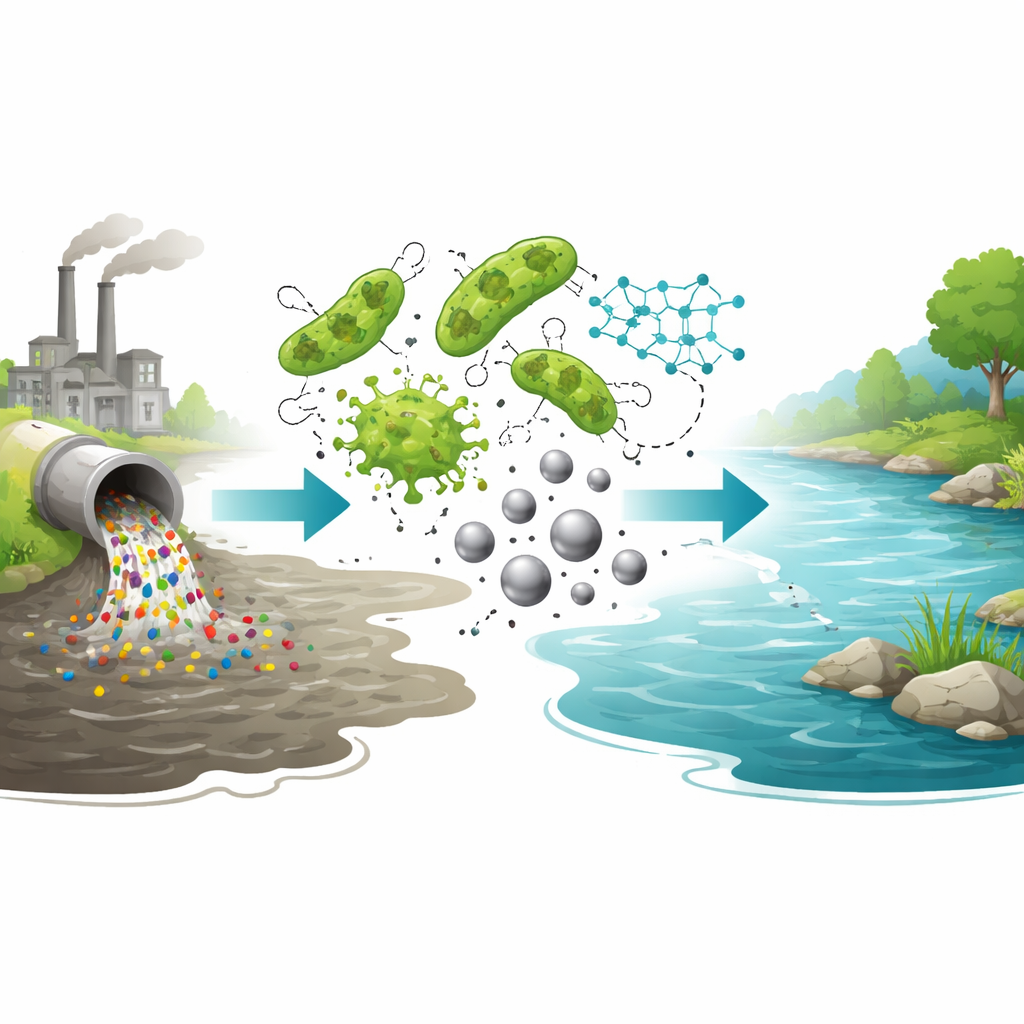
Brightly colored industrial dyes make our clothes vivid and our foods appealing, but when they end up in rivers and lakes, they pose serious risks to ecosystems and human health. This study explores a nature-inspired way to clean such polluted water, using microscopic algae and bacteria-like organisms to grow tiny particles of silver. Guided by artificial intelligence, the researchers fine-tune this process so that the silver particles can break down stubborn dyes with remarkable efficiency.
Tiny Helpers from Sun-Loving Microbes
The work centers on two fast-growing, photosynthetic microorganisms: a cyanobacterium called Synechococcus PCC 11901 and a green microalga, Chlorella sorokiniana MSP1. Instead of relying on harsh chemicals to make silver nanoparticles, the team uses extracts from these microbes. Natural compounds in the extracts, such as pigments and proteins, act as gentle “reducing agents,” turning dissolved silver ions into solid silver particles only a few billionths of a meter across. This approach taps into organisms that are already easy to grow in large tanks using light, water, and simple nutrients, making the process potentially scalable and eco-friendly.
Letting Artificial Intelligence Tune the Recipe
Making nanoparticles is like cooking: the final product depends on how much of each ingredient you use and how long you let the mixture react. Here, the key knobs are the amount of microbial extract, the concentration of silver salt, and the reaction time. Rather than changing one factor at a time, the researchers first used a statistical design of experiments to map how these variables interact. They then fed these data into an artificial neural network—software loosely inspired by brain circuitry—and coupled it with a genetic algorithm that mimics evolution by repeatedly testing and keeping the best-performing combinations. This hybrid AI tool was able to predict conditions that maximize nanoparticle yield with high accuracy, giving correlation scores of about 0.97 and 0.98 for the two microbe-based systems.
Probing Shape, Stability, and Strength
To understand what they had made, the team examined the particles using a suite of imaging and analytical tools. Electron microscopes showed that particles made from Synechococcus extract averaged about 11 nanometers across and tended to form cube-like shapes, while those from Chlorella were somewhat larger and more spherical, around 26 nanometers. Other techniques confirmed that the particles were crystalline silver, coated by organic molecules from the extracts that help keep them dispersed in water and resistant to clumping. Thermal tests showed that the particles retained most of their mass even at several hundred degrees Celsius, indicating good stability for real-world use.
Putting the Nanoparticles to Work on Hazardous Dyes
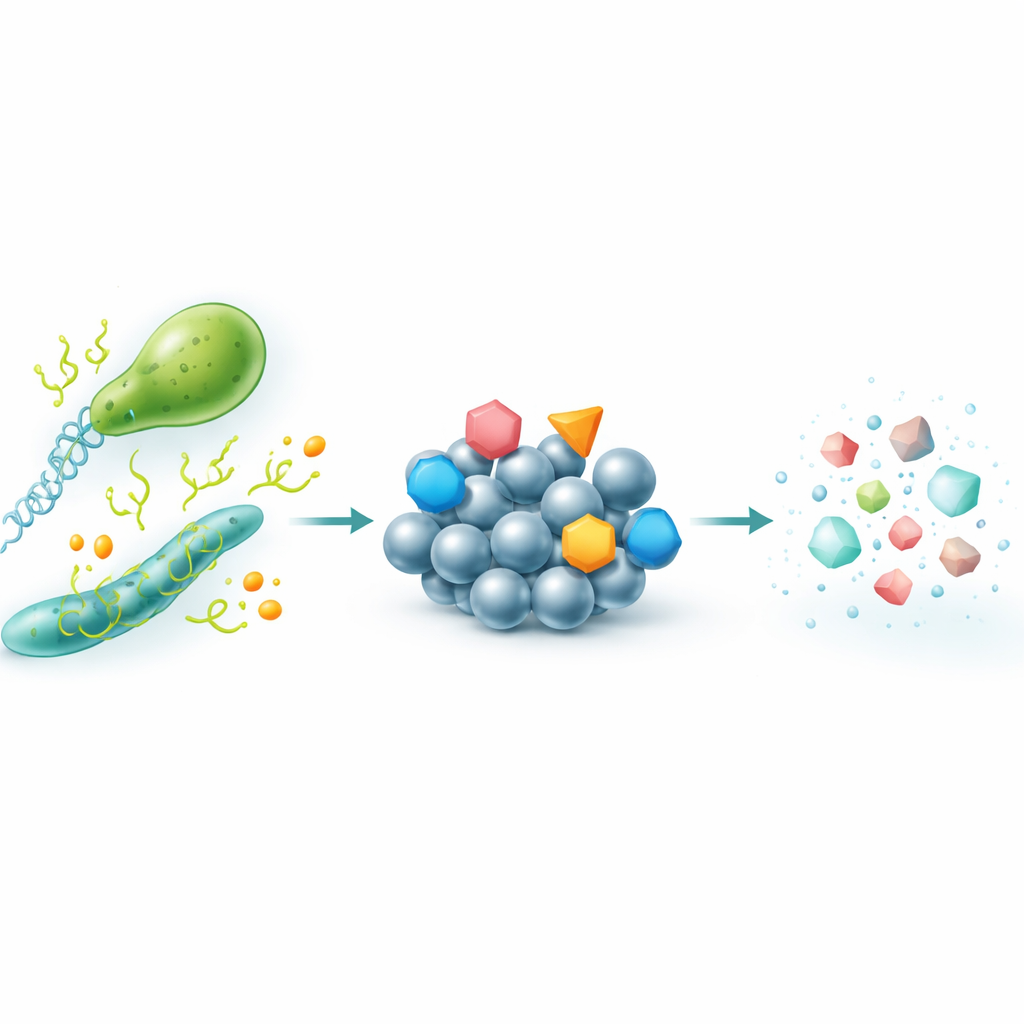
The ultimate test was whether these bio-grown particles could clean up problem dyes. The researchers focused on Orange II, a negatively charged azo dye often used in textiles, and Sudan Black, a neutral dye used in various industrial applications. When the nanoparticles were added to dye-contaminated water under optimized conditions, they removed nearly all of the color. The Synechococcus-based particles degraded about 99.8% of Orange II and over 98% of Sudan Black; the Chlorella-based particles achieved slightly lower removal of Orange II but similar performance on Sudan Black. By tracking how quickly the dyes disappeared, the team found that the process followed a “pseudo-second-order” pattern, a technical way of saying that the rate strongly depends on how many active sites are available on the nanoparticle surfaces.
From Lab Discovery to Cleaner Rivers
In plain terms, this study shows that sunlight-powered microbes, guided by smart algorithms, can be turned into miniature factories for powerful cleaning agents. The silver nanoparticles they produce are small, stable, and highly effective at breaking down hazardous dyes that conventional treatments struggle to remove. While further work is needed to scale up the process and assess long-term safety and reuse, the results point toward a future where engineered microbe–nanoparticle systems help strip toxic color from wastewater before it reaches rivers and seas, offering a greener path to cleaner water.
Citation: Tiwari, D., Gupta, G.K., Chhabra, D. et al. Artificial intelligence tools for AgNP-SSB-SN and AgNP-CSS-SN biosynthesis from Synechococcus PCC 11901 and Chlorella sorokiniana MSP1 for hazardous dyes remediation. Sci Rep 16, 13699 (2026). https://doi.org/10.1038/s41598-026-40621-4
Keywords: silver nanoparticles, microalgae, dye degradation, artificial intelligence optimization, wastewater treatment