Clear Sky Science · en
AI-based intelligent sensing detection of cybersecurity threats using multimodal sensor data in smart devices
Why Your Everyday Gadgets Need Better Nerves
Phones, fitness bands, smart speakers, and thermostats quietly surround us, sensing how we move, what we say, and the temperature of our homes. The same sensors that make these gadgets helpful can also be abused by attackers who want to spy, steal data, or sabotage devices. This paper shows how combining signals from many sensors and analyzing them with advanced artificial intelligence can catch such cyber-physical attacks quickly, even on small, low-power devices.

The Hidden Weak Spots in Smart Devices
Smart devices are spreading through homes, hospitals, factories, and cities, bringing convenience and automation. But they are also easy targets. Traditional security tools focus on network traffic and fixed rules, which struggle to keep up with fast-changing attacks and cannot easily see what is happening inside a device. Many internet-connected gadgets have limited processing power and battery life, so they cannot run heavy protection software. Meanwhile, their built-in sensors constantly stream motion, sound, and temperature data, which attackers can manipulate to hijack devices, disrupt services, or violate privacy.
Listening to Many Senses at Once
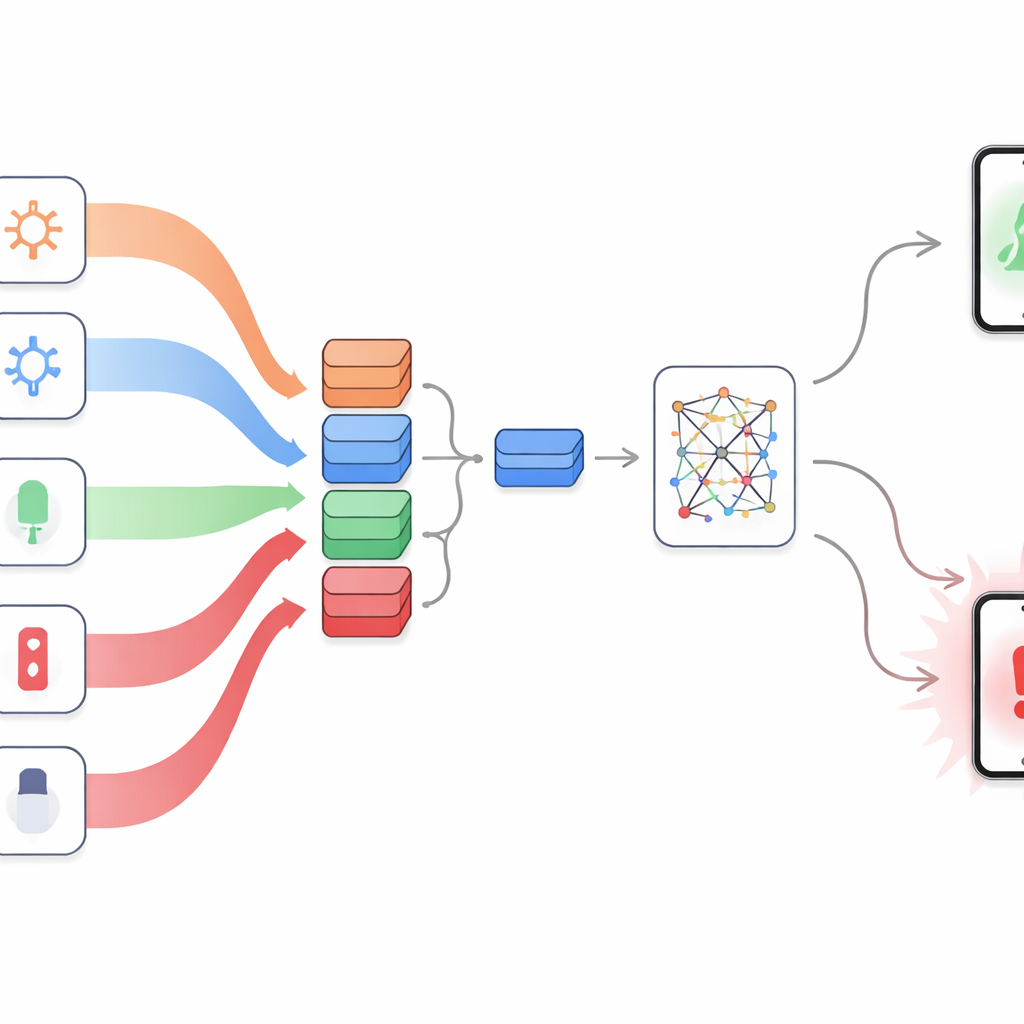
The authors propose a new way to defend these devices by treating sensors as an early-warning system. Instead of looking only at network packets, their framework watches four on-device sensors at the same time: accelerometer, gyroscope, microphone, and temperature. Each sensor captures a different aspect of physical behavior—vibration, rotation, sound, and heat. When fused together, these streams form a rich “story” of how a device should normally behave. Any unusual combination, such as odd vibrations plus unexpected heat or strange sounds, can signal tampering, spoofing, or other forms of attack—even if network connections are blocked or forged.
How the AI Brain Learns from Sensor Streams
To make sense of this flood of data, the study builds a hybrid deep learning model that mimics how we process patterns over space and time. First, separate branches of a convolutional network analyze each sensor’s signal, extracting shapes that correspond to characteristic vibrations, acoustic fingerprints, or temperature shifts. These feature maps are then stitched together into a shared representation and passed to a recurrent network that tracks how patterns evolve over time, capturing the rhythm of normal and malicious behavior. On top of this, a Transformer module applies an attention mechanism that highlights the most important cross-sensor relationships and long-range dependencies, helping the system notice subtle, stealthy threats.
Proving It Works in the Lab and at the Edge
The researchers test their framework on a controlled multimodal dataset they collected and on two widely used cybersecurity benchmarks, CICIDS-2017 and IoT-23. Across these data sources, the model reliably distinguishes normal activity from several common attack types, including denial-of-service, spoofing, replay, man-in-the-middle, and physical tampering. It achieves a high area-under-curve score of 0.96 and an F1-score of 0.94, outperforming state-of-the-art methods that rely on a single type of data or simpler models. Importantly, they deploy the system on a modest Raspberry Pi 4 and show that it can make decisions in about 23 milliseconds, with a compact model size of roughly 4.2 megabytes, which fits the tight resource limits of many consumer devices.
What This Means for Safer Connected Lives
In essence, the paper demonstrates that fusing data from multiple sensors and analyzing it with a carefully designed deep learning pipeline can give smart devices a kind of built-in “sixth sense” for danger. Instead of depending solely on distant servers or network firewalls, gadgets can monitor their own physical signals and raise alarms when something feels off. This approach makes protection more robust, as it continues to work even when connections are unreliable, and it is efficient enough for tiny, low-power hardware. As more everyday objects join the internet, such intelligent sensing could become a cornerstone of keeping our homes, hospitals, and factories both smart and safe.
Citation: Latif, M., Abro, A.A., Daniyal, S.M. et al. AI-based intelligent sensing detection of cybersecurity threats using multimodal sensor data in smart devices. Sci Rep 16, 11091 (2026). https://doi.org/10.1038/s41598-026-40614-3
Keywords: Internet of Things security, multimodal sensors, cyber-physical attacks, deep learning detection, edge device protection