Clear Sky Science · en
One-pot multicomponent diastereoselective synthesis of indoline spirobicyclics using a recyclable chiral nanomagnetic L-proline catalyst under mild conditions
Clever Chemical Building with Tiny Magnets
Modern chemistry is under pressure to make valuable molecules while wasting less energy and producing less pollution. This study shows how tiny magnetic particles can be turned into reusable “mini factories” that snap together several simple ingredients in one step to build complex ring‑shaped molecules. These products, called indoline spirobicyclics, are useful frameworks for dyes, sensors, and potential medicines. By attaching a natural amino acid to a magnetic core, the researchers create a catalyst that works at room temperature, without added solvent, and can be pulled out with a magnet and reused.
Tiny Magnets as Reusable Helpers
At the heart of the work is a special kind of catalyst: a nanoparticle made of iron oxide (a magnetic material) coated with a thin shell of silica (similar to glass) and then decorated with small organic groups. On the outside, the team attaches a modified version of L‑proline, an amino acid often called a “simple enzyme” because it can guide many reactions. The result is a chiral nanomagnetic catalyst – “chiral” meaning it can favor one three‑dimensional arrangement of atoms over another, much like a right hand differs from a left hand. Because the particles are magnetic, they can be collected from a reaction mixture simply by applying a magnet, instead of using energy‑intensive filtration or distillation.
Checking the Structure from Core to Shell
To prove that they had built the catalyst as designed, the scientists used a battery of physical and chemical tests. Infrared spectroscopy, nuclear magnetic resonance, and mass spectrometry confirmed the organic part – the proline‑based fragment and how it is linked to a triazine ring “anchor.” X‑ray diffraction showed that the iron oxide core keeps its crystalline structure even after coating and functionalization. Electron microscope images revealed nearly spherical particles with an iron‑rich core, a lighter silica layer, and an even lighter organic shell, with average sizes in the tens of nanometers, far below the width of a human hair. Thermal analysis demonstrated that the material remains stable up to several hundred degrees Celsius, and magnetic measurements confirmed strong superparamagnetic behavior, meaning the particles respond quickly to a magnet but do not clump permanently when the field is removed.
One‑Pot Construction of Complex Rings
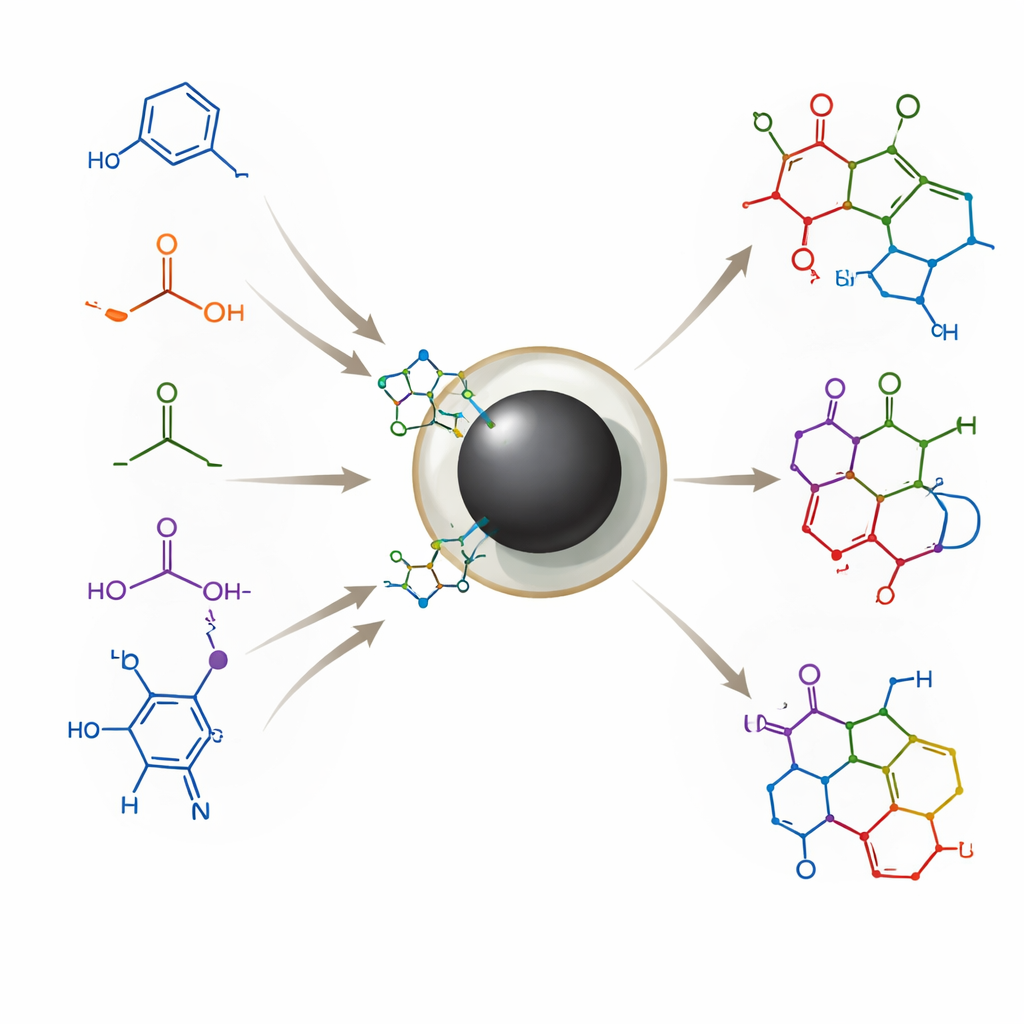
The real test of the catalyst is whether it can guide a demanding multicomponent reaction. The team designed a “one‑pot” process in which four different starting materials – an aniline (a simple aromatic amine), a carbon‑based acid such as dimedone or related rings, an aldehyde, and a so‑called Fischer’s base – are all combined with the magnetic catalyst. Under mild, solvent‑free conditions at room temperature, these pieces link together in sequence to form indoline spirobicyclic products, where two or more ring systems share a single carbon atom. These spiro compounds are valued for their light‑responsive behavior and potential use in optical switches, data storage, and other functional materials. In many cases, the reactions give high to excellent yields and, more importantly, produce almost exclusively one relative arrangement (anti versus syn) of the groups around the spiro center.
How the Catalyst Steers Shape and Cleanliness
To understand how the catalyst imposes such control, the authors carried out detailed studies of selected products using advanced NMR methods, X‑ray crystallography, and chromatography. These techniques confirmed the three‑dimensional shapes and showed that, in most examples, one diastereomer dominates almost completely. The authors propose a step‑by‑step pathway: the proline fragment on the catalyst temporarily activates the aldehyde, while another part activates the carbon acid and aniline. These activated partners form reactive intermediates that are held close together on the surface of the nanoparticle in a fixed orientation. A final ring‑closing step then locks in the spiro structure with a preferred handedness. When alternative carbon acids are used, the pathway subtly shifts and can even bypass the aniline, leading instead to related spiro compounds known as spiropyrans.
Green, Reusable Tools for Future Molecules
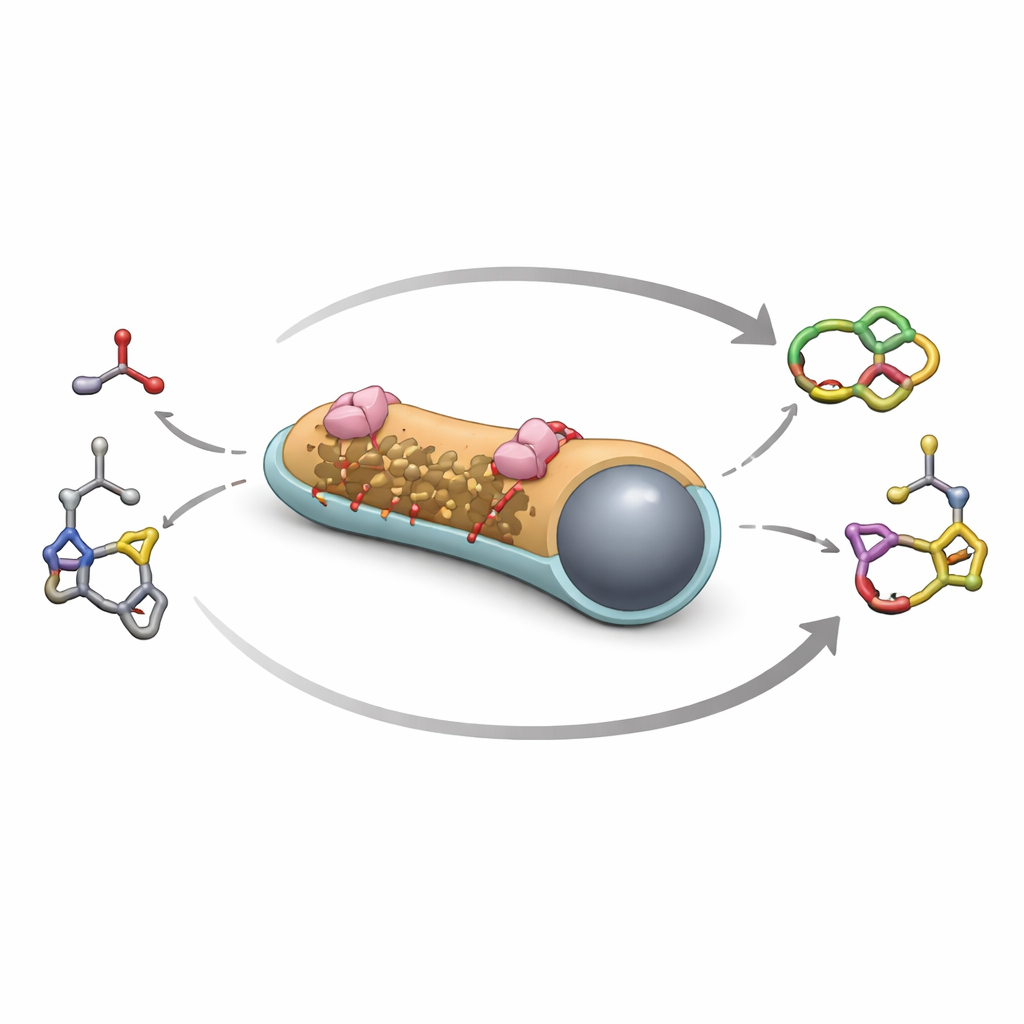
From a practical standpoint, the most attractive feature of this system is its robustness. After each reaction, the catalyst is retrieved with a magnet, washed, and reused. Tests show that it retains most of its activity and selectivity over at least seven cycles, and its structural signatures remain nearly unchanged. For a non‑specialist, the take‑home message is that chemists are learning to design smart, recyclable tools that can assemble complex, three‑dimensional molecules in a single step, under gentle conditions, and with very little waste. Such advances help make the production of advanced materials and drug‑like molecules cleaner and more sustainable.
Citation: Rafipour, D., Sardarian, A.R., Jamali, M. et al. One-pot multicomponent diastereoselective synthesis of indoline spirobicyclics using a recyclable chiral nanomagnetic L-proline catalyst under mild conditions. Sci Rep 16, 14481 (2026). https://doi.org/10.1038/s41598-026-40598-0
Keywords: green chemistry, magnetic nanoparticles, chiral catalysis, multicomponent reactions, spirocyclic molecules