Clear Sky Science · en
Comparative study of wavelet transform and Fourier domain filtering for medical image denoising
Why cleaner scans matter
Modern medical scans such as CT and MRI are full of life-or-death details: tiny lesions, faint textures, and subtle tissue boundaries. Unfortunately, every scan is also contaminated by random "snow" and speckles—noise that can hide important clues and force doctors to use higher radiation doses or longer scan times. This paper asks a deceptively simple question with big clinical consequences: among two popular mathematical clean‑up tools, which one actually produces clearer, more reliable images when noise strikes in different ways?
Two ways to look at a picture
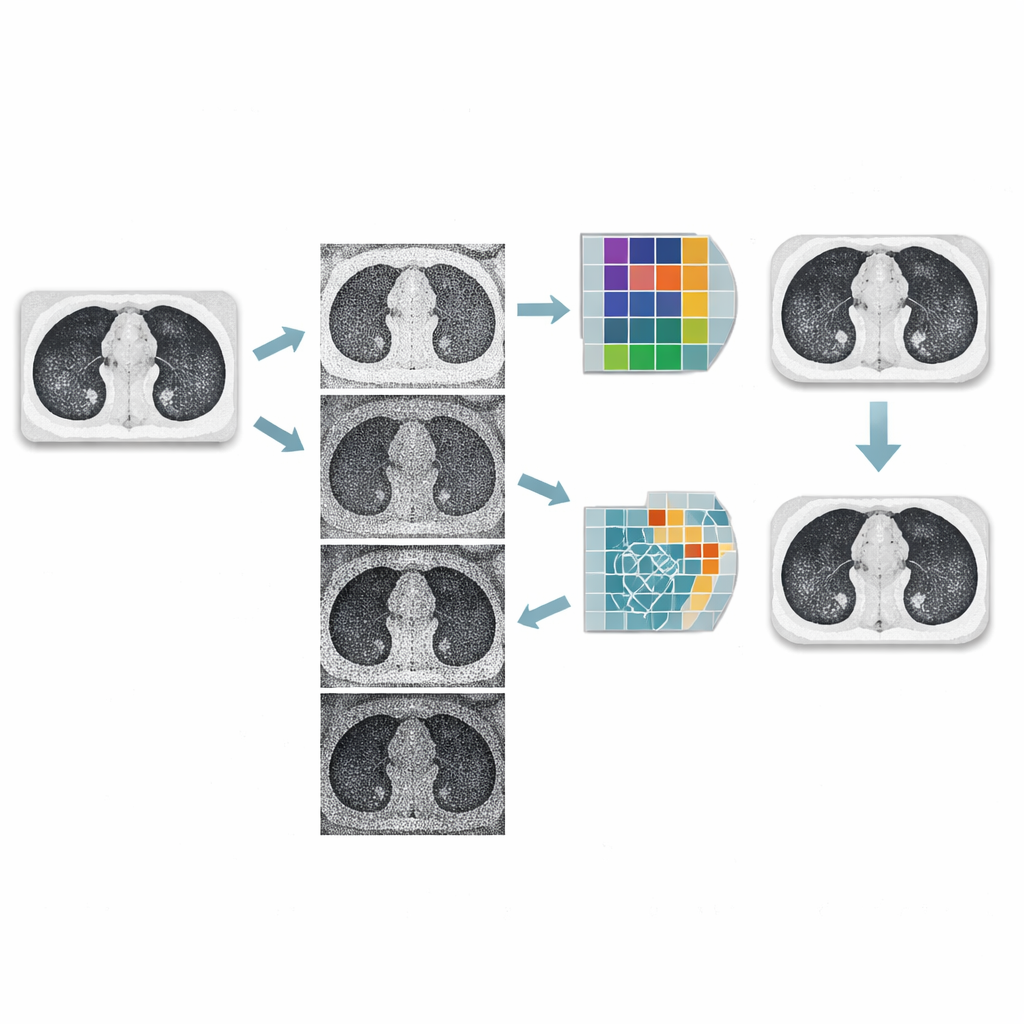
The authors focus on two classic strategies that re‑express an image before cleaning it. The first uses wavelets, which break the picture into coarse background structure plus successively finer levels of detail. In this representation, most of the random noise turns into many tiny coefficients, while real edges and textures appear as a smaller number of larger ones. Denoising then means shrinking or discarding the small coefficients according to various threshold rules and rebuilding the image. The second strategy uses a cousin of the Fourier transform called the discrete cosine transform, applied not to the entire picture at once but to many small, overlapping square blocks. Within each block, the transform separates smooth structure (low frequencies) from fine variations (high frequencies), allowing the algorithm to suppress the high‑frequency components that mainly carry noise.
Putting popular methods to a fair test
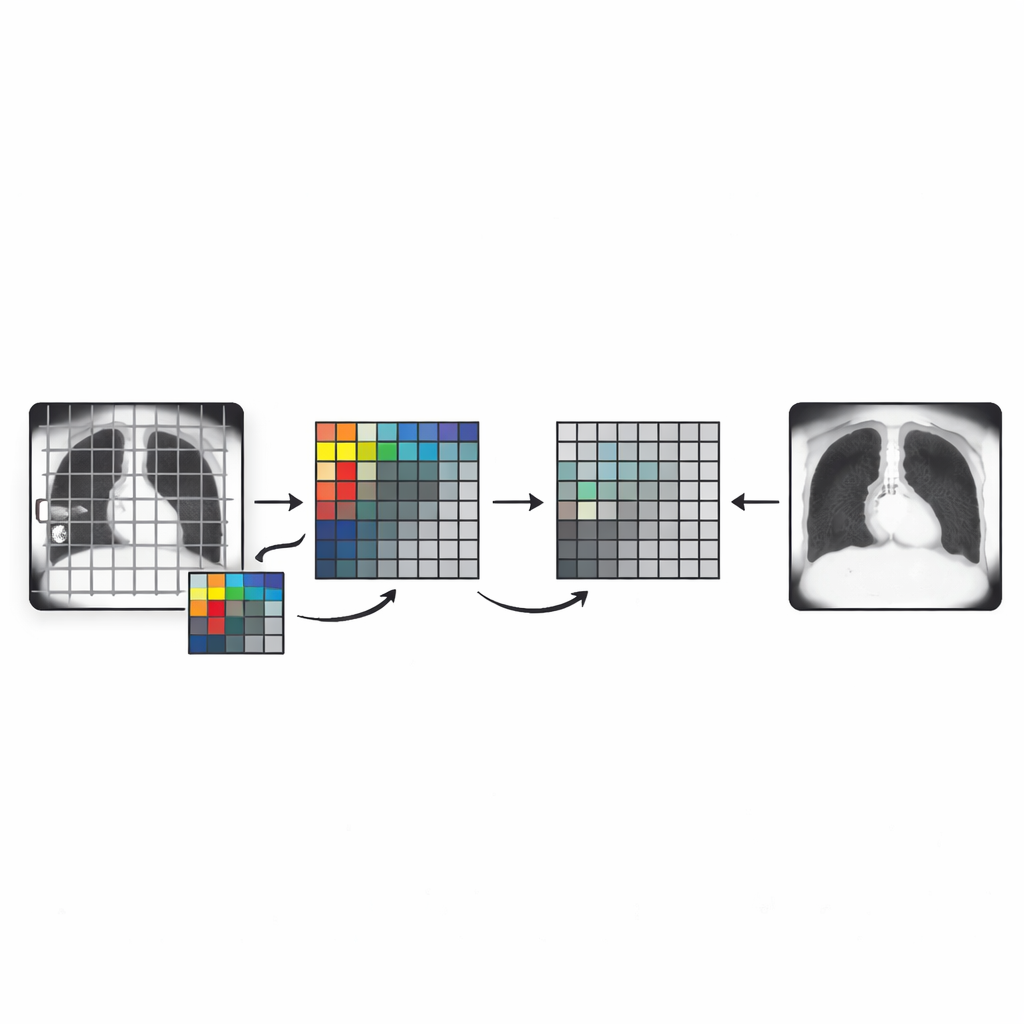
To compare these approaches fairly, the researchers built a large testbed around a 512 × 512 CT image. They added four kinds of synthetic noise that mimic real medical problems: Gaussian and uniform noise (grainy fluctuations), Poisson noise (typical of low‑dose X‑ray imaging where few photons are collected), and "salt‑and‑pepper" noise (bright and dark specks that simulate impulse errors). For wavelets, they tried eight different families—ranging from the simplest Haar wavelet to more sophisticated biorthogonal splines—combined with twelve ways of shrinking coefficients and four ways of choosing how strong the shrinkage should be. For the cosine‑based method, they processed overlapping 16 × 16 blocks, transformed each block, zeroed out small high‑frequency components, and then averaged the overlapping blocks back into a full image.
Who cleans better, and by how much?
Performance was judged with standard image‑quality scores that compare the cleaned image to the original noise‑free one. Within the wavelet camp, biorthogonal spline and Daubechies wavelets stood out, especially when paired with adaptive threshold rules such as SURE and Smooth Garrote that tune themselves to the observed data. These combinations consistently beat simpler wavelets like Haar and more exotic ones like Meyer and Shannon. Even so, the best wavelet setups were surpassed by the block‑based cosine method in every noise scenario tested. For Gaussian noise, for example, the top wavelet configuration reached a peak signal‑to‑noise ratio (PSNR) of about 31 dB, whereas the block‑based cosine method climbed to roughly 36 dB. Similar margins of 4–6 dB appeared for uniform, Poisson, and salt‑and‑pepper noise, meaning noticeably crisper images and fewer residual artifacts.
Why smaller pieces win
The surprise is not that cosine transforms work—they are the backbone of image compression—but that a relatively simple, block‑based cosine filter can outperform carefully tuned wavelets, which are often praised for their multiscale view of images. The authors argue that the key is not the mathematical transform itself but how it is used. Their wavelet technique applies one global decision rule to the entire image, so faint but genuine structures may be mistaken for noise and wiped away. In contrast, the block‑based cosine method adapts to local neighborhoods: each overlapping patch is analyzed, cleaned, and then softly blended with its neighbors. This local view helps preserve fine anatomical details while still cutting down on grain, and the overlap avoids the blocky artifacts that usually plague block methods.
What this means for future scans
For clinicians and imaging engineers, the central takeaway is that method design—especially local versus global processing—can matter more than the choice between "wavelet" and "Fourier." In this controlled study, a localized cosine‑based filter provided cleaner CT images than a wide range of wavelet recipes, across multiple realistic noise types, with only a modest increase in computation time. That suggests hospitals and device makers looking for practical, non–deep‑learning denoisers may want to lean toward block‑based frequency methods or hybrids that borrow their locality. Ultimately, the payoff of such algorithmic choices is simple to understand: clearer images at lower dose or shorter scan times, and better chances that subtle signs of disease will not be lost in the noise.
Citation: Saif, M.A., Mughalles, B.M. & Loqman, I.G.H. Comparative study of wavelet transform and Fourier domain filtering for medical image denoising. Sci Rep 16, 10145 (2026). https://doi.org/10.1038/s41598-026-40594-4
Keywords: medical image denoising, CT imaging, wavelet transform, discrete cosine transform, image noise reduction