Clear Sky Science · en
A robust strategy for FE model updating of composite panels using a combined ANN-SMA surrogate-assisted optimization framework
Why tuning virtual structures matters
Engineers increasingly rely on computer models to predict how bridges, aircraft parts, and wind turbine blades will vibrate and survive in service. But these models are only as good as the numbers fed into them. For layered composite materials, which are now common in aerospace and marine structures, getting those numbers right is especially hard. This paper shows how laboratory tests, artificial intelligence, and a nature‑inspired search method can be combined to tune a computer model of a composite panel so that it behaves almost exactly like the real structure.
From lab tests to digital twins
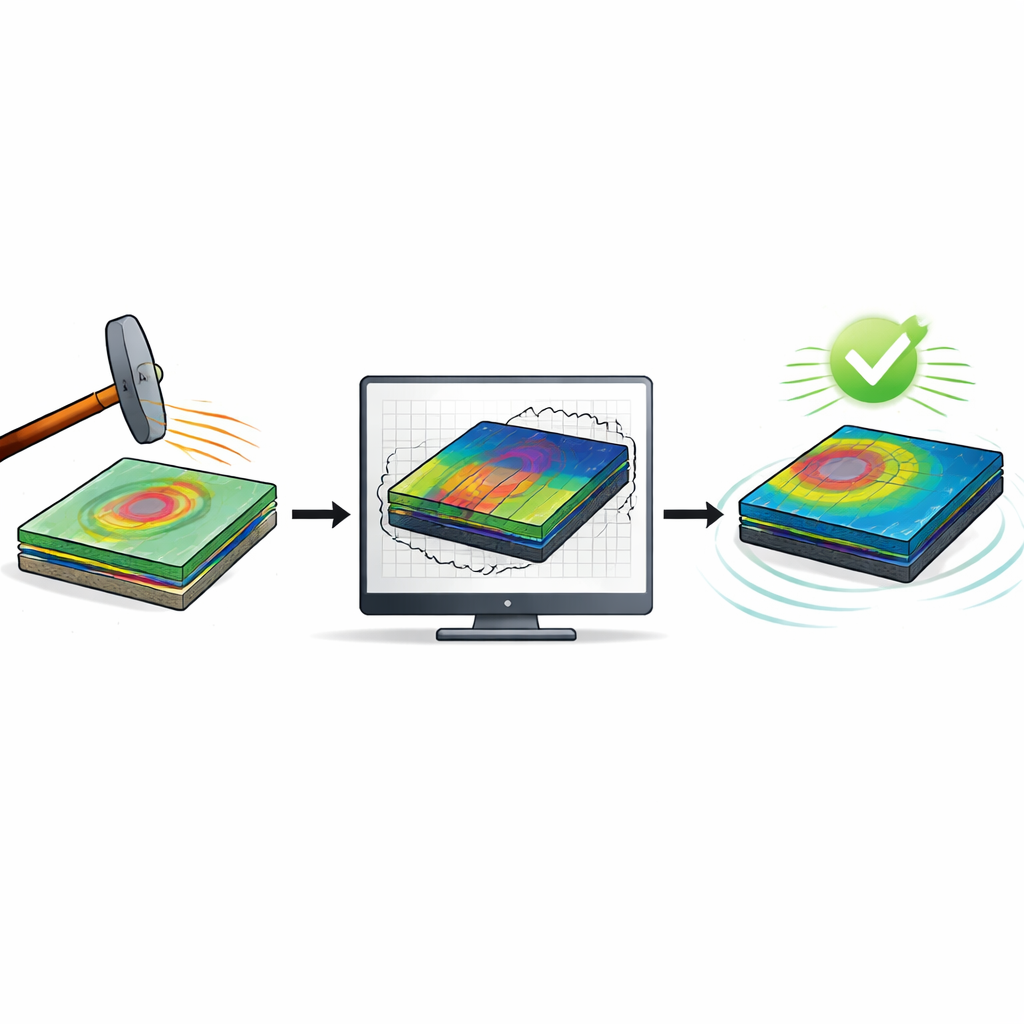
The study begins with a real glass‑fiber composite panel, built from ten thin fabric layers bonded with epoxy. In the lab, the panel is supported at its edges and gently struck with an instrumented hammer while tiny accelerometers record how it vibrates. By processing these measurements, the researchers extract key vibration features: the panel’s natural frequencies (the tones at which it prefers to vibrate) and the associated bending shapes. These experimental fingerprints serve as the gold standard that the computer model must match.
Building and checking the first model
In parallel, the team creates a detailed virtual version of the same panel using a standard engineering tool for simulating structures. The virtual panel is divided into many small shell elements so that its layered nature and stiffness in different directions are represented. When they compute its natural frequencies and vibration shapes, they find that the predictions are close but not perfect: some tones differ from the lab results by more than 10 percent. A closer comparison of the shapes shows that, while the overall patterns look similar, they are not identical. This mismatch confirms that some of the assumed properties in the virtual model—such as stiffness, thickness, or density—are slightly off.
Teaching a fast stand‑in to mimic the model
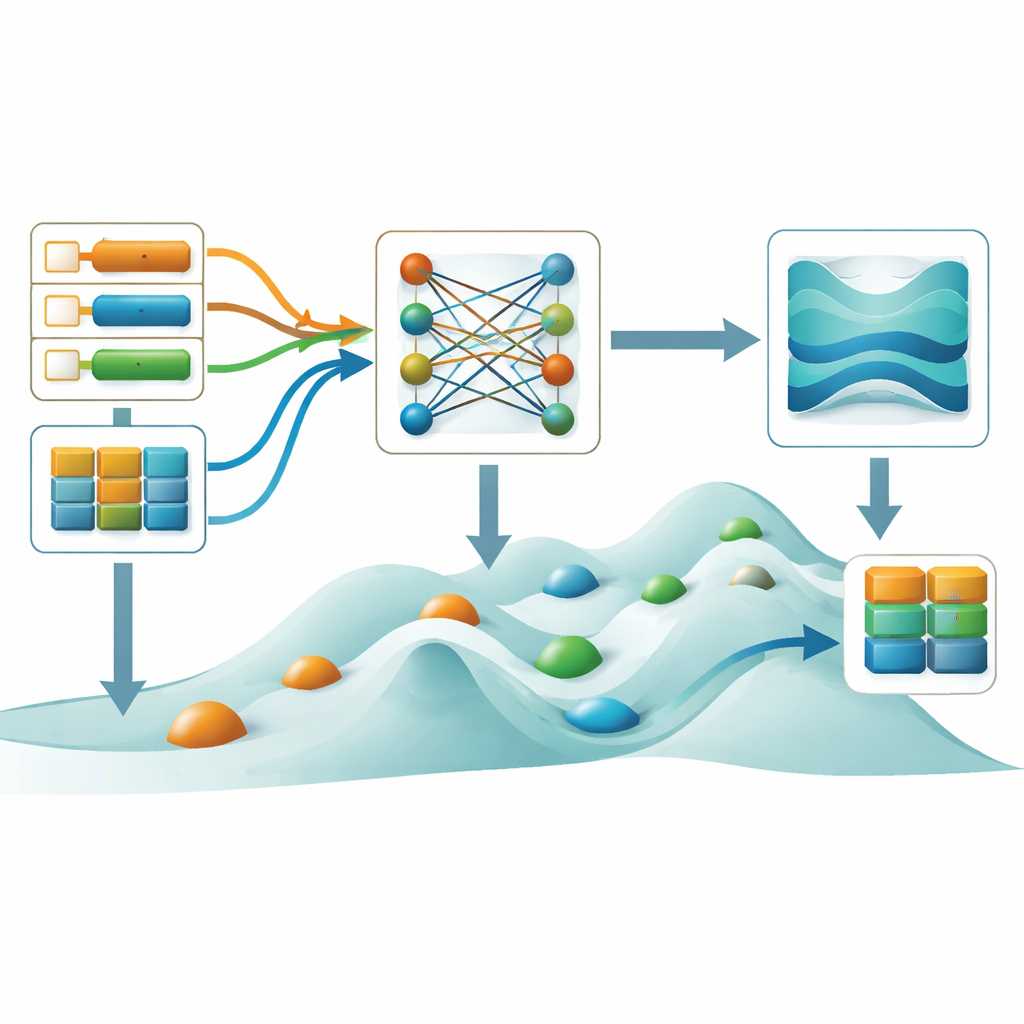
Directly adjusting model parameters and rerunning full simulations thousands of times would be too slow, so the authors introduce “surrogate” models: fast mathematical stand‑ins that learn to imitate the expensive simulation. They randomly sample hundreds of combinations of thickness, stiffness, and density within realistic bounds, run the full simulation for each, and collect the resulting frequencies and shape‑matching scores. Three types of surrogates are trained on this dataset: a simple polynomial surface, a statistical method called Kriging, and an artificial neural network. Tests show that the neural network best captures the complex relationships between inputs and vibration response while remaining quick to evaluate, reducing each prediction from seconds to fractions of a second.
Letting slime moulds search the design space
With the neural network acting as a near‑instant predictor, the next challenge is to search the sea of possible parameter combinations for those that make the virtual panel line up with the real one. For this, the researchers use an algorithm inspired by the way slime mould organisms spread out to explore their surroundings and then retract toward rich food sources. In the optimization, each “organism” represents a candidate set of panel properties. Guided by a measure of mismatch between predicted and measured frequencies, the virtual slime moulds shift their positions, balancing wide exploration with focused refinement. This artificial search is run entirely on the surrogate, so thousands of trials can be completed quickly.
Sharper match and faster computing
The combined neural‑network and slime‑mould strategy sharply improves the digital panel. After updating, four of the first five natural frequencies differ from the laboratory values by less than 1 percent, and even the most difficult higher‑frequency mode improves markedly compared with the original model. The adjustments needed are physically reasonable: a modest reduction in effective stiffness and slight tweaks to thickness and density, consistent with real‑world manufacturing variations. When the same neural‑network surrogate is paired with more established search methods that mimic flocks of birds or genetic evolution, the new slime‑mould approach still converges more reliably and cuts computing time by about 7 to 30 percent. In practical terms, this means engineers can obtain more trustworthy “digital twins” of composite structures faster, supporting better design decisions and more sensitive health‑monitoring systems.
Citation: Kouhi, M., Mojtahedi, A. & Lotfollahi-Yaghin, M.A. A robust strategy for FE model updating of composite panels using a combined ANN-SMA surrogate-assisted optimization framework. Sci Rep 16, 10343 (2026). https://doi.org/10.1038/s41598-026-40583-7
Keywords: composite structures, finite element model updating, surrogate modeling, artificial neural networks, metaheuristic optimization