Clear Sky Science · en
A fuzzy time-series driven ensemble approach for accurate forecasting of higher education rankings
Why tomorrow’s college rankings matter today
For many families, choosing a university feels like betting on an uncertain future. Global upheavals like the COVID‑19 pandemic can suddenly shake up campus life, finances, and research, causing familiar league tables to lurch unpredictably from year to year. This study introduces a new way to forecast those rankings that attempts to embrace, rather than ignore, that uncertainty—so students, parents, and policymakers can base decisions on realistic, forward‑looking expectations instead of static snapshots.
How rankings became a moving target
International league tables such as the Shanghai Rankings, QS, and Times Higher Education guide everything from student applications to government funding. They reflect factors like teaching quality, research output, student outcomes, and international presence. But the pandemic exposed how fragile these measures can be: enrollments dropped, labs closed, digital infrastructure was stretched, and travel restrictions undercut internationalization. Traditional prediction methods assume the future looks much like the past, with stable patterns and steady trends. When those assumptions fail—as they did during COVID—forecasts can mislead, masking risk for institutions and for students who rely on rankings to choose where to study.
Letting uncertainty into the calculation
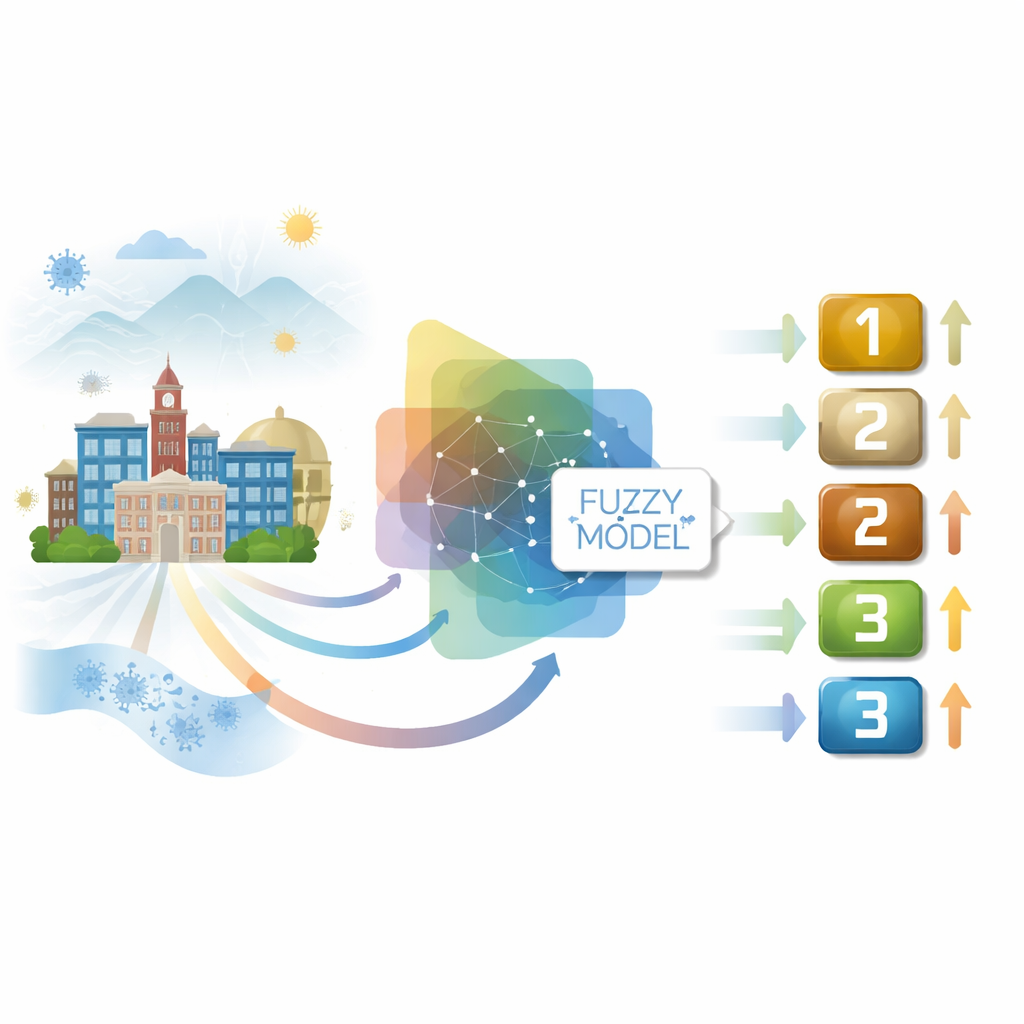
The authors propose a method that treats rankings not as fixed points but as fuzzy, shifting quantities. Instead of assigning each university a single clean number, the model spreads that rank across several overlapping bands, acknowledging that an institution might sit near the boundary between tiers or be unusually volatile in crisis years. Recent data, especially from pandemic‑affected periods, is given more influence than distant history, reflecting the idea that last year’s upheavals matter more for tomorrow than events a decade ago. This “fuzzy” view captures ambiguity and short‑term shocks in a way that crisp averages cannot.
Clustering similar journeys and pruning weak guesses
To turn this fuzzier picture into concrete forecasts, the model groups universities with similar ranking paths over time, including special clusters for pandemic years when many institutions suffered sudden drops or gains. Within each cluster, separate prediction machines are trained, each learning from a slightly different slice of history. A dedicated pruning step then throws away the weakest and most erratic of these machines, keeping only the most reliable ones and combining their outputs. This ensemble approach reduces the risk that any one overconfident model, or one odd year of data, will dominate the forecast.
Testing the model on education and beyond
The researchers evaluated their approach on the Shanghai global ranking data from 2008 to 2021, spanning both pre‑ and post‑COVID years. They also tested it on other time‑dependent data—such as stock prices, sea ice measurements, air quality, and student enrollment—to see whether the method handled very different kinds of uncertainty. Across these cases, their ensemble consistently produced more accurate predictions than several established fuzzy time‑series techniques. For university rankings specifically, the model cut average percentage error to about 7% and correctly anticipated the direction of rank movement—whether a university would climb or fall—over 80% of the time.

From better forecasts to fairer choices
In plain terms, the study shows it is possible to build a ranking forecast that “knows what it doesn’t know.” By explicitly modeling ambiguity, sudden shocks, and the greater weight of recent events, the proposed system delivers more dependable glimpses of where universities are heading, not just where they have been. That can help families avoid overreacting to one‑off dips, guide institutions as they invest in digital readiness or research strength, and inform public efforts to expand quality education and reduce inequality. While no model can make rankings perfectly predictable, this work suggests they can at least be forecast in a way that is honest about uncertainty—and more useful to the people whose futures depend on them.
Citation: Agarwal, N., Tayal, D.K., Rajeena, P.P.F. et al. A fuzzy time-series driven ensemble approach for accurate forecasting of higher education rankings. Sci Rep 16, 13329 (2026). https://doi.org/10.1038/s41598-026-40570-y
Keywords: university rankings, education forecasting, fuzzy time series, COVID-19 impact, ensemble learning