Clear Sky Science · en
Spatial and temporal dynamics in the use of urban habitats by Hooded Crows
City birds that love our leftovers
For many city dwellers, the harsh calls of crows are part of the daily soundtrack of urban life. These birds are clever, adaptable, and often seen rummaging in trash or gathering near parks and zoos. This study asks a simple but important question: what draws Hooded Crows to particular places in a city, and how can this knowledge help reduce conflicts with people while protecting urban wildlife?
Where the city meets the crows
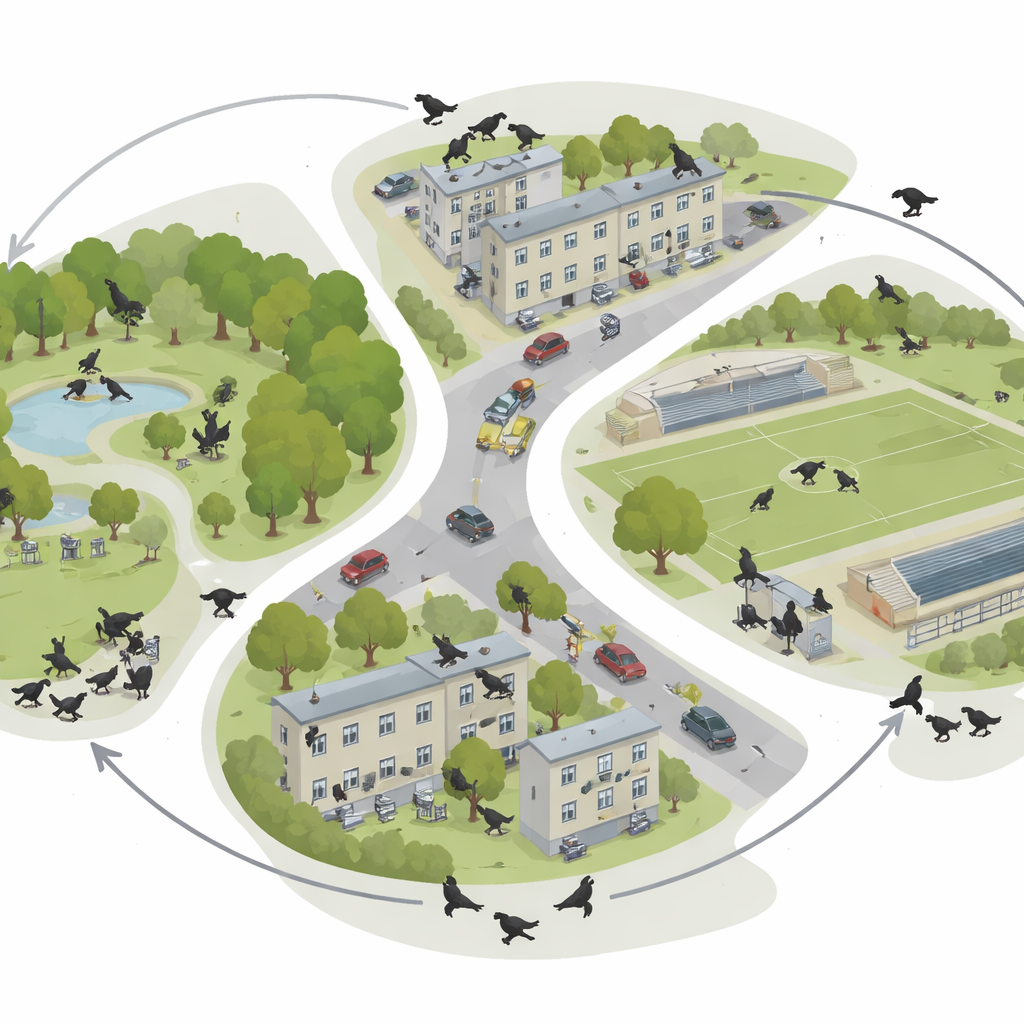
The researchers focused on a Hungarian city that Hooded Crows have colonized only in recent decades, turning it into a kind of open-air laboratory of urban bird life. They divided the northern part of Debrecen into 16 sections, including leafy parks, busy residential streets, and large sports complexes. Over three years, a single observer walked a 10‑kilometer route more than 240 times, counting every crow seen and noting exactly where and when it appeared. They also mapped trashbins, restaurants, and crow nests within and around each section to understand how food and nesting opportunities shape the birds’ choices.
Different seasons, different city maps
Hooded Crows live very different lives in and out of the breeding season, and this turned out to be crucial. In spring, pairs defend small territories and raise chicks; in winter and the rest of the year, they roam in loose flocks. During the breeding season, the number of crows in a section rose sharply where there were more nests nearby, as expected, but also where many trashbins were present. In other words, nesting pairs seemed to cluster where safe nesting spots and easy food were both within reach. Outside the breeding season, those clear patterns faded. Flocks shifted around the city with time, increasingly concentrating in one park rich in trashbins and restaurants, while numbers fell in residential streets and at the zoo.
Food-rich streets are not ideal nurseries
To go beyond simple counts, the team used a statistical approach that tracks which sections are occupied in one breeding season and whether they gain or lose crows by the next. This revealed an apparent paradox. Sections with many trashbins and restaurants were good at attracting crows to feed, but were less likely to be colonized as new nesting areas. Parks, sports fields, and quieter neighborhoods had higher chances of being chosen for breeding than traffic‑heavy residential zones or food‑packed recreation hot spots. The results suggest that while crows are drawn to food waste, they avoid raising young in places where human disturbance, noise, or traffic are intense, even if the buffet is generous.
Winners, losers, and quiet corners
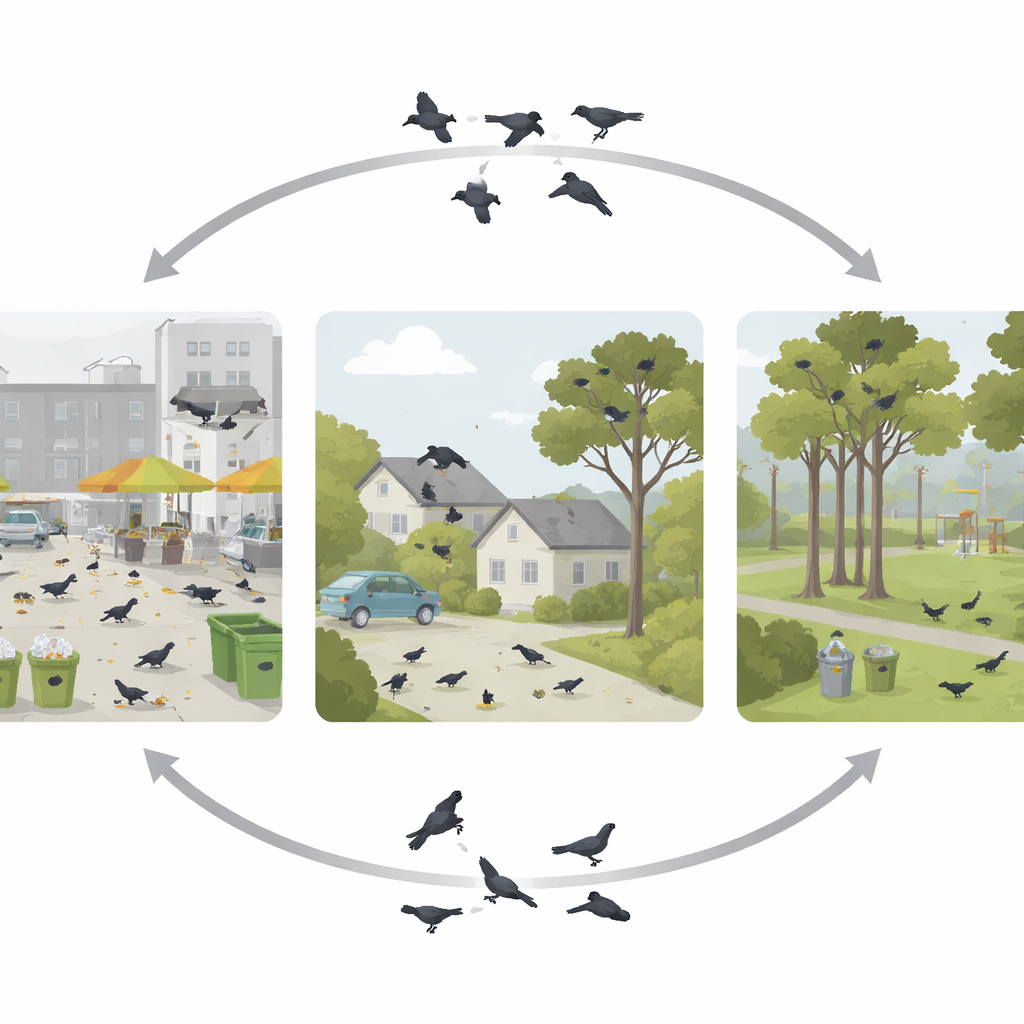
Across the 16 sections, just two parks—a zoo and a popular pond—held the highest crow densities, thanks to open grass, animal feed, and constant human food waste. Sports complexes also supported relatively many crows, likely because their broad lawns mimic farmland. Residential areas told a different story. Many street sections with mature trees and greenery had surprisingly few or no crows, especially along busy roads. In calmer residential pockets with fewer cars and people, crows were present but still in modest numbers. Overall, habitat type and size mattered less than the fine‑scale balance between food supply and disturbance.
Designing cities that work for people and birds
The study’s message for city planners and residents is straightforward. Hooded Crows thrive on our discarded food, yet they shy away from nesting in the noisiest, busiest corners where that food is most abundant. This means that residential areas with fewer open trash sources and outdoor eateries are unlikely to become crow strongholds, lowering the risk of noise, mess, or predation on other urban wildlife. The authors suggest practical steps such as installing closed‑top trashbins and better covering animal enclosures in zoos to make food waste harder to exploit. For cities that still need to manage crow numbers, they recommend focusing control efforts on the breeding season in selected residential zones, and in winter on the few park areas where large flocks gather. By understanding how crows read the urban landscape, we can design cleaner, calmer neighborhoods that are better for both people and birds.
Citation: Paládi, P., Benmazouz, I., Tóth, M. et al. Spatial and temporal dynamics in the use of urban habitats by Hooded Crows. Sci Rep 16, 9881 (2026). https://doi.org/10.1038/s41598-026-40561-z
Keywords: urban birds, hooded crows, city wildlife, food waste, urban ecology