Clear Sky Science · en
Application of modified multi-verse optimization for temperature control in thermal power plant condensers
Keeping Power Plants Running Smoothly
Modern thermal power plants quietly depend on unsung pieces of hardware to keep electricity flowing. One of these is the surface condenser, which cools steam back into water so it can be reused. If the condenser’s temperature swings too high or too low, the entire plant can waste fuel, lose efficiency, or become unstable. This paper explores a smarter way to keep that temperature steady by combining a familiar industrial controller with a new kind of computer-based search method inspired by the idea of multiple universes.
Why Condenser Temperature Is Hard to Control
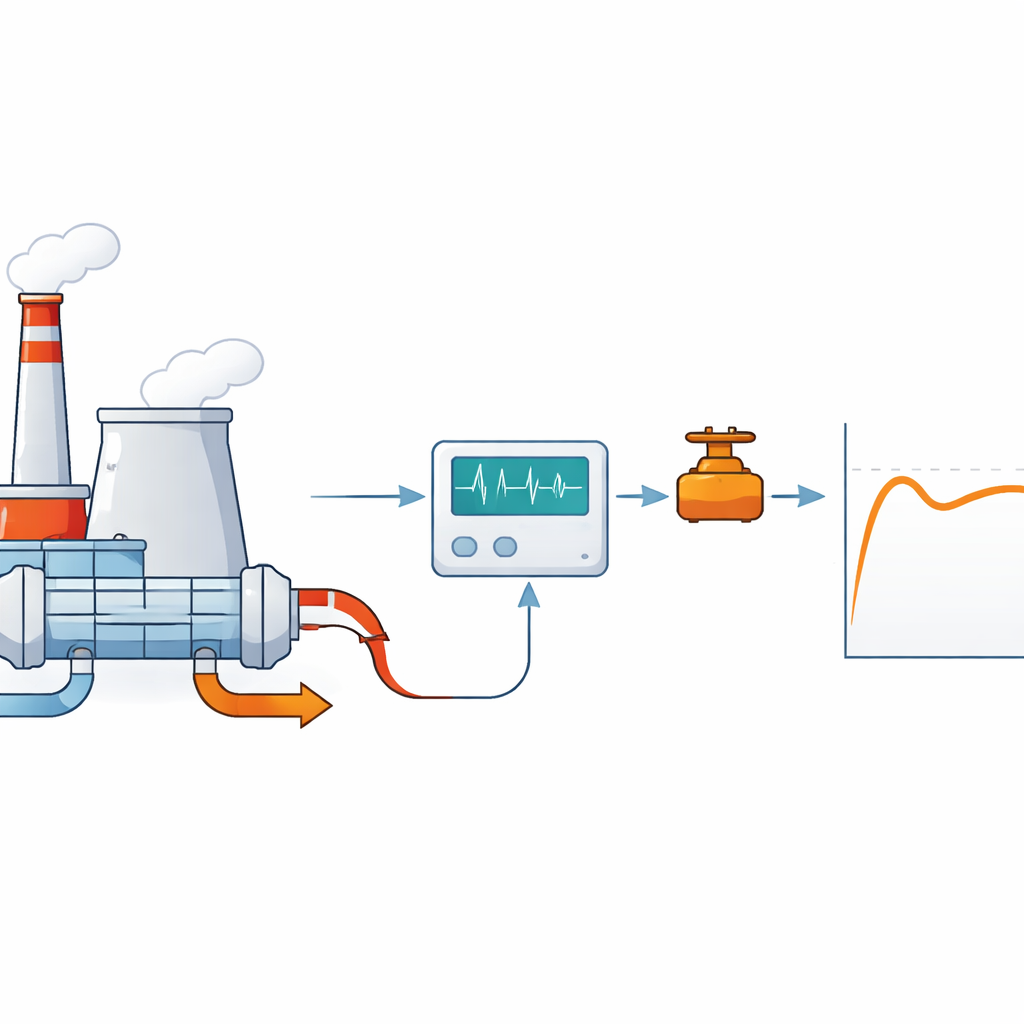
In a typical power station, hot steam from the turbine enters a shell-and-tube heat exchanger, where cooler water removes heat and turns the steam back into liquid. This process sounds simple, but the equipment behaves in a complex way. The temperature responds slowly, with delays and nonlinear effects: a change in steam flow today may only fully show up many seconds later, and the response is not proportional. Standard control tools must work against these quirks to keep the outlet temperature of the process fluid close to a desired set point while the plant load and operating conditions change.
Old Tools and Their Shortcomings
Most industrial plants rely on a workhorse device called a PID controller, which adjusts the steam valve opening based on how far the temperature is from its target and how that error changes over time. Traditionally, engineers tune the three PID settings using rules of thumb such as the Ziegler–Nichols method, or with evolutionary search techniques like genetic algorithms. These approaches can bring the system under control, but they tend to produce large temperature overshoots, long settling times, or inconsistent results from one tuning run to the next. The underlying difficulty is that the mathematical landscape of possible settings is rugged, riddled with many “good enough” valleys that can trap conventional search methods.
A Multi‑Verse Search for Better Settings
The authors build on a recent algorithm called the Multi‑Verse Optimizer, which borrows imagery from cosmology: many trial solutions are treated as separate universes that exchange information through analogues of black holes, white holes, and wormholes. They introduce a Modified Multi‑Verse Optimizer (MMVO) that changes how strongly these universes move toward promising regions as the search progresses. In the original method, the step size shrinks over time, favoring fine polishing but making it easy to get stuck. The modified version instead gradually increases a key movement factor, encouraging continued exploration around promising areas so the search can escape local traps while still homing in on better solutions.
Testing the New Approach in Silicon
To see whether MMVO actually improves tuning, the researchers first applied it to 23 standard mathematical test functions that are widely used to challenge optimization algorithms. Across a range of problem types—from smooth single‑valley landscapes to jagged, multi‑peak terrains—MMVO generally produced better best values, smaller average errors, and lower variation between runs than the original Multi‑Verse Optimizer and a well‑known Moth‑Flame Optimization method. They then used MMVO to tune the three gains of the PID controller for a detailed model of a surface condenser, comparing the results with Ziegler–Nichols tuning, a genetic‑algorithm‑based PID, and the unmodified MVO approach. The MMVO‑tuned controller cut temperature overshoot to about 1% and reduced settling time to roughly 53 seconds, outperforming the rival methods, which either overshot more severely or took much longer to stabilize.

What the Findings Mean for Real Plants
In practical terms, this work suggests that plant operators could keep condenser temperatures closer to their targets, with fewer swings and quicker recovery after disturbances, by letting an MMVO‑driven program choose the PID settings instead of relying on manual trial‑and‑error or older automatic rules. The study is based on simulations rather than full‑scale field trials, and it simplifies some real‑world complications such as fouling, noisy measurements, and rapidly changing loads. Even so, the results point toward a future in which power‑plant control systems quietly harness advanced optimization to squeeze more efficiency and stability out of familiar hardware, without needing to replace the underlying equipment.
Citation: Panda, S., Das, S.R., Sahoo, A.K. et al. Application of modified multi-verse optimization for temperature control in thermal power plant condensers. Sci Rep 16, 12409 (2026). https://doi.org/10.1038/s41598-026-40559-7
Keywords: surface condenser control, PID tuning, metaheuristic optimization, thermal power plant, multi-verse optimizer