Clear Sky Science · en
Study on the high-temperature static and dynamic constitutive model of silicon carbide-modified concrete
Why hotter, stronger concrete matters
From tunnels and airport runways to protective shelters, many concrete structures must endure both extreme heat and sudden impacts, such as fires, explosions, or collisions. Conventional concrete weakens sharply at high temperatures, putting people and infrastructure at risk. This study explores how adding grains of a ceramic material called silicon carbide can help concrete stay stronger when it is heated and hit very quickly, and builds a mathematical description of how this improved concrete behaves under such harsh conditions. 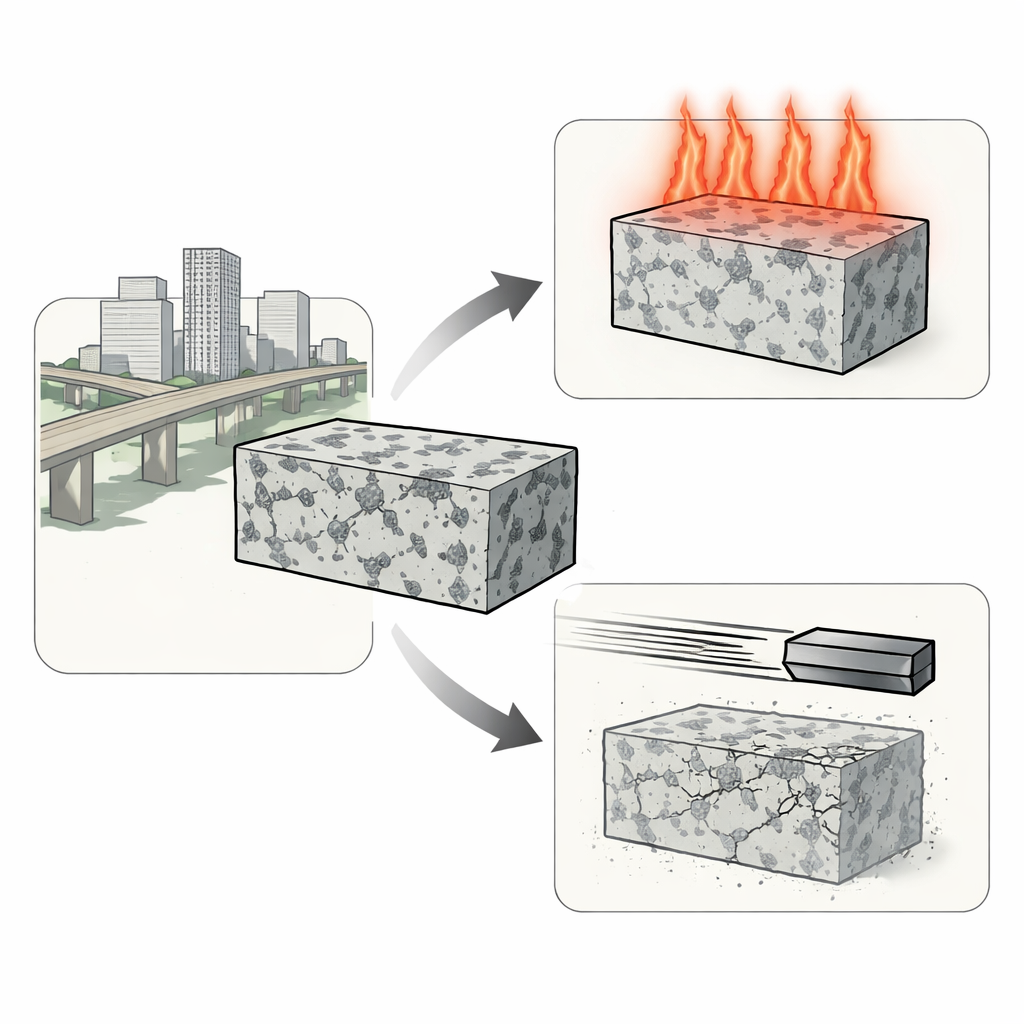
Making a tougher mix
The researchers began by producing concrete that was modified with different amounts and grain sizes of silicon carbide, alongside ordinary concrete for comparison. They used standard cement, sand, gravel, water, and a plasticizer, then added silicon carbide powders of varying fineness—from relatively coarse to very fine—and at several dosage levels. The goal was to see how these particles, known for their high‑temperature stability and hardness, change the way concrete carries load when it is hot and when it is struck very quickly.
Putting concrete through fire and shock
To mimic real disaster scenarios, the team exposed cylindrical specimens to temperatures up to 600 °C in a high‑temperature furnace and then subjected them to rapid compression using a device called a Split Hopkinson Pressure Bar, which generates very high loading rates. They carefully controlled strain rates so that different mixes could be compared fairly. The results showed a nuanced picture: as temperature increased to moderate levels (around 200–400 °C), both ordinary and silicon carbide‑modified concretes could actually show higher peak strength, likely because heat helped the cement harden further and improved the internal pore structure. At 600 °C, however, ordinary concrete generally lost strength, while some silicon carbide mixes—especially with certain coarser particle sizes—retained or even slightly increased their impact strength, hinting that the modifier changes how heat and shock interact inside the material.
What happens inside the material
Microscope images helped explain why silicon carbide makes a difference. Fine particles tended to fill pores and densify the cement paste, while coarser grains acted like small shields or bridges that redirected or slowed growing cracks. The transition region between stones and cement became more compact, and cracks were forced to weave around the hard silicon carbide rather than cut straight through weaker paths. After high‑temperature exposure, modified concretes showed fewer heat‑induced microcracks and better overall integrity than ordinary concrete. These observations guided how the authors built their damage model: they treated concrete as a collection of many tiny elements whose strengths vary statistically, and represented failure as the gradual growth of damaged elements as load, temperature, and strain rate increase. 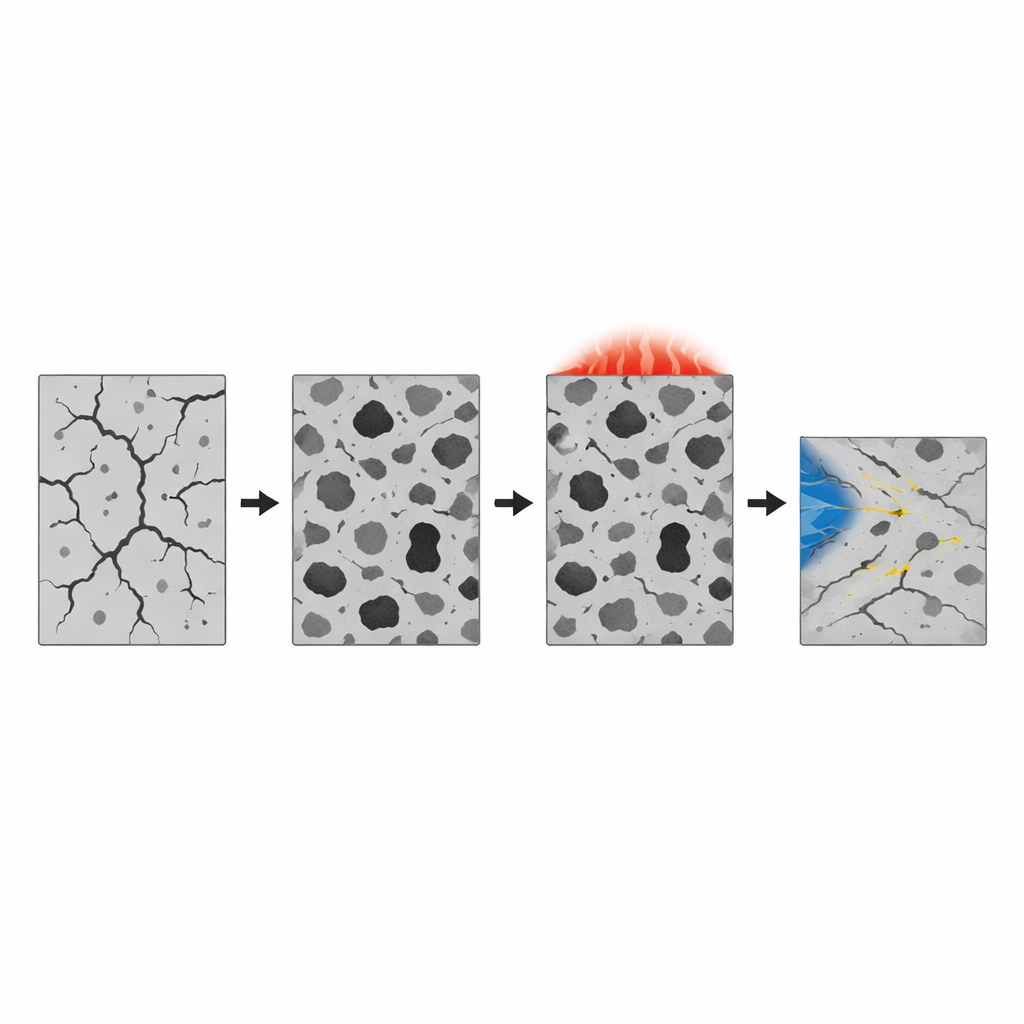
From experiments to a unified damage model
Using ideas from damage mechanics and probability theory, the authors proposed a family of constitutive models—mathematical rules that relate stress and strain—for this modified concrete. They assumed that the strengths of the tiny internal elements follow a Weibull distribution, which naturally captures gradual damage in brittle materials. They then defined separate factors for three influences: how silicon carbide changes basic strength, how temperature degrades or enhances strength, and how high loading rates increase strength. First, they built simple models that treat each factor on its own. Next, they combined them in pairs to describe, for example, hot silicon carbide concrete or fast‑loaded silicon carbide concrete. Finally, they knitted all three together into a high‑temperature, high‑rate model tailored to silicon carbide‑modified concrete. The model links microscopic damage, expressed as a damage factor, to the overall stress–strain curves seen in the tests.
How well the model matches reality
When the researchers compared the model’s predictions with the measured curves from impact tests at different temperatures and mix designs, the agreement was good. The shape of the curves and the peak strengths were reproduced across a range of conditions. Importantly, their framework separates the baseline strengthening from silicon carbide from the extra changes caused by heat and by rapid loading. This makes it easier to understand and adjust each contribution, rather than relying on one large empirical correction that hides the underlying mechanisms.
What this means for real structures
In everyday terms, the study shows that carefully chosen amounts and sizes of silicon carbide can make concrete more resistant to both fire‑like heating and sudden impacts, and that this behavior can be captured in a compact, physics‑inspired mathematical model. Engineers can use these constitutive relations to simulate how protective walls, pavements, or military and aviation structures made with such concrete might perform in extreme events, helping them design safer, more resilient infrastructure.
Citation: Wang, J., Chen, Q., Huang, H. et al. Study on the high-temperature static and dynamic constitutive model of silicon carbide-modified concrete. Sci Rep 16, 11849 (2026). https://doi.org/10.1038/s41598-026-40544-0
Keywords: high-temperature concrete, silicon carbide concrete, impact-resistant materials, damage mechanics model, stress–strain behavior