Clear Sky Science · en
Nondestructive sheet resistance prediction of silver nanowire transparent electrode with convolutional neural network
Why this matters for everyday tech
From foldable phones and touch screens to solar panels on windows, many next‑generation devices rely on see‑through layers that carry electricity without blocking light. These transparent conductors are often made from ultra‑thin metal wires laid down like a random web. Measuring how well electricity flows through these delicate webs usually means poking them with probes, which can damage them. This study shows how simple microscope pictures, combined with modern artificial intelligence, can predict electrical performance without touching the material at all.

The challenge of fragile wire webs
Metal nanowires, especially those made of silver, are prime candidates for transparent, bendable electrodes used in displays, touch panels, and flexible solar cells. Their key electrical property is called sheet resistance, which tells engineers how easily current flows across a thin film. Conventional methods that use metal probes or complex contact‑free setups can damage fragile networks, require careful calibration, and often miss small‑scale variations in how evenly the wires are spread. These variations matter: clusters of wires can carry current well, while sparse regions act as bottlenecks or even failure points, leading to uneven heating, dim spots, or broken circuits.
Seeing structure with simple light
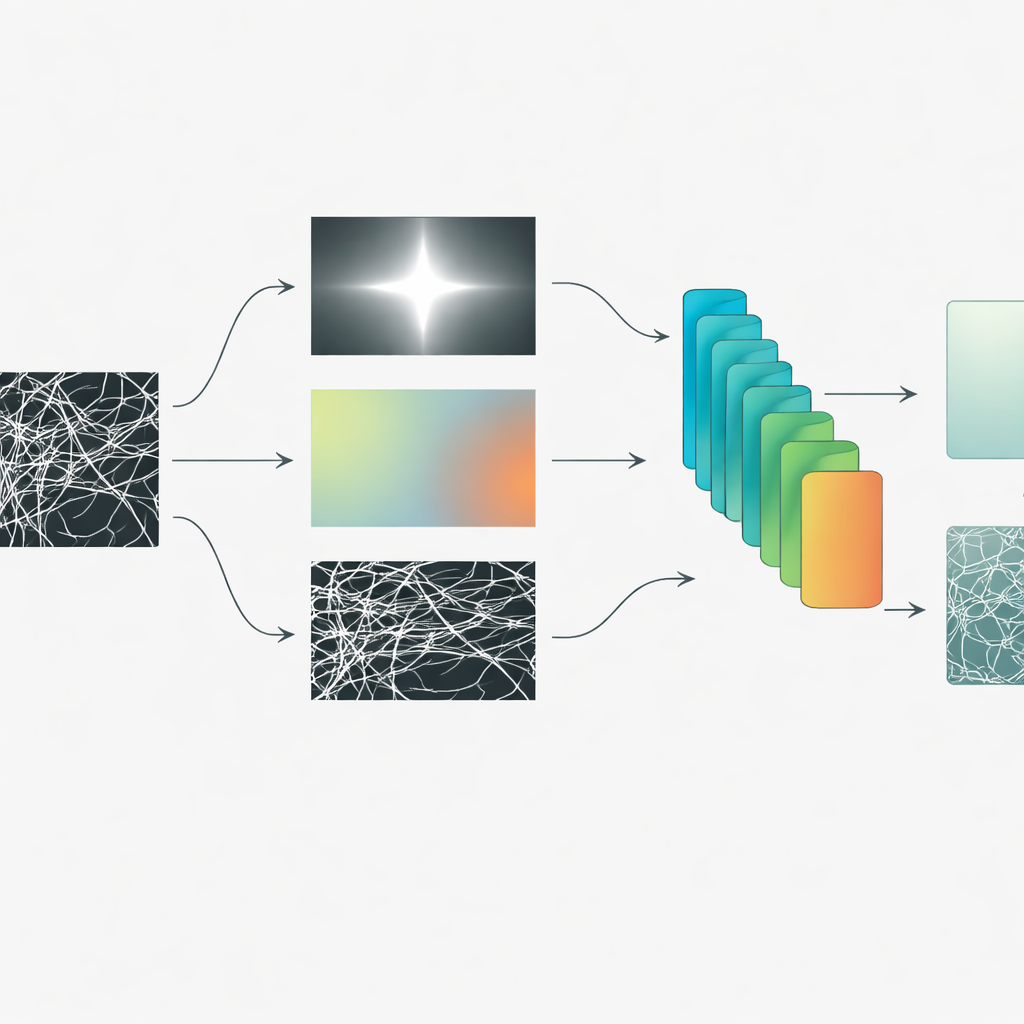
Instead of specialized equipment, the authors rely on high‑resolution optical microscopy—the same basic type of imaging found in many labs. Each image shows bright silver nanowires crisscrossing on a dark background over a tiny fraction of the sample area. To capture more than just what the eye can immediately see, the team processes these images in several ways. A mathematical tool called the Fast Fourier Transform turns the visual pattern into a map of repeating features and preferred directions, revealing whether the wires are evenly spread or aligned. At the same time, a simple measure of average brightness and color captures how densely the wires cover the surface on a larger scale.
Teaching a neural network to read the patterns
These different views of the same scene—original image, frequency‑based pattern, and average color—are combined into a three‑channel picture and shrunk to a compact size so a computer can analyze them quickly. A convolutional neural network, a form of deep learning widely used in image recognition, is then trained to link these visual cues to actual electrical measurements of sheet resistance and its variation across each glass sample. The model learns to associate dense, uniform webs of wires with low resistance, and sparser or more uneven webs with higher resistance and greater variability. When all three image types are used together, the predictions are noticeably more accurate than when any one type is used alone.
Judging uniformity, not just strength
Beyond predicting a single resistance value, the method also estimates how uniform that resistance is from place to place, a crucial factor in real devices. By examining multiple images taken from different spots on the same sample and averaging the model’s predictions, the researchers can better distinguish truly even films from ones with hidden weak regions. This multi‑image strategy substantially improves the reliability of judging uniform films with low resistance, where traditional single‑point tests often overlook subtle non‑uniformity.
What this means for future devices
The study shows that a non‑contact, image‑based approach can accurately predict both the strength and uniformity of electrical conduction in silver nanowire films. For manufacturers, this means faster and gentler quality checks using only optical microscopes and trained neural networks, with no need for probing each sample. In the long run, such tools could be built directly into production lines, providing real‑time feedback to adjust printing or coating conditions as films are formed. That could help make flexible screens, smart textiles, and next‑generation solar cells more reliable, cheaper to produce, and easier to scale.
Citation: Han, Y., Ndikumana, J., Choi, S. et al. Nondestructive sheet resistance prediction of silver nanowire transparent electrode with convolutional neural network. Sci Rep 16, 11028 (2026). https://doi.org/10.1038/s41598-026-40528-0
Keywords: silver nanowires, transparent electrodes, deep learning, sheet resistance, optical microscopy