Clear Sky Science · en
Disambiguation of multiple nutrient deficiency stresses in coconut using compositional nutrient diagnostic norms powered by machine learning algorithms
Why Coconut Nutrition Matters
Coconuts are far more than a tropical backdrop; they are a financial lifeline for millions of small farmers, especially in southern India. Yet in Kerala, one of the world’s coconut heartlands, yields have dropped sharply in recent years. A major culprit is not drought or pests alone, but a quiet and complicated problem beneath farmers’ feet: multiple nutrient shortages in the soil and in the palms themselves. This study explores a new way to untangle those overlapping shortages using a mathematical tool called compositional nutrient diagnosis, combined with machine learning, to help farmers understand which nutrients matter most and how to restore healthy yields.
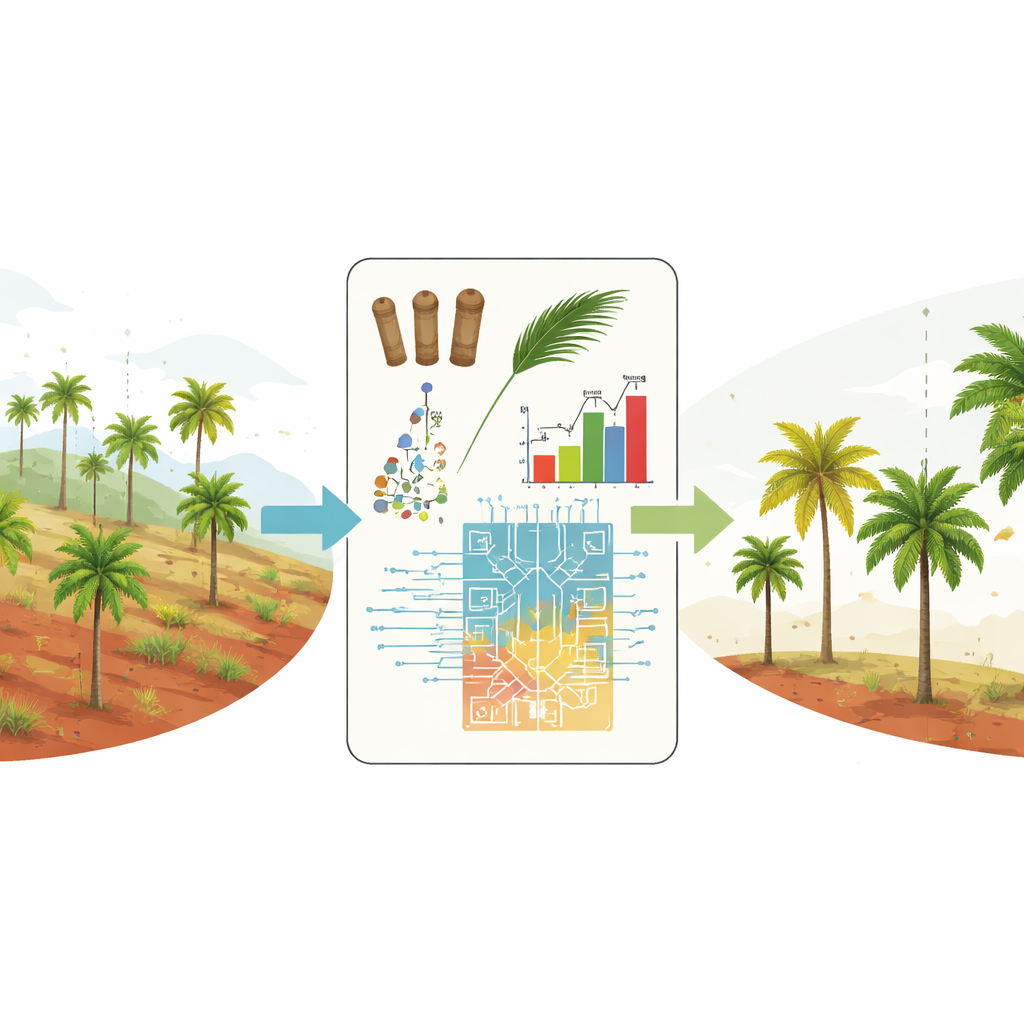
A Hidden Crisis in Coconut Groves
Across Kerala’s laterite soils, coconut palms often grow in small homesteads where fertilizer use is low, irregular, or based on guesswork. These highly weathered red soils are acidic and prone to leaching, so key nutrients are washed away by heavy monsoon rains. Traditional approaches to diagnosis—looking at yellowing leaves, testing one or two nutrients at a time, or relying on small pot experiments—struggle to cope when many nutrients are out of balance at once. Symptoms of different deficiencies overlap and can easily be confused with disease or insect damage. As a result, farmers may apply the wrong fertilizer or too little of the right one, leaving much of the yield potential untapped.
From Field Sampling to Nutrient Fingerprints
To capture the full nutritional picture, the researchers sampled 120 coconut fields across a large region of southern Kerala, all planted with the common West Coast Tall variety. They collected soil at two depths near the palms, along with a specific “index” leaf from each tree, and carefully measured a suite of nutrients: major elements such as nitrogen, phosphorus, and potassium; supporting nutrients like calcium, magnesium, and sulfur; and trace elements including iron, manganese, zinc, copper, and boron. Yields varied widely—from about 34 to 118 nuts per palm per year—reflecting how differently each tree experienced this complex nutrient environment. The analyses confirmed many patterns typical of laterite soils: acidic conditions, declining calcium and magnesium with depth, patchy phosphorus and potassium, and particularly fragile supplies of boron.
Using Ratios and Algorithms to Decode Imbalance
Instead of judging each nutrient on a simple “enough or not” scale, the team treated plant nutrition as a closed system, where all nutrient levels must be interpreted in relation to each other. Compositional nutrient diagnosis converts leaf nutrient contents into a set of log‑ratios that describe how each nutrient compares to the group as a whole. From the highest-yielding palms (those producing more than about 81 nuts per year), the researchers defined a pattern of “ideal” balance—norms that act like a nutritional fingerprint of a well-fed tree. For any new palm, its set of ratios can be compared to these norms, producing an index for each nutrient that shows both direction (deficiency or excess) and severity. A combined “imbalance score” then summarizes how far the palm’s nutrition has drifted from the optimum.
What Limits Yield and How Machines Help
Applying this framework to the field data revealed that magnesium was the most common limiting nutrient, closely followed by potassium; shortages of phosphorus, sulfur, zinc, and boron also appeared in many palms. In low-yield trees, the nutrient indices for magnesium, potassium, and phosphorus showed strong positive links to yield, meaning that better balance in these nutrients translated directly into more nuts. The study also uncovered intricate interactions: for example, extra phosphorus tended to clash with zinc, and high levels of some cations interfered with others. To test whether the diagnostic rules were robust, the authors trained machine-learning models—a decision tree and a deep neural network—to classify palms as nutrient-deficient or sufficient based on their CND indices. Using repeated cross-validation, both models achieved very high accuracy and excellent ability to distinguish balanced from imbalanced trees across all nutrients.
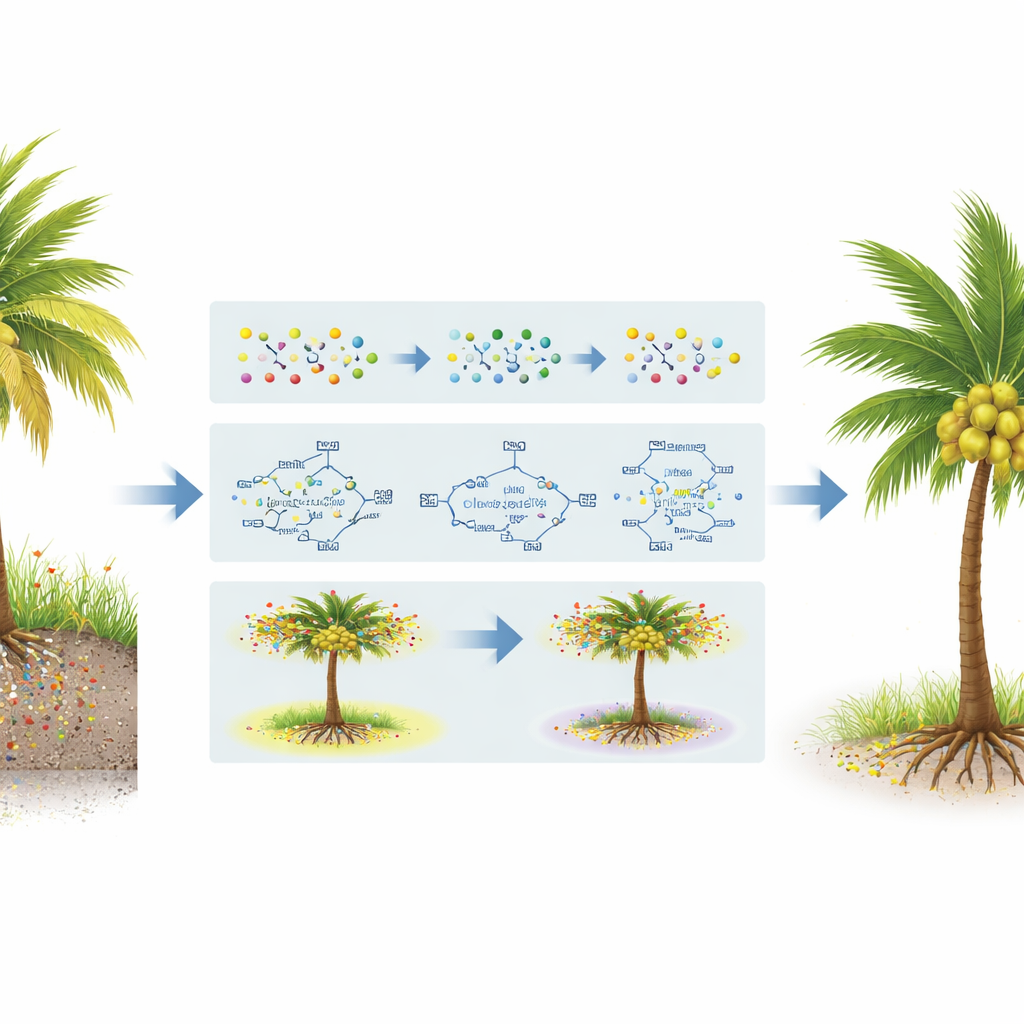
Stress Above Ground and Below
The study went further by comparing nutrient balance with the incidence of root (wilt) disease and attacks by the tiny eriophyid mite, two major biological threats in Kerala’s coconut groves. Palms suffering from both magnesium and potassium deficits not only produced fewer nuts but also showed more severe disease symptoms and heavier mite damage than palms lacking magnesium alone. The researchers propose that weak nutrition reduces leaf and nut integrity, making it easier for mites to hide under the loosened perianth (the base of the nut) and for disease to progress. In this way, unseen nutrient stress and visible pest and disease problems reinforce each other, deepening yield losses.
From Complex Data to Practical Decisions
By combining compositional nutrient diagnosis with machine learning, this work turns a tangled web of soil chemistry, plant physiology, and pest pressure into a structured decision tool. Rather than guessing which single nutrient to add, farmers and advisors can identify the most limiting nutrient, rank secondary constraints, and understand how imbalances may be fueling pest and disease outbreaks. For Kerala’s coconut growers—and potentially for other perennial crops in challenging soils—this approach offers a path toward smarter fertilizer programs, healthier palms, and more reliable harvests from the “Tree of Heaven.”
Citation: N., N., Raj, K.K., Gopinath, P.P. et al. Disambiguation of multiple nutrient deficiency stresses in coconut using compositional nutrient diagnostic norms powered by machine learning algorithms. Sci Rep 16, 13713 (2026). https://doi.org/10.1038/s41598-026-40501-x
Keywords: coconut nutrition, soil fertility, machine learning, nutrient imbalance, plant health